Wenceslas, king of Bohemia and Germany and …
Years: 1394 - 1394
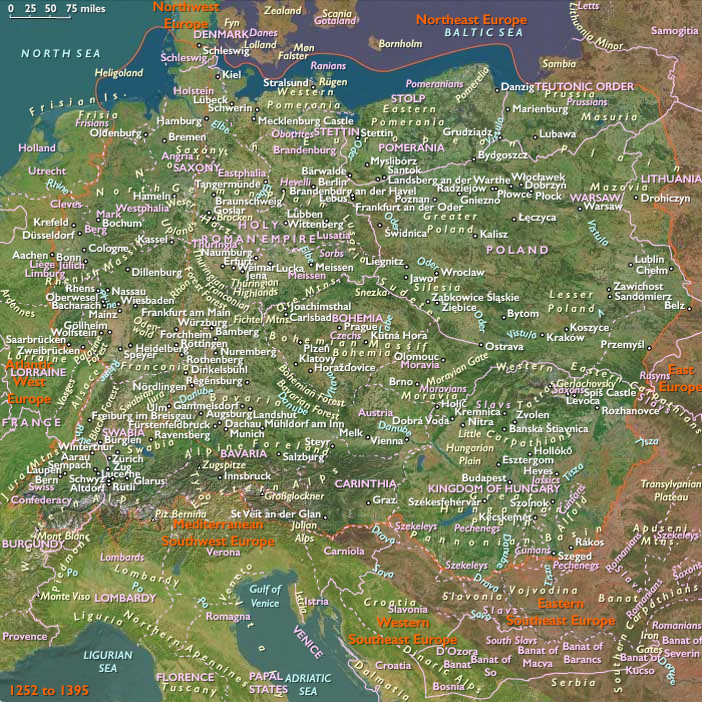
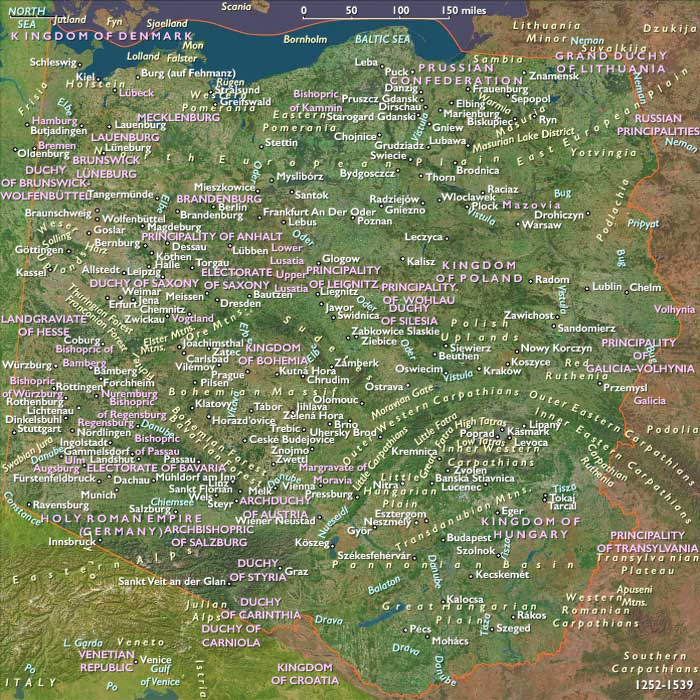
Wenceslas, king of Bohemia and Germany and Holy Roman Emperor, rules mostly from Prague.
In 1390, he had become involved in a civil war with jealous and ambitious Bohemian magnates led by his cousin Jobst (Jossus), Margrave of Moravia, who had taken him prisoner and briefly incarcerates him in Austria in 1393-94.
After his release, Wenceslas virtually ignores Germany to focus his attentions on his Bohemian kingdom, but loses much of his authority there to the magnates, who erect a council to govern the realm.
Locations
People
Groups
Commodoties
Subjects
Regions
Subregions
Related Events
Filter results
Showing 10 events out of 43432 total
The kingdom of Dai Viet, or Annam, having conquered the kingdom of Champa (central Vietnam) through incessant warfare, has experienced a concurrent decline in royal authority as a series of corrupt and ineffectual Tran rulers proves increasingly powerless in the suppression of rebellious mountain tribes.
In 1394, a disgruntled general, the capable Ho Qui Ly, has the reigning monarch, Tran Nghe Ton, strangled to death and appoints himself regent for the new king, Tran Thuon Tong.
The new Joseon capital is established at Hanseong (Seoul) in 1394.
Envoys from the Ryūkyū Kingdom had been received in 1392 and 1394 and 1397; Siam had sent an envoy in 1393.
In this process of establishing the new dynasty's foreign relations, envoys had been dispatched to Japan, seeking the reestablishment of amicable relations.
The mission is successful; and Shogun Ashikaga Yoshimitsu is reported to have been favorably impressed by this initial embassy.
Bayezid had crossed the River Danube in 1394 to attack Wallachia, ruled at this time by Mircea the Elder.
The Ottomans are superior in number, but on October 10, 1394 (or May 17, 1395), in the Battle of Rovine, on forested and swampy terrain, the Wallachians prevent Bayezid's army from advancing beyond the Danube.
During the fierce battle the main role is played by the Wallachian archers, who annihilate the Ottoman ranks at the beginning of their attack.
Bayazid's vassals Stefan Lazarević and Marko Mrnjavčević, the mightiest of all Serbian feudal lords, also participate in the battle; Stefan shows great courage, Marko dies in battle.
Jaunpur, historically known as Sheeraz-e-Hind, dates from 1359, when the city was founded by the Sultan of Delhi, Feroz Shah Tughlaq, and named in memory of his cousin, Muhammad bin Tughluq, whose given name was Jauna Khan.
In 1388, Feroz Shah Tughlaq had appointed Malik Sarwar, a eunuch, who is notorious for having been the lover of Feroz Shah Tughlaq's daughter, as the governor of the region.
The Sultanate is in disarray because of factional fighting, and in 1393 Malik Sarwar declares independence.
He and his adopted son Mubarak Shah found what will come to be known as the Sharqi dynasty (dynasty of the East).
During the Sharqi period, the Jaunpur Sultanate will be a strong military power in North India, and on several occasions will threaten the Delhi Sultanate.
Dabiša will spend the rest of his reign quarreling with the Hungarian King Sigismund and the King of Naples Ladislaus for control over Croatia and Dalmatia.
King Ladislaus manages to win the Vukčić family to his side.
Vuk Vukčić, Dabiša's Ban, takes Ostrovica and Vrana from Ivaniš Paližna.
Dabiša desires to put Zadar under his supreme rule, but Vuk works for Ladislaus.
Hrvoje Vukčić recognizes Dabiša's supreme rule, stating that he will serve him as long as he breathes, after which he will serve the Hungarian King Sigismund.
At the beginning of 1394, the nobility under Ivaniš Horvat, a subject of Ladislaus, refuses to serve King Dabiša.
Dabiša dispatches Prince Ivan Radivojević to take Omiš from Horvat as a punishment.
The Hungarian King Sigismund moves to destroy both Horvat and Dabiša.
The Hungarian Army besieges and burns to the ground Dobor in the lower stream of Bosna.
Dabiša arrives here, recognizes King Sigismund's suzerainty and gives up Dalmatia and Croatia in his name.
In turn, the Hungarian King nominates him Prince of the Szomod Principality.
King Stephen Dabiša dies of an illness on September 8, 1395 and King Sigismund takes control over most of Bosnia, but the Bosnian Rusag elects Dabiša’s wife and consort, Jelena Gruba, to ascend the throne as queen regnant.
The Swiss victory at Nafels results in a truce with Austria, during which the confederation improves its military organization.
In 1394, the Austrians sign a twenty-year peace with Zurich and abandon rights in Lucerne, Zug, and Glarus (the last had joined the confederation after the Battle of Nafels).
Spanish cardinal Pedro de Luna, elected at the death of Antipope Clement VII of the Avignon line in 1394, swears that as Pope Benedict XIII to work toward reunification of the Roman and Avignonese obediences.
Vincent Ferrer, a forty-four-year-old Spanish Dominican protégé and friend of the new antipope, becomes his confessor.
Florence had granted citizenship in 1391 to the renowned mercenary captain Sir John Hawkwood; he dies at about seventy-four on March 16, 1394.
The Final Expulsion of the Jews from France (September 17, 1394)
On September 17, 1394, King Charles VI of France issued a royal ordinance expelling all Jews from his kingdom, marking the final banishment of Jews from France until the French Revolution. This decree followed several previous expulsions and readmissions, with Jews having been repeatedly accused of financial and religious offenses by the crown and clergy.
The Expulsion Decree and Its Justification
- Charles VI’s ordinance stated that he had long been aware of "many complaints" regarding the Jews, accusing them of violating agreements made with the crown.
- According to the Religieux de St. Denis, the king was influenced by Queen Isabeau of Bavaria, who advocated for the expulsion (Chronique de Charles VI, ii. 119).
- The official reason given was the alleged misconduct of Jewish communities toward Christians, but in reality, the decision was likely driven by:
- Financial motives, including royal debts owed to Jewish lenders.
- Religious pressure from the Catholic Church and popular hostility.
- Political stability, as scapegoating Jews helped appease social unrest.
Terms of the Expulsion
- The decree did not take effect immediately, allowing Jews time to:
- Sell their property.
- Settle outstanding debts.
- Christians who owed money to Jewish lenders were ordered to pay their debts within a set timeframe.
- Jewish possessions held in pawn could be sold if the debt was not repaid.
- The provost was tasked with escorting Jewish communities to the kingdom’s borders, forcing them eastward into the German states.
- Shortly after the expulsion, the king released Christians from their remaining debts to Jewish lenders, further financially disadvantaging the expelled Jews.
Long-Term Impact and Legacy
- This expulsion remained in effect across much of France until the French Revolution (1789), when Jews were officially granted citizenship and allowed to return.
- Many Jews resettled in the Holy Roman Empire, where some territories provided temporary refuge, though they often faced further persecution.
- The decree marked the end of medieval Jewish life in France, closing a chapter of intermittent tolerance and persecution that had shaped Jewish communities in France since Roman times.
The expulsion of the Jews from France in 1394 was one of the most significant medieval expulsions, reinforcing anti-Jewish policies across Europe and shaping Jewish migration patterns for centuries.
Roger Mortimer, born April 11, 1374, at Usk in Monmouthshire, is the eldest son of Edmund Mortimer, 3rd Earl of March, by his wife Philippa Plantagenet, who as the daughter of Lionel of Antwerp, 1st Duke of Clarence, and granddaughter of King Edward III, had a claim to the crown which she passed on to her children.
He has a younger brother, Edmund Mortimer, and two sisters, Elizabeth, who has married Henry 'Hotspur' Percy, and Philippa (1375–1401), who will marry firstly John Hastings, 3rd Earl of Pembroke, killed in a tournament at Woodstock Palace in 1389, secondly Richard de Arundel, 11th Earl of Arundel, who will be beheaded in 1397, and thirdly, Sir Thomas Poynings.
Roger Mortimer's mother, Philippa, died on or before January 5, 1382, and was buried at Wigmore Abbey.
His father, said to have caught cold crossing a river in winter, had died at the Dominican friary at Cork in Munster on December 27, 1381, leaving his son to succeed to a title and extensive estates at only six years of age.
Mortimer's estates in England and Wales are on December 16, 1383, granted, for four thousand pounds per annum, to a consortium consisting of Mortimer himself, the Earls of Arundel, Northumberland, and Warwick, and John, Lord Neville.
The guardianship of Mortimer's person had initially been granted to Arundel, but at the behest of King Richard's mother, Joan of Kent, in August 1384 Mortimer's wardship and marriage had been granted, for six thousand marks, to Joan's son, Thomas Holland, 2nd Earl of Kent, who is Richard's half-brother, and on or about October 7, 1388, Mortimer had married Kent's daughter, Eleanor Holland, who is Richard's half-niece.
Mortimer does homage and was on June 18, 1393, granted livery of his lands in Ireland, and on February 25, 1394, of those in England and Wales .
King Richard has no issue, and Mortimer, a lineal descendant of Edward III, is next in line to the throne and married to his half-niece.
George Edward Cokayne, in The Compete Peerage (1932) states that in October 1385 Mortimer was proclaimed by the King as heir presumptive to the crown.
However, according to R.R. Davies in his entry for Mortimer in the Oxford Dictionary of National Biography (1994) the story that Richard publicly proclaimed Mortimer as heir presumptive in Parliament in October 1385 is baseless, although contemporary records indicate that his claim was openly discussed at the time.
He was knighted on April 23, 1390, by the King.
Mortimer after he came of age spent much of his time in Ireland.
King Richard had first made Mortimer his Lord Lieutenant of Ireland on January 24, 1382 when he was a child of seven, with his uncle, Sir Thomas Mortimer, acting as his deputy.
The King had reappointed Roger Mortimer as his lieutenant in Ireland on July 23, 1392, and in September 1394 Mortimer accompanies the King on an Irish expedition in response to interclan strife affecting English administration.
Richard engages in little fighting, but successful negotiations gain him the submission of fifty Irish chiefs and result in his knighting of five Irish kings before he departs the following year.