Wen Tianxiang, who had fought against the …
Years: 1278 - 1278
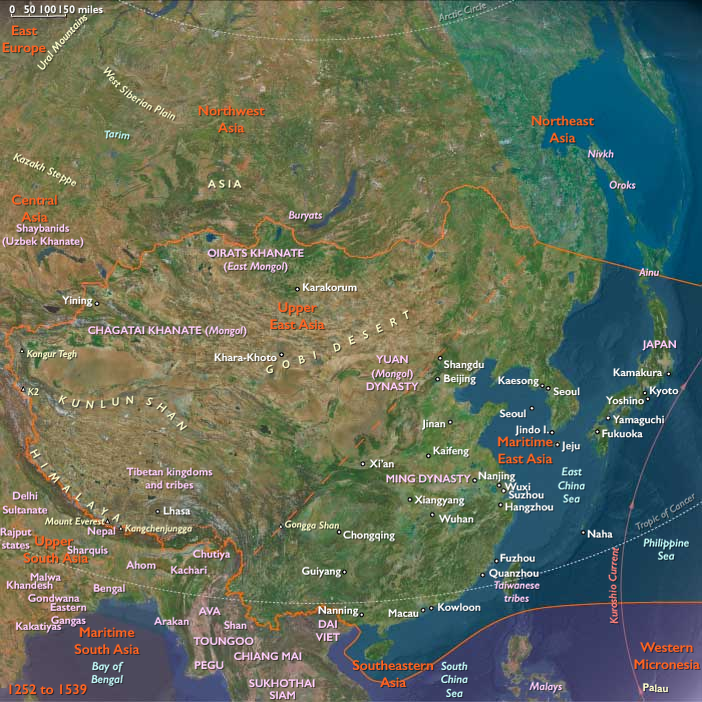
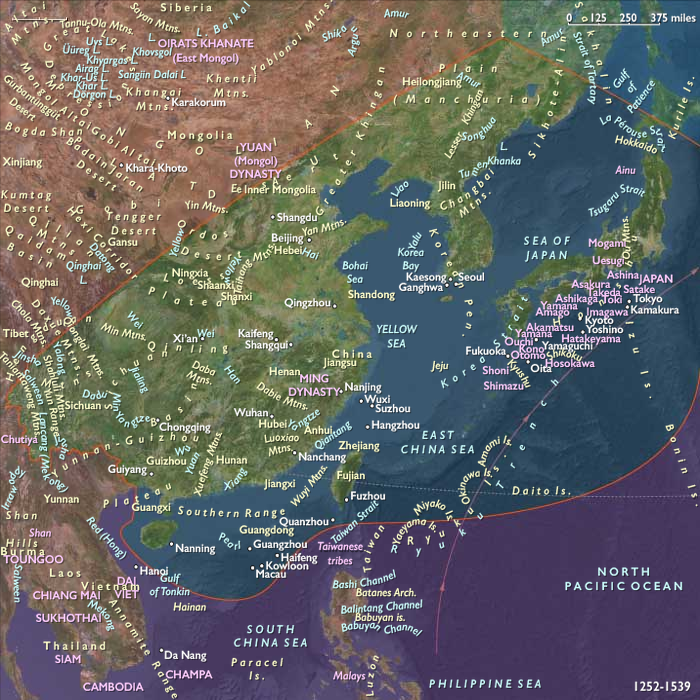
Wen Tianxiang, who had fought against the Yuan in Guangdong and Jiangxi, is captured 12 1278 by Wang Weiyi in Haifeng County, eliminating all the Song land forces nearby.
Locations
People
Groups
- Chinese (Han) people
- Mongols
- Chinese Empire, Nan (Southern) Song Dynasty
- Mongol Empire
- Kublai Khan, Empire of
- Chinese Empire, Yüan, or Mongol, Dynasty
Topics
Commodoties
Subjects
Regions
Subregions
Related Events
Filter results
Showing 10 events out of 45582 total
The boat carrying Emperor Zhao Shi had capsized in a storm on the way to Leizhou as the Song court sailed to Guangdong from Quanzhou,
Although he survived, he had fallen ill because of this ordeal.
The imperial court eventually seeks refuge in Lantau Island's Mui Wo, where Emperor Zhao Shi dies on May 8, 1278, and is succeeded by his younger sibling, Zhao Bing, who is seven.
Zhang Shijie brings the new emperor, Huaizong of Song, to Yamen and prepares the defense against Yuan there.
Meanwhile, armed forces under the control of Mongol leader Kublai Khan draw closer to the remnants of the Song imperial court.
The crusaders and Sudovians engage in guerilla warfare, at which the Sudovians are particularly adept.
However, they lack the sheer numbers to deal with their German, Polish, and Volhynian adversaries, and the Sudovian nobility has begun gradually surrendering one by one.
Marshal Conrad von Thierberg the Younger raids Pokima, capturing large amounts of cattle, horses, and prisoners.
They then successfully ambush the three thousand-strong force of pursuing Sudovians, losing only six Christians in the process.
Rudolf confers recognition upon the archbishops of Salzburg in 1278 as princes of the Holy Roman Empire.
Ottokar II campaigns in 1278 against Austria, supported by Duke Henry I of Lower Bavaria, who had switched sides.
Ottokar first lays siege to the towns of Drosendorf and Laa an der Thaya near the Austrian border, while Rudolph decides to leave Vienna and to face the Bohemian army in an open pitched battle in the Morava basin north of the capital, where the Cuman cavalry of King Ladislaus can easily join his forces.
Compelled to make terms with German king Rudolf I in 1275 but embarrassed by his extensive losses and his forced recognition of Rudolf’s suzerainty over Bohemia and Moravia, Ottokar rebels in 1278 and assembles an army in Prague.
Spurning Rudolf’s efforts to negotiate, Ottokar advances on Vienna.
Rudolf, his army reinforced with Alsatian and Swabian troops and aided by King Ladislas IV of Hungary, engages his opponent in the Battle of the Marchfield, near Durnkrut, on August 26, 1278, in a match of over eighty thousand men and the largest battle of knights in the Middle Ages.
After three hours of continued fighting on a hot summer day, Ottokar's knights in their heavy armor are exhausted, many of them suffering from circulatory failure and unable to move.
At noon Rudolph orders a fresh heavy cavalry regiment he had concealed behind nearby hills and woods to attack the right flank of Ottokar's troops.
Such ambushes are commonly regarded as dishonorable in warfare and Rudolph's commander Ulrich von Kapellen apologizes to his own men in advance.
Nevertheless, the attack prevails in splitting and stampeding the Bohemian troops.
Ottokar realizes the surprise attack and tries to lead a remaining reserve contingent in the rear of von Kapellen's troops, a maneuver that is misinterpreted as a rout by the Bohemian forces.
The following collapse results in a complete victory of Rudolph and his allies.
Ottokar's camp is plundered, and he himself is found slain on the battlefield.
Rudolph has Ottokar's body displayed in Vienna to demonstrate his victory.
The "poor count" from Swabian Habsburg Castle assures his possession of the Duchies of Austria and Styria, the heartland and foundation of the rise of the House of Habsburg.
Rudolph acts cautiously in Bohemia and reaches an agreement with the nobility and Ottokar's widow Kunigunda of Slavonia on the succession of her son Wenceslaus II to the throne.
On the same occasion he reconciles with the Brandenburg margraves, ceding them the guardianship over the minor heir apparent.
Witelo, whose mother was from a Polish knightly house, while his father was a German settler from Thuringia, calls himself, in Latin, "Thuringorum et Polonorum filius"—"a son of Thuringians and Poles."
He had studied at Padua University about 1260, then went on to Viterbo.
He became friends with William of Moerbeke, the translator of Aristotle.
Witelo's major surviving work on optics, Perspectiva, completed in about 1270–78, is dedicated to William.
Perspectiva is largely based on the work of the Persian polymath Alhazen (Ibn al-Haytham; d. around 1041) and in turn will powerfully influence later scientists, in particular Johannes Kepler.
Witelo's treatise in optics is closely linked to the Latin version of Ibn al-Haytham's Arabic opus: Kitab al-manazir (The Book of Optics; De aspectibus or Perspectivae), and both will be printed in the Friedrich Risner edition Opticae Thesaurus (Basel, 1572).
Witelo's Perspectiva, which rests on Ibn al-Haytham's research in optics, influenced also the Renaissance theories of perspective.
Lorenzo Ghiberti's Commentario terzo (Third Commentary) is based on an Italian translation of Witelo's Latin tract: Perspectiva.
Witelo's treatise also contains much material in psychology, outlining views that are close to modern notions on the association of ideas and on the subconscious.
Perspectiva also includes Platonic metaphysical discussions.
Witelo argues that there are intellectual and corporeal bodies, connected by causality (corresponding to the Idealist doctrine of the universal and the actual), emanating from God in the form of Divine Light.
Light itself is, for Witelo, the first of all sensible entities, and his views on light are similar to those held by Roger Bacon, though he is closer in this to Alhazen's legacy.

Later Michael VIII changes his plan and marries his eldest daughter Eirene to Ivan Asen III, a descendant of Bulgaria's ruling dynasty living at the imperial court, and dispatched troops to place him on the throne.
With imperial armies marching north intent on placing Ivan Asen III on the throne, Maria Kantakouzene comes to an arrangement with Ivaylo, whereby she marries her husband's murderer and associates him on the throne together with her minor son.
Tradition holds that Charlemagne had granted a charter to the Andorran people in return for fighting against the Moors.
Overlordship of the territory was by the Count of Urgell and eventually by the bishop of the Diocese of Urgell.
In 988, Borrell II, Count of Urgell, gave the Andorran valleys to the Diocese of Urgell in exchange for land in Cerdanya Since then the Bishop of Urgell, based in Seu d'Urgell, has owned Andorra.
Before 1095, Andorra did not have any type of military protection and the Bishop of Urgell, who knew that the Count of Urgell wanted to reclaim the Andorran valleys, asked for help and protection from the Lord of Caboet.
In 1095, the Lord of Caboet and the Bishop of Urgell signed under oath a declaration of their co-sovereignty over Andorra.
Arnalda, daughter of Arnau of Caboet, married the Viscount of Castellbò and both became Viscounts of Castellbò and Cerdanya.
Years later their daughter, Ermessenda, married Roger Bernat II, the French Count of Foix.
They became Roger Bernat II and Ermessenda I, Counts of Foix, Viscounts of Castellbò and Cerdanya, and co-sovereigns of Andorra (shared with the Bishop of Urgell).
A dispute that had arisen between the Bishop of Urgell and the Count of Foix in the eleventh century is resolved in 1278 with the mediation of Aragon by the signing of the first paréage, which provides that Andorra's sovereignty be shared between the count of Foix (whose title will ultimately transfer to the French head of state) and the Bishop of Urgell, in Catalonia.
This gives the principality its territory and political form.
Algeciras, the Marinids’ foothold in Iberia, is besieged from August 5, 1278, by the forces of the Kingdom of Castile under the command of Alfonso X of Castile and his son, Sancho IV.
This siege is the first of a series of attempts to take the city; it will in failure for the Castilian forces a year later.
An armada sent by Castile is also annihilated while trying to blockade the city's harbor.
Years: 1278 - 1278
Locations
People
Groups
- Chinese (Han) people
- Mongols
- Chinese Empire, Nan (Southern) Song Dynasty
- Mongol Empire
- Kublai Khan, Empire of
- Chinese Empire, Yüan, or Mongol, Dynasty