
Watteau’s mature paintings seem to be so …
Years: 1719 - 1719
Watteau’s mature paintings seem to be so many depictions of frivolous fêtes galantes, but they in fact display a sober melancholy, a sense of the ultimate futility of life, that makes him, among eighteenth century painters, one of the closest to modern sensibilities.
His many imitators, such as Nicolas Lancret and Jean-Baptiste Pater, borrowe his themes but cannot capture his spirit.
Watteau typifies the lyrically charming and graceful style of the Rococo.
Among his last works is Pierrot (long identified as "Gilles"), a portrait of a clown in white painted as a signboard for the Théâtre de la Foire.
White as innocence (or imbecility) and roseate in complexion, “Gilles”, with his slowly fading smile, is the image of the actor during intermission—the actor who offers himself every day to the laughter of his fellows, the uncomprehending victim of a ceremony the full meaning of which seems to evade him.
He is represented in a grandness that recalls Rembrandt's Christ Presented to the People (Ecce Homo).
The painting may be read as Watteau's wry comment on his mortal illness.
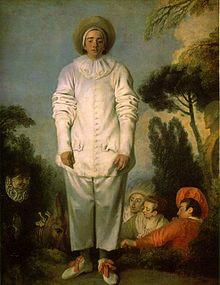
Antoine Watteau's commedia dell'arte player of Pierrot, ca 1718–19, traditionally identified as "Gilles". Oil on canvas; 184 × 149 cm (72.4 × 58.7 in) (Louvre Museum, Paris)
Locations
People
Groups
Topics
Subjects
Regions
Subregions
Related Events
Showing 10 events out of 28184 total
Years: 1719 - 1719
Antoine Watteau's commedia dell'arte player of Pierrot, ca 1718–19, traditionally identified as "Gilles". Oil on canvas; 184 × 149 cm (72.4 × 58.7 in) (Louvre Museum, Paris)
Locations
People
Groups
Topics
Subjects
Regions
Subregions