
Wanyan Wulu is a grandson of the …
Years: 1162 - 1162
Wanyan Wulu is a grandson of the founder of the Jin dynasty, Wanyan Aguda, and the son of the famous early-Jin general Wanyan Zongfu.
Wulu's father had died when the boy was just twelve years old, and he has grown up under the influence of his mother, who had come from a Sinicized Bohai gentry family from Liaoyang.
After her husband's death, Wulu's mother had chosen to become a nun instead of remarrying one of her husband's relatives, as is the Jurchen custom.
Thanks to his mother and her relatives, Wulu has received a good Chinese education, and has as good a knowledge of Chinese classics as any Chinese emperor.
Wulu is said to have also been greatly influenced by the wife he had had before becoming emperor.
Her birth name was Wulinda.
She had advised Wulu to be patient and to pretend to be loyal to his cousin, the then reigning Emperor Hailing Wang (also known as Wanyan Liang).
Hailing Wang had admired his cousin's wife and in 1151 called her to his inner court, but she had committed suicide.
This event resulted in a deep enmity between the two cousins.
When in 1161 Emperor Hailing Wang invaded the Southern Song to reunify China under the Jurchen rule, he had also sent agents to assassinate many of his own relatives and thus to cement his power within the Jin state.
Wulu, also on this hit list, had raised a rebellion against Emperor Hailing Wang.
The rebellion had been supported by many Jurchen officers and aristocrats dissatisfied with Hailing Wang's policy of cultural Sinicization and administrative centralization, and the human cost of Hailing Wang's southern adventure.
The first military officer to support the rebellion was said to be Wanyan Mouyan.
Hailing, after losing the Battle of Caishi against the Song, had been assassinated by his own disaffected officers at the end of 1161.
Wulu has been able to become the new ruler of the empire without actually fighting Hailing Wang.
Once on the throne, Wulu—who from now on will be known to the posterity as Emperor Shizong—reverses Hailingwang's plan for invading Southern Song, as well as his domestic Sinicization policies.
Although conversant with Chinese culture himself, Shizong thinks that the Jurchens' strength is in maintaining their "simple and sincere” culture, and will often attribute Hailing Wang's defeat to the latter's wholesale abandonment of it.
He isn't opposed to Chinese culture per se—in fact, he claims at one point that the "natural and honest" Jurchen way of life is much like what the ancient Chinese sages had taught—but he thinks that merely reading the classics without putting their ideas into practice is counterproductive.
During Shizong's reign, he confiscates large areas of unused land and land that had been grabbed by a few large Jurchen landowners, and redistributes it to the Jurchen settlers in North China.
Still, many Jurchen's prefer not to work their land plots, but lease them to Chinese farmers, and engage in heavy drinking instead.
The emperor criticizes his people for losing their martial spirit and military skills, such as archery and riding.
To give an example to his subjects, Shizong makes hunting an annual royal activity in 1162, and until 1188 he will go hunting almost every autumn and winter.
He likes archery and ball games as well.
As part of his promotion of the Jurchen culture and Jurchen language, soon after ascending the throne Shizong starts a program of translating Chinese classics into Jurchen.
The Jurchen version of the Chinese Classic of History (Shang shu) wil lbe first to be published; by the end of the Dading era, many other Chinese classics will have become available in Jurchen as well.
Locations
People
Groups
- Chinese (Han) people
- Jurchens
- Chinese Empire, Nan (Southern) Song Dynasty
- Jin Dynasty (Chin Empire), Jurchen
Topics
Commodoties
Subjects
Regions
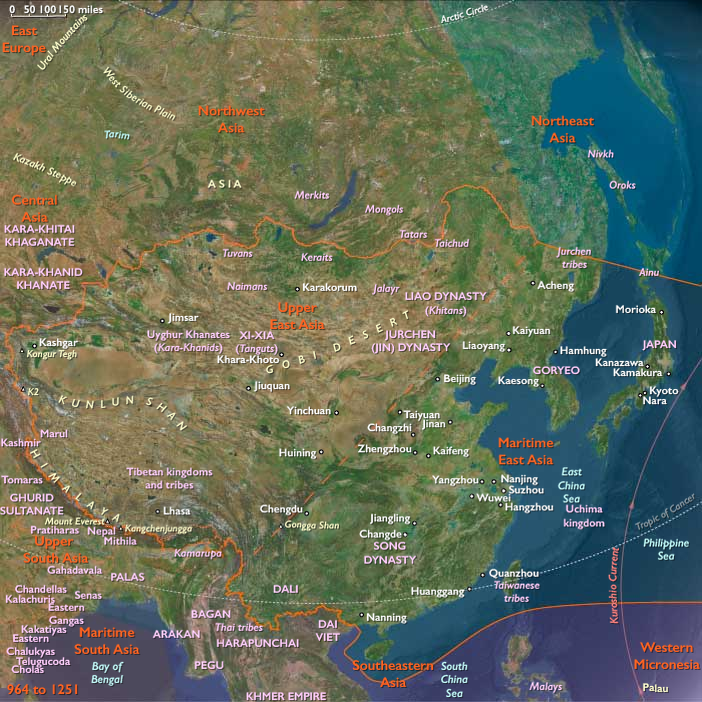
Subregions
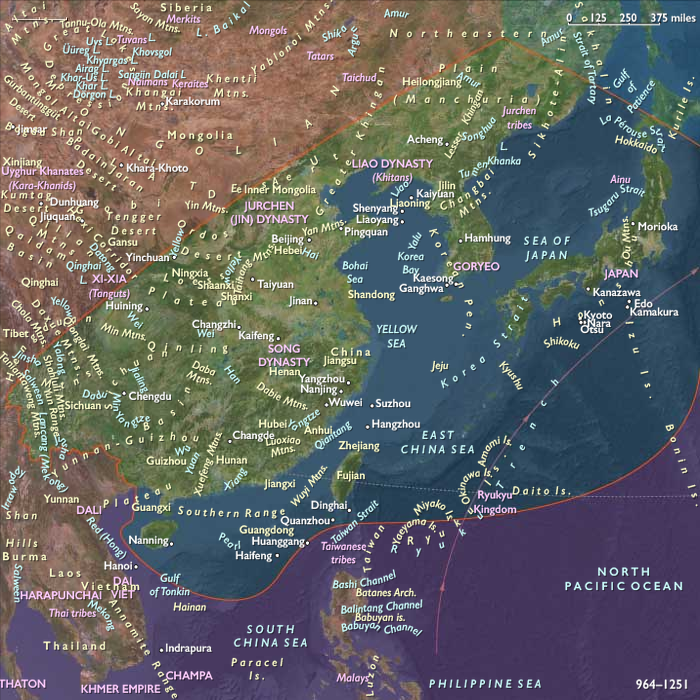
Related Events
Showing 10 events out of 48509 total
Years: 1162 - 1162
Locations
People
Groups
- Chinese (Han) people
- Jurchens
- Chinese Empire, Nan (Southern) Song Dynasty
- Jin Dynasty (Chin Empire), Jurchen
Topics
Commodoties
Subjects
Regions
Subregions