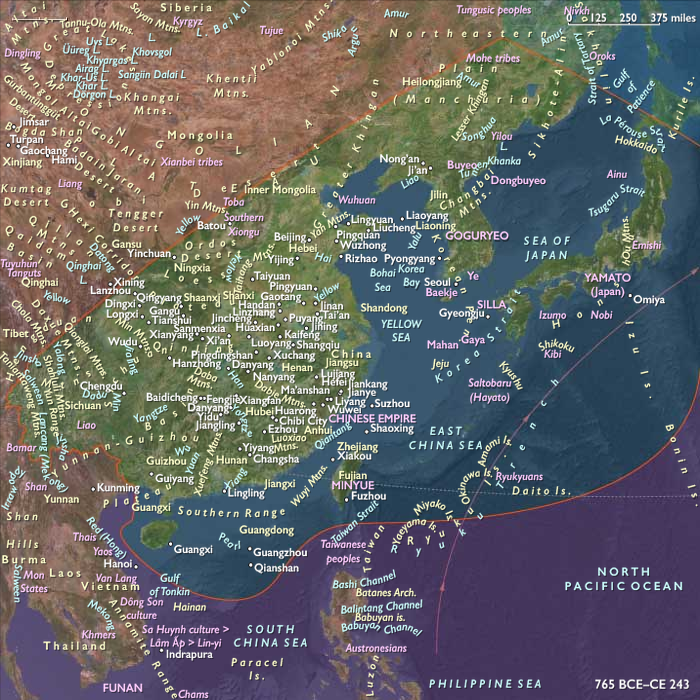
Wang Mang, at the behest of his …
Years: 19 - 19
Wang Mang, at the behest of his official Tian Kuang, reacts oddly to the agrarian rebellions by raising taxes in 19, which only aggravates the rebels.
Locations
People
Groups
Topics
Commodoties
Subjects
Regions
Subregions
Related Events
Filter results
Showing 10 events out of 61953 total
Maroboduus has remained neutral in the war of revenge launched by Tiberius and Germanicus against the Cherusci.
War had broken out in 17 between Arminius and Maroboduus, and after an indecisive battle Maroboduus had withdrawn in 18 into the area now known as Bohemia.
In the next year Catualda, a Marcomannic nobleman, who had been exiled by Maroboduus and fled to the Goths, returns—perhaps by a subversive Roman intervention, possibly at the instigation of Drusus—and defeats Maroboduus.
The deposed king has to flee to Italy and Tiberius detains him in Ravenna, where Maroboduus will die eighteen years later, in 37.
Shortly afterwards, Catualda himself is driven out by the Hermundurian Vibilius and flees to Forum Iulii (Fréjus) (Tac. Ann.2, 62-63).
Germanicus, stopping in Antioch in 19 on the return trip from Egypt, finds that the governor of Syria, Gnaeus Calpurnius Piso, has canceled the provincial arrangements that he had made.
Germanicus in turn orders Piso's recall to Rome, although this action is probably beyond his authority.
In the midst of this feud, Germanicus is stricken with a mysterious illness and dies shortly thereafter in Antioch.
His death arouses much speculation, with several sources blaming Piso, acting under orders from Emperor Tiberius.
This will never be proven, and Piso will later die while facing trial (ostensibly by suicide, but Tacitus supposes Tiberius may have had him murdered before he could implicate the emperor in Germanicus' death).
Germanicus’ death, announced in Rome during December of 19, brings much public grief in Rome and throughout the Roman Empire.
There is public mourning during the festive days in December.
The historians Tacitus and Suetonius record the posthumous honors of Germanicus and his funeral, at which there are no procession statues of Germanicus, but there are abundant eulogies and reminders of his fine character.
His posthumous honors include his name being placed into the Carmen Saliare, the Curule chairs, and as an honorary seat of the Brotherhood of Augustus; his coffin is crowned by oak-wreaths.
Other honors include his ivory statue as head of procession of the Circus Games.
His posts of priest of Augustus and Augur are to be filled by members of the imperial family; knights of Rome give his name to a block of seats in a theater in Rome.
Arches are raised to him throughout the Roman Empire; in particular, arches record his deeds and death at Rome, Rhine River and Nur Mountains.
In Antioch, where he is cremated, a sepulcher and funerary monument are dedicated to him.
On the day of Germanicus’ death his sister Livilla gives birth to twins.
Germanicus had made a Latin version, which survives, of Aratus's Phainomena, for which reason he is ranked among Roman writers on astrology.
His work is popular enough for scholia to be written on it, which have survived.
The dating of a magnificent sculpture of Rome’s first emperor, known as the Augustus of Prima Porta, is widely contested.
It is thought to be a marble copy of a possible bronze original.
This original, along with other high honors, is devoted to Augustus by the Senate in 20 BCE and set up in a public place.
Up until this time Augustus has lived modestly, but the fact that the statue was found in his wife's villa shows that he was thoroughly pleased with it.
It is also contested that this particular sculpture is a reworking in marble of a bronze original, possibly a gift from Tiberius Caesar to his mother Livia (since it was found in her villa Ad Gallinas Albas in the vicinity of the ninth marker of the via Flaminia, and close to a late Imperial gate called Prima Porta) after Augustus' death and in honor of the woman who had campaigned so long for him to become the next Caesar.
This would explain the divine references to Augustus in the piece, notably his being barefoot, the standard representation of gods or heroes in classical iconography.
Also, the reliefs in the cuirass depict the retrieval of Crassus' standards captured by the Parthians, an event in which the young Tiberius himself took a part, serving as intermediary with the Parthian king, in the act that is shown in the central scene of the armor, possibly his grandest service to his adopted father Augustus.
With the introduction of Tiberius as the figure responsible for the retrieval of the standards, he associates himself with Augustus, the emperor and the new god, as Augustus himself had done previously with Julius Caesar.
Under this hypothesis, the dating of the statue can be placed during the first years of Tiberius' reign as emperor.

Many Jews have immigrated to Rome during Tiberius' early reign and have begun proselytizing Roman citizens and performing Jewish rites.
Tiberius is suspicious and in 19 CE orders Jews who are of military age to join the Roman Army.
Tiberius banishes the rest of the Jews from Rome and threatens to enslave them for life if they do not leave the city.
Agrarian revolts now crop up virtually everywhere in the empire, fostered by Wang's incompetent rule and aggravated by the natural disasters.
The two largest branches are the Lülin (concentrated in modern southern Henan and northern Hubei) and Chimei (concentrated in modern southern Shandong and northern Jiangsu).
Herod Antipas establishes Tiberias, a port on the western shore of the Sea of Galilee in northeastern Israel in 20, naming it for the Roman emperor (Teverya in Hebrew).
He partly models Tiberias on the plan of a Greek polis; although he erects statues in the Greek manner in his palace, his coins bear no images.
He also encourages the Herodians, well-to-do Jews who support him and are tolerant of Roman authority.
The Gentiles who live in Tiberias and other Jewish cities are probably natives of nearby Gentile cities, and many are Syrians, who can probably speak both Aramaic and Greek.
Germanicus had meanwhile survived a little over a year in the East before dying, accusing Gnaeus Calpurnius Piso, the governor of Syria, of poisoning him.
The Pisones had been longtime supporters of the Claudians, and had allied themselves with the young Octavian after his marriage to Livia, the mother of Tiberius; Germanicus's death and accusations indict the new Princeps.
Piso is placed on trial and, according to Tacitus, threatens to implicate Tiberius.
Whether the governor actually could connect the Princeps to the death of Germanicus is unknown; rather than continuing to stand trial when it becomes evident that the Senate is against him, Piso commits suicide, though it is rumored that Tiberius, fearing incriminating disclosures, had put him to death.
Tiberius and his mother Livia are able to avoid incrimination of Piso’s wife Plancina.
The scattered Praetorian encampments inside the city are centralized into a single garrison just outside Rome in 20 and the number of cohorts is increased from nine to twelve, one of which now holds the daily guard at the palace.
The practice of joint leadership between two prefects is abandoned, and Sejanus himself appoints he centurions and tribunes.
With these changes in effect, Sejanus now commands the complete loyalty of a force of around twelve thousand soldiers, all of which are at his immediate disposal.
The facade of Augustus is no longer maintained, and Tiberius openly displays the strength of the guard at parades.
Wang sends vice generals Jing Shang and Wang Dang in 21 to try to put down the rebellions, but Jing and Wang's soldiers are so lacking in military discipline that they further anger that portion of the populace which had not rebelled, causing them to join or help the rebels in greater earnest.
Tian, who had earlier aggravated the rebellions, however, has some success against them, an advocates a policy whereby the villagers would be evacuated to the cities to trap the rebels into attacking fortifications.
Wang, who by this point distrusts Tian due to his military successes, refuses and recalls him to the capital.
About this time, Mother Lü dies, and her followers joined forces with Fan Chong's forces.
Fan and the other rebel leaders still lack any real political ambition—even as they are showing genuine military abilities.
The only rules of law that the rebels observe is that one who murders will die, and one who wounds will be responsible for the care of the victim until he or she heals.
The only titles for the rebel leaders are "county educator", "county clerk", and "sheriff", rather than more grandiose titles such as "general" or "prince”.