Vologases, on becoming king of the Parthians …
Years: 55 - 55
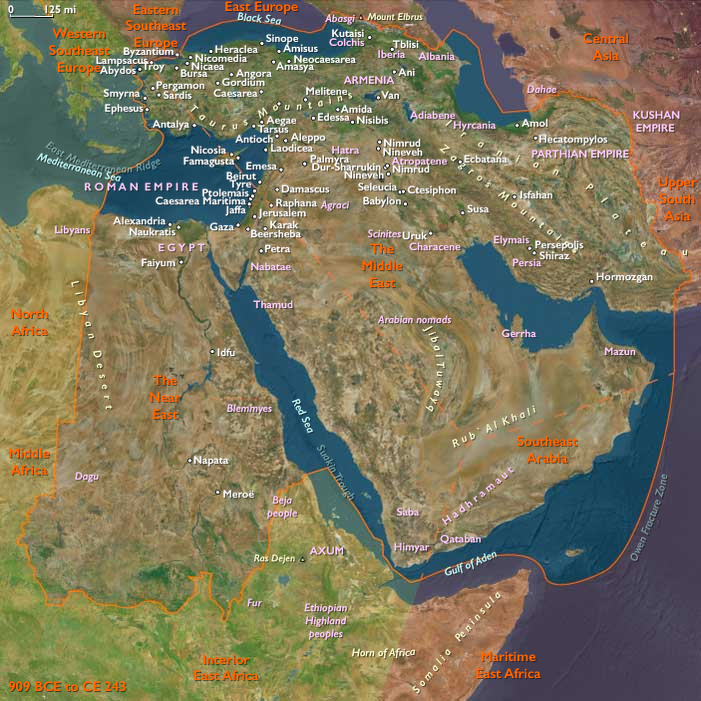
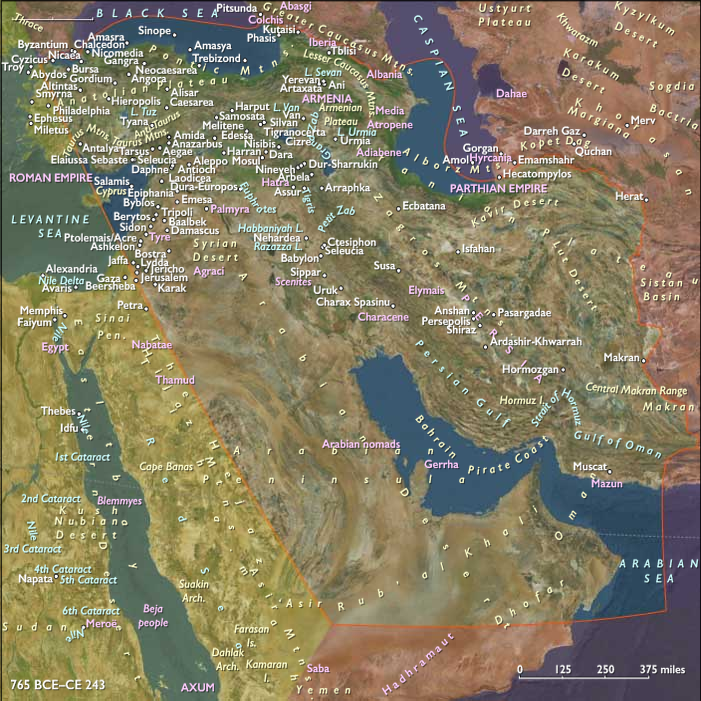
Vologases, on becoming king of the Parthians in CE 51, had given the kingdom of Media Atropatene to his brother Pacorus II, and has now occupied Armenia for another brother, Tiridates.
This will lead ultimately to a long war with the Roman Empire (58–63), which will be ably conducted by the Roman general Corbulo.
Locations
People
Groups
- Iranian peoples
- Atropatene, (Media) Kingdom of
- Parthian Empire
- Armenia, Kingdom of Greater
- Roman Empire (Rome): Julio-Claudian dynasty
Topics
Commodoties
Subjects
Regions
Subregions
Related Events
Filter results
Showing 10 events out of 61719 total
The Armenian cities soon revolt and, in 55 BCE, replace Rhadamistus with the Parthian prince Tiridates.
Rhadamistus if forced to flee along with his pregnant wife, Zenobia, of whom Tacitus relates a romantic story.
Unable to bear a long ride on horse, she persuades her husband to kill her so she will not fall into the hands of their pursuers.
Though stabbed and left at the banks of the Araxes, she survives and is found by some shepherds.
They carry Zenobia to the court of Tiridates, who receives her kindly and treats her as royalty.
Nero had become Emperor at seventeen, the youngest emperor until this time.
Ancient historians describe Nero's early reign as being strongly influenced by his mother Agrippina, his tutor Lucius Annaeus Seneca, and the Praetorian Prefect Sextus Afranius Burrus, especially in the first year.
Other tutors are less often mentioned, such as Alexander of Aegae.
Problems arose very early in Nero's rule from competition for influence between Agrippina and Nero's two main advisers, Seneca and Burrus.
Agrippina had tried in 54 to sit down next to Nero while he met with an Armenian envoy, but Seneca had stopped her and prevented a scandalous scene (as it is unimaginable at this time for a woman to be in the same room as men doing official business).
Nero's friends also mistrust Agrippina and tell him to beware of his mother.
Nero is reportedly unsatisfied with his marriage to Octavia and enters into an affair with Claudia Acte, a former slave.
In 55, Agrippina attempts to intervene in favor of Octavia and demands that her son dismiss Acte.
Nero, with the support of Seneca, resists the intervention of his mother in his personal affairs.
With Agrippina's influence over her son severed, Nero has become progressively more powerful, freeing himself of his advisers and eliminating rivals to the throne.
One of Agrippina's favorites, the freedman Pallas, is sacked in early 55 from his job as secretary of the treasury—a post he had held since the reign of Claudius.
According to Tacitus, Agrippina reacted violently to this slight by Nero.
She declared that she repented of her actions to bring Nero to the throne, and would throw in her lot with Britannicus, the true heir who would soon come of age.
She threatened to take the boy to the Praetorian camp, where she would admit to murdering Claudius and Britannicus would be declared emperor.
Nero does not take this threat lightly.
Tacitus recounts Nero's numerous attempts to publicly undermine Britannicus' image.
One such attempt was when Nero asked Britannicus to sing at a drunken party, months before his fourteenth birthday.
Britannicus however, not only avoided humiliation, but also generated sympathy among the guests, after singing a poem telling the tale of how he had been cast aside in favor of Nero.
Tacitus also stated that a few days before his death, Britannicus was sexually molested by Nero (Tacitus Book XIII, 17).
According to Tacitus, Nero moved against Britannicus, employing the same poisoner, Locusta, who had been hired to murder his father, Claudius.
Earlier in 55, Locusta had been convicted of poisoning another victim.
When Nero learns of this, he sends a tribune of the Praetorian Guard to rescue her from execution.
In return for this, she is ordered to poison Britannicus.
The first dose fails, and Nero decides to throw caution in the wind.
Britannicus is poisoned at a dinner party attended by his sister, Claudia Octavia, Agrippina, and several other notables.
The first-century chronicler Suetonius wrote that the assassin avoided being given away by a food taster by adding the poison to his drink when Britannicus asked for it to be cooled, as he felt it was too hot.
The substance was instantly fatal, and Britannicus fell to the floor foaming at the mouth.
He dies on February 11, 55, one day before his fourteenth birthday, less than a month before he is to assume manhood, and just four months after his father's death.
Nero dismisses the murder by claiming that the boy had suffered from epilepsy.
Some modern historians, particularly Anthony Barrett, suggest that he may have indeed suffered from the disease, and that a particularly bad seizure killed him.
After the death of Britannicus, Agrippina is accused of slandering Octavia and Nero orders her out of the imperial residence.
According to Tacitus, Nero protected Locusta by granting her immunity from execution, rewarding her with a vast estate and even sending students to her.
According to Suetonius, Britannicus had been good friends with the future Emperor Titus, whose father Vespasian had commanded legions in Britain.
As part of the Flavians' attempts to link themselves with the Julio-Claudians, Titus will claim that he had been seated with Britannicus on the night he was killed.
He even claimed to have tasted the poison, which resulted in a serious and long illness.
Titus will go on to erect a gold statue of his friend, and issue coins in his memory.
Tacitus states that from this moment Octavia became very unhappy, but learned to hide her affections and feelings around her husband and stepbrother.

Rhadamistus himself returns to Iberia.
However, he is soon put to death by his father for having plotted against the royal power.
After a third missionary journey, Paul delivers a gift of money collected from the other churches to the church of Jerusalem, intending this as a gesture of mutual love between Gentile and Jewish Christians.
Hostility aroused by his attitude toward the law, however, leads to a riot in Jerusalem and to Paul's arrest and imprisonment.
Pallas and the Praetorian prefect Sextus Afranius Burrus are in 56, two years after Nero’s accession, accused of conspiring to have Faustus Sulla declared emperor.
Seneca is accused of having relations with Agrippina and embezzlement.
The conspirators are put on trial, but Faustus does not appear to have been implicated.
Seneca succeeds in having himself, Pallas and Burrus acquitted.
According to Cassius Dio, at this time, Seneca and Burrus reduce their role in governing from careful management to mere moderation of Nero.
Nero, however, begins to watch his brother-in-law closely, afraid of his connection to the imperial family.
Crown Prince Zhuang, as heir apparent to the Chinese imperial throne, is often requested by Emperor Guangwu to render opinions in important matters.
In 51, he had been involved in making a major decision in the Han dynasty's relationship with the Xiongnu.
By that point, Xiongnu had had a civil war and divided into two—with the Northern Xiongnu ruled by Chanyu Punu and South Xiongnu ruled by Chanyu Bi.
Han had become allied with the Southern Xiongnu, and in response, Chanyu Punu, also wanting peace with Han, requested a heqin marriage (literally "peace marriage").
During the Western Han dynasty between 200 and 140 BCE, there had been ten instances of such marriage alliances during between Han “princesses” (one actually was an Imperial princess) and Xiongnu chieftains.
In the closing decade of the second century BCE, Emperor Wu of Ha had arranged the marriage of two Han princesses to kings of Wusun; in 31 BCE, Emperor Yuan of Han had married Wang Zhaojun, a lady of the imperial harem, to Xiongnu chieftain Huhanye.
Prince Zhuang had suggested that Emperor Guangwu refuse the proposal, reasoning that the Northern Xiongnu had only made the proposal to alienate the Southern Xiongnu from Han.
Emperor Guangwu agrees.
At the death of Emperor Guangwu in 57, Crown Prince Zhuang ascends the throne as Emperor Ming.
Emperor Nero, unhappy with the growing Parthian influence at the Roman’s doorstep in the East following Vologases’ installation of his brother, Tiridates, on the Armenian throne, directs Corbulo, his general in Asia Minor, to install another puppet king.
A Hasmonean named Aristobulus had already been given Lesser Armenia (Nicopolis and Satala) and Sohaemus of Emesa had in 54 received Armenia Sophene.
Paul’s Epistle to the Philippians, written probably while he is imprisoned in Ephesos in 56—57 (or, as some scholars believe, while imprisoned in Rome in the early 60s), promotes a theology of self-emptying love as an antidote to partisanship and a response to adversity, and reveals much about the sharing of missionary work between Paul and the congregations he serves.
In the generally joyful Phillippians, a probable composite of three letters, Paul, in the first letter, thanks the Philippians, with whom he has good relations, for a gift they send him; in the second, he delivers a hopeful report of his legal situation and encourages them to Christian living; in a third, he attacks a Judaizing gnostic group attempting to mislead the Philippians.
Paul makes an eloquent appeal on behalf of a runaway slave, Onesimus, whom he has converted to Christianity, in his Epistle to Philemon, possibly written during his Ephesian imprisonment or during his Roman imprisonment five years later.
He displays in the letter the depth of his Christian humaneness by asking Philemon—a wealthy Christian of Colossae whom he has also converted—for Onesimus's quiet return to his former station (or, in another interpretation, for his complete freedom to become an evangelist).
Nero had begun taking on a more active role as an administrator in 55; he will serve as consul four times between 55 and 60.
During this period, some ancient historians speak fairly well of Nero and contrast it with his later rule.
Cartimandua has seized and holds hostage Venutius' brother and other relatives, Venutius makes war against her in 57, then wars against her Roman protectors.
Building alliances outside the Brigantes, he stages an invasion of the kingdom.
The Romans, having anticipated this, send some cohorts to defend their client queen.
The fighting is inconclusive until Caesius Nasica arrives with a legion, the IX Hispana, and defeats the rebels.
Thanks to this prompt military support from Roman forces, Cartimandua retains her throne.
Tacitus presents Cartimandua in a negative light in his moralizing narratives, the Annals and the Histories.
Although he refers to her loyalty to Rome, he invites the reader to judge her "treacherous" role in the capture of Caratacus, who had sought her protection; her "self-indulgence" (her sexual impropriety in rejecting her husband in favor of a common soldier); and her "cunning strategems" in taking Venutius' relatives hostage.
However, he also consistently names her as a queen (regina), the only one such known in early Roman Britain.
Boudica, the only other female British leader of the period, is not described in these terms.
Years: 55 - 55
Locations
People
Groups
- Iranian peoples
- Atropatene, (Media) Kingdom of
- Parthian Empire
- Armenia, Kingdom of Greater
- Roman Empire (Rome): Julio-Claudian dynasty