Vologases is infuriated by the fact that …
Years: 58 - 58
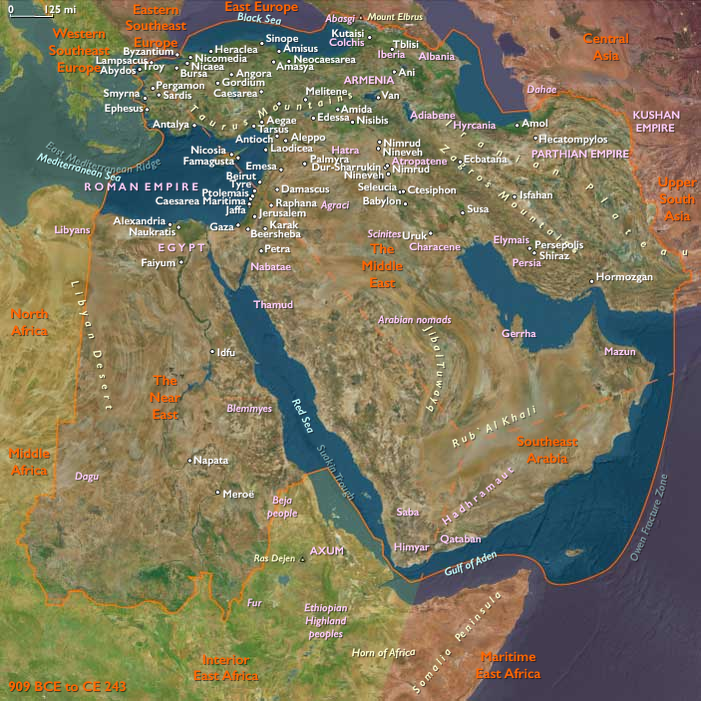
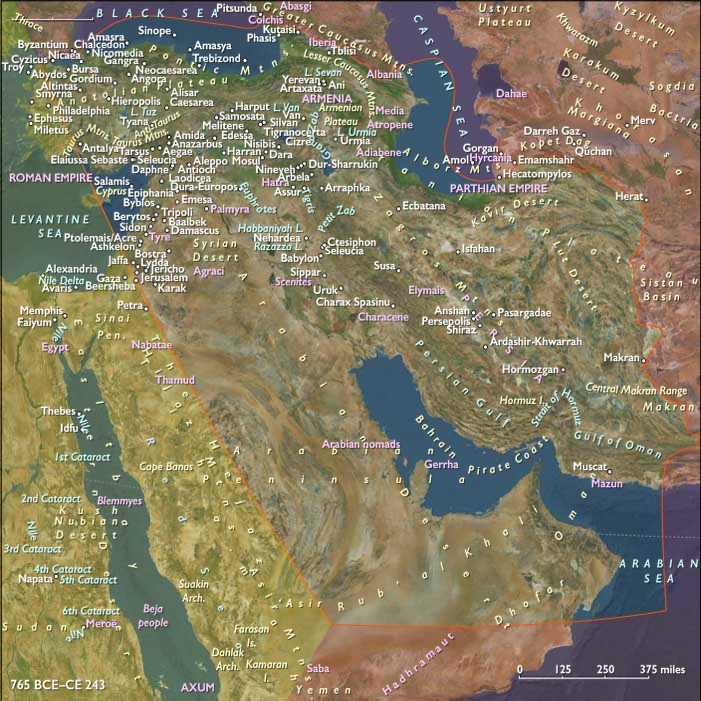
Vologases is infuriated by the fact that an alien now sits on the Armenian throne but hesitates to reinstate his brother as his power has been weakened by an attack of the Dahae and Sacae nomads, a rebellion of the Hyrcanians, and the usurpation of his son Vardanes II.
Locations
People
Groups
- Iranian peoples
- Scythians, or Sakas
- Armenian people
- Dahae
- Hyrcania
- Parthian Empire
- Armenia, Kingdom of Greater
- Roman Empire (Rome): Julio-Claudian dynasty
Topics
Commodoties
Subjects
Regions
Subregions
Related Events
Filter results
Showing 10 events out of 61707 total
Emperor Ming quickly establishes himself as a diligent and capable administrator of the empire.
He takes a number of measures to try to stamp out corrupt officials, often putting them to death ion discovery of wrongdoing.
Historians praised him for was his fair treatment of his brothers by the deposed Empress Guo, treating them as if they were also born of his mother Empress Dowager Yin.
In 58, when his older brother, Prince Jiang of Donghai (the former crown prince) dies, he orders the princes and major officials to attend Prince Jiang's funeral—highly unusual honor—at Lucheng (in modern Jining, Shandong), the capital of Donghai.
Corbulo with his army enters Greater Armenia from Cappadocia in the spring of 58, and advances towards Artaxata, while Pharasmanes I of Iberia attacks from the north and Antiochus IV of Commagene attacks from the southwest.
Supported by his brother, Tiridates sends flying columns to raid the Romans far and wide.
Corbulo retaliates by using the same tactics and employing the Iberian tribes, who raid outlying regions of Armenia.
Tiridates I flees his capital, which Corbulo burns to the ground.
In the summer of this year, Corbulo advances towards Tigranakert through rough terrain and passing through the Taronitida (Taron), where several of his commanders die in an ambush by the Armenian resistance.
However, the city opens its gates, with the exception of one of the citadels, which is destroyed in the ensuing assault.
By this time, the majority of Armenians have abandoned resistance and accepted the Herodian prince favored by Rome.
Nero gives the crown to the last royal descendant of the Kings of Cappadocia, the grandson of Glaphyra (daughter of Archelaus of Cappadocia) and Alexander of Judea (the brother of Herod Archelaus and the son of Herod the Great), who assumes the Armenian name Tigranes (his uncle was Tigranes V).
Nero crowns Tigrans in Rome.
Little is known of his life before becoming king.
Raised in Rome, he had married a Phrygian noblewoman from central Anatolia called Opgalli, who may have been a Hellenic Jew.
His wife is only known through surviving numismatic evidence from his kingship.
Opgalli bore Tigranes at least two known children: a son Gaius Julius Alexander and a daughter Julia.
Tigranes and his children are the last royal descendants of the Kings of Cappadocia.
Nero is hailed vigorously in public for this initial victory, and Corbulo is rewarded with the governorship of Syria.
Border districts are bestowed to Roman allies that had assisted Corbulo, including Polemon, Parasmanes, Aristobolus and Antiochus IV of Commagene.
Nero had given to Tigranes a guard of one thousand legionary soldiers, three auxiliary cohorts and two wings of horses were allotted to him in order to defend and protect Armenia.
At the same time, his son Alexander marries Julia Iotapa, a Commagenean Princess and the daughter of King Antiochus IV of Commagene in Rome.
Nero crowns Alexander and Iotapa as Roman Client Monarchs of Cetis, a small region in Cilicia, which was previously ruled by Antiochus IV.
Vardanes II has rebelled against his father from about CE 55 to 58 and must have occupied Ecbatana, since he issues coins from the mint here, bearing the likeness of a young beardless king wearing a diadem with five pendants.
Nothing more about him is known.
Relations between Paul and the Corinthians have deteriorated into open conflict by the time he writes the second Letter to the Corinthians, which reveal Paul's zeal, strength, closeness to Christ, and feelings for his communities.
The early chapters largely reflect past conflict over the Corinthians' behavior, the rejection of Paul's apostolic authority by some, and subsequent reconciliation.
Next come distinct appeals for contributions to be given to the Jerusalem church, and finally Paul’s emotional defense of his life and ministry against adversaries claiming to have authority above Paul's.
Paul defends himself against rival missionaries who boast of their own attainments, arguing that God can accomplish his purposes through the weakest of human instruments.
Another imperial freedman had falsely accused Faustus of plotting to attack Nero, possibly at the latter's instigation, in 58.
Nero treats Faustus as proven guilty.
Faustus is exiled in 59 and confined to Massilia (modern Marseille, France).
In this year, Nero becomes romantically involved with Poppaea Sabina, the wife of his friend and future emperor Otho.
The parents of Poppaea Sabina were Titus Ollius of Picenum (modern Marche and Abruzzo, Italy), a quaestor in the reign of the Emperor Tiberius, and Poppaea Sabina, called the Elder to distinguish her from her daughter.
Ollius' friendship with the infamous Imperial palace guardsman Lucius Aelius Sejanus had ruined him, before gaining public office.
A unknown minor character in Imperial politics, Titus Ollius dies in 31.
Poppaea's mother remarried Publius Cornelius Lentulus Scipio (I), who was a divisional commander in 22, consul in 24 and later a senator.
Publius Cornelius Lentulus Scipio (II), who is most probably Poppaea's stepbrother, had served as a consul in 56 and will later serve as a senator.
Poppaea Sabina was a distinguished woman, whom Tacitus, describing her as ‘the loveliest woman of her day’, praises as a wealthy woman and a woman of distinction.
In 47, she had committed suicide as an innocent victim of the intrigues of the Roman Empress Valeria Messalina, having been charged with committing adultery with former consul Decimus Valerius Asiaticus.
Poppaea Sabina's first marriage was to Rufrius Crispinus, a man of equestrian rank.
They married in 44, when Poppaea was fourteen years old.
He was the leader of the Praetorian Guard during the first ten years of the reign of the Emperor Claudius, until 51, when Claudius's new wife Agrippina the Younger, regarding him as loyal to the deceased Messalina's memory, removed him from this position and replaced him with Sextus Afranius Burrus.
During their marriage, Poppaea had given birth to his son, a younger Rufrius Crispinus.
Poppaea next married Otho, who is seven years younger than she.
Nero falls in love with Poppaea and she becomes his mistress.
According to Tacitus, Poppaea divorced Otho in 58 and focused her attentions solely on becoming empress of Rome and Nero's new wife.
Otho is ordered away to be governor of Lusitania.
Suetonius places these events after 59.
According to Tacitus, Poppaea was ambitious, ruthless, and bisexual.
He reports that Poppaea married Otho to get close to Nero and then, in turn, became Nero's favorite mistress.

Veranius reverses Didius's policy of maintaining existing borders and begins military operations against the troublesome Silures in what is now Wales, but dies within a year.
In his will, he flatters Nero and claims that, had he had another two years, he would have conquered the whole of the island.
He is replaced by Gaius Suetonius Paulinus.
Emperor Ming, following a suggestion by his brother Liu Cang, the Prince of Dongping, in 59, institutes a number of Confucian rituals, in which the emperor, to show humility, personally honors the officials who had helped him.
Nero’s wife Octavia is meanwhile caught up in the power struggles between Nero and his mother, which conclude when Nero murders his mother in March 59.
Tacitus claims that Poppaea was the reason that Nero murdered his mother.
Poppaea induced Nero to murder Agrippina in 59 so that she could marry him.
Modern sources, though, question the reliability of this story as Nero did not marry Poppaea until 62.
Additionally, Suetonius mentions how Poppaea's husband, Otho, was not sent away until after Agrippina's death, which makes it very unlikely that an already married woman would be pressing Nero to marry her.
Some modern historians, however, theorize that Nero's decision to kill Agrippina was prompted by her plotting to set Gaius Rubellius Plautus (Nero's maternal second cousin) on the throne, rather than as a result of Poppaea's motives.
According to Suetonius, Nero had tried to kill his mother through a planned shipwreck, which had taken the life of her friend, Acerronia Polla, but when Agrippina survived, he had her executed and framed it as a suicide.
The incident is also recorded by Tacitus.
Emperor Ming creates his favorite Consort Ma (who is also a favorite of his mother Empress Dowager Yin) empress in 60, and creates her adopted son Prince Da crown prince.
The same year, to honor the generals and officials who had assisted his father Emperor Guangwu in reestablishing the Han Dynasty, Emperor Ming, perhaps echoing what Emperor Xuan had done, had the portraits of twenty-eight of them drawn on a palace tower (known as the "Yuntai 28 Generals").
Later, four more portraits will be added.
However, Ma Yuan, because he was the father of the empress, did not receive this honor, although his reputation is posthumously restored.
Restrictions are put on the amount of bail and fines under Nero.
Also, fees for lawyers are limited.
There is a discussion in the Senate on the misconduct of the freedmen class, and a strong demand is made that patrons should have the right of revoking freedom.
Nero supports the freedmen and rules that patrons have no such right.
The Senate tries to pass a law in which the crimes of one slave applied to all slaves within a household.
Despite riots from the people, Nero supports the Senate on their measure, and deploys troops to organize the execution of four hundred slaves affected by the law.
However, he vetoes strong measures against the freedmen affected by the case.
After tax collectors are accused of being too harsh to the poor, Nero transfers collection authority to lower commissioners.
Nero bans any magistrate or procurator from exhibiting public entertainment for fear that the venue is being used as a method to sway the populace.
Additionally, there are many impeachments and removals of government officials along with arrests for extortion and corruption.
When further complaints arise that the poor are being overly taxed, Nero attempts to repeal all indirect taxes.
The Senate persuades him that this action will bankrupt the public treasury.
As a compromise, taxes are cut from four and a half percent to two and a half percent.
Additionally, secret government tax records are ordered to become public.
To lower the cost of food imports, merchant ships are declared tax-exempt.
In imitation of the Greeks, Nero builds a number of gymnasiums and theaters.
Enormous gladiatorial shows ware also held.
Nero also establishes the quinquennial Neronia.
The massive Greek-style festival includes games, poetry, and theater.
Historians indicate that there was a belief that theater led to immorality.
Others considered that to have performers dressed in Greek clothing was old fashioned.
Some questioned the large public expenditure on entertainment.
Junia Silana, sister of Caligula's first wife Junia Claudilla, a rival of Empress Agrippina the Younger and the ex-wife of Messalina's lover Gaius Silius, had in 55 accused Agrippina of plotting to overthrow Nero to place Plautus on the throne.
Nero had taken no action at the time, but over time, Nero's relationship with Silana had warmed while his relationship with his mother soured.
After a comet appears in 60, public gossip renews rumors of Nero's fall and Plautus' rise.
Nero exiles Plautus in 60 to his estate in Asia with his family.
Years: 58 - 58
Locations
People
Groups
- Iranian peoples
- Scythians, or Sakas
- Armenian people
- Dahae
- Hyrcania
- Parthian Empire
- Armenia, Kingdom of Greater
- Roman Empire (Rome): Julio-Claudian dynasty