Vladimir, the son of the Norse-’Rus prince …
Years: 976 - 976
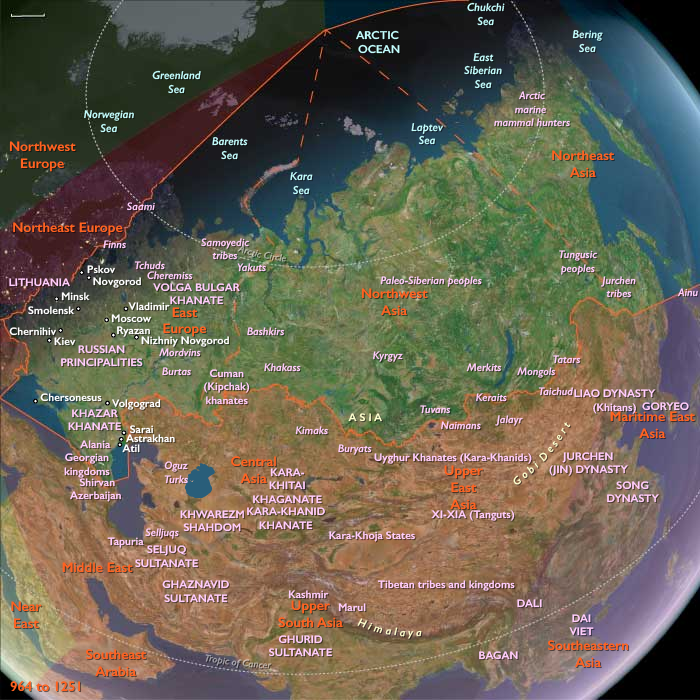
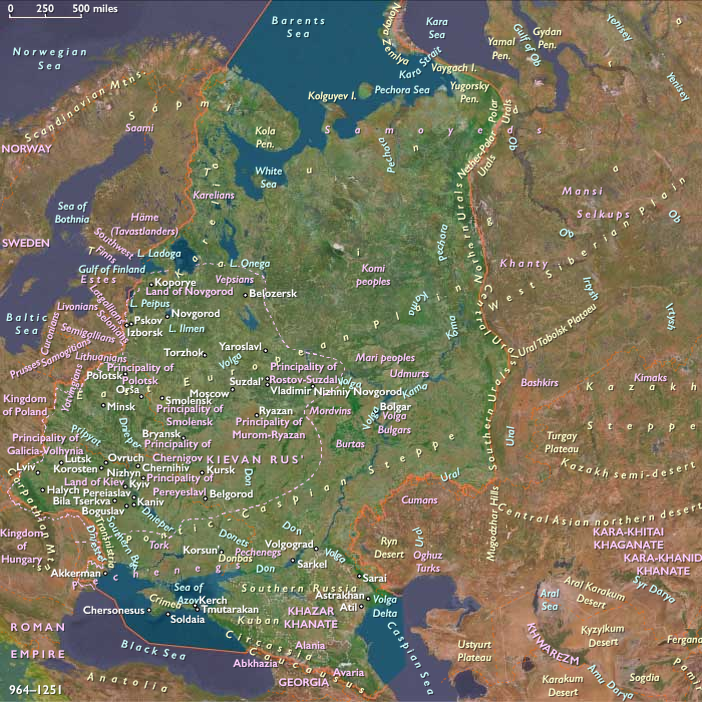
Vladimir, the son of the Norse-’Rus prince Sviatoslav of Kiev by one of his courtesans, had been made prince of Novgorod in 970.
His brothers Oleg and Yaropolk had received, respectively, Drevlian and Kiev.
A few years after the death of their father in 972, the brothers initiate a civil war for their father's throne.
Locations
People
Groups
- Balts
- Volga Bulgaria, or Volga-Kama Bulgaria
- Rus' people
- Novgorod, Principality of
- Kievan Rus', or Kiev, Great Principality of
- Bulgarian Empire (First)
Topics
Commodoties
Subjects
Regions
Subregions
Related Events
Filter results
Showing 10 events out of 52417 total
Jayavarman V, though a Shaivite, is very tolerant of Buddhism, which flourishes under his reign.
Kirtipandita, his Buddhist minister, brings ancient texts from foreign lands to Cambodia, though none survive.
He even suggests that priests use Buddhist prayers as well as Hindu during a ritual.
Buddha teaches tolerance toward all beings, and the rise of Buddhism during Jayavarman V's reign also ushers women into many high positions.
Jahavi, the younger sister of Yajnavaraha, had helped raise money for the construction of Banteay Srei as this temple was not funded by the king.
Prana, of the Saptadevakula family, is the king's trusted advisor.
Vladimir I of Kiev orders the Christian conversion of Kiev and Novgorod and establishes the Russian Orthodox Church.
East Central Europe (976–987 CE): Ottonian Conflicts and Bohemian Expansion, Consolidation of Polish Christianity, and Hungary’s Path toward Kingdom
Between 976 and 987 CE, East Central Europe—encompassing modern-day Poland, Czechia, Slovakia, Hungary, and the eastern regions of Germany and Austria east of 10°E and north of the defined southeastern boundary—experienced intensified political competition, internal consolidation, and cultural integration. This era saw significant dynastic conflicts within the Ottonian Empire, territorial expansion and strengthening under the Bohemian Přemyslid dynasty, the deepening Christianization and political consolidation of Poland under Mieszko I, and further Magyar political stabilization under Prince Géza as Hungary moved decisively toward Christian statehood.
Political and Military Developments
Ottonian Internal Struggles and Regional Instability
-
Following Otto I’s death (973), his successor Otto II (973–983) faced considerable internal dissent and external pressures, particularly rebellions among eastern frontier nobles in Bavaria and Austria, temporarily weakening imperial authority and regional stability.
Přemyslid Bohemia’s Expansion
-
Under Boleslaus II "the Pious" (r. 972–999), Bohemia expanded its territorial and political influence significantly. The Přemyslid state became a prominent regional power, asserting autonomy from Ottonian overlordship and extending its influence into Silesia, Moravia, and parts of modern Slovakia.
Polish State Strengthening under Mieszko I
-
Mieszko I consolidated his rule by strategic alliances, territorial expansions, and the deepening of Poland’s integration into Christian Europe. His alliance through marriage to the Přemyslid princess Doubravka solidified Polish-Bohemian relations and reinforced Christianization.
Hungary’s Continued Political Consolidation
-
Magyar ruler Géza (r. c. 972–997) reinforced central authority, furthering Christian influence, fortifying settlements, and diplomatically navigating relations with neighboring states, positioning Hungary to emerge soon as a Christian kingdom under his son, Stephen I.
Economic and Technological Developments
Expansion of Regional Commerce
-
Continued political stabilization, especially in Bohemia and Poland, revitalized regional commerce, strengthening trade networks and economic prosperity. Trade routes linked East Central Europe firmly with the broader European economy, exchanging textiles, metals, and agricultural commodities.
Further Development of Defensive Infrastructure
-
Persistent threats and political rivalries led to intensified construction of fortified towns and castles across Bohemia, Poland, and Hungary, significantly shaping medieval settlement patterns and regional security infrastructure.
Cultural and Artistic Developments
Bohemian Cultural Renaissance under the Přemyslids
-
Under Boleslaus II, Bohemian culture flourished, evident in ecclesiastical architecture, monastic foundations, illuminated manuscripts, and liturgical traditions. Prague solidified its role as a vibrant cultural and religious center.
Deepening of Polish Christian Identity
-
Mieszko I’s patronage facilitated rapid growth of ecclesiastical institutions and Slavic-Christian culture within Poland, creating a distinct Polish Christian identity evident in religious architecture, literature, and administrative structures.
Magyar Cultural Synthesis and Christian Influence
-
Géza’s rule further encouraged Magyar acceptance of Christianity, integrating Western European cultural and ecclesiastical traditions into Hungarian society, laying foundations for Hungary’s distinct medieval Christian identity.
Settlement and Urban Development
Growth of Bohemian Urban Centers
-
Bohemia experienced significant urban growth under Přemyslid rule, notably in Prague, which developed into a key political, cultural, and commercial hub, centralizing administrative functions and regional influence.
Expansion of Polish Administrative Settlements
-
Polish towns, particularly Gniezno and Poznań, further expanded, developing into important administrative and ecclesiastical centers that fostered early urbanization and stable political governance.
Hungarian Administrative Centers
-
Under Géza, Hungarian settlements, especially Esztergom and Székesfehérvár, strengthened administrative structures and urban organization, providing critical foundations for Hungary’s later royal administration and urban networks.
Social and Religious Developments
Ecclesiastical Integration and Expansion
-
Christianity deepened its influence, reshaping social structures and governance. Churches and monasteries played essential roles in governance, education, and social organization, integrating East Central Europe fully into European Christendom.
Strengthening of Dynastic Power
-
Dynastic and aristocratic hierarchies in Bohemia, Poland, and Hungary grew stronger, laying clear foundations for medieval political institutions and social organization.
Long-Term Consequences and Historical Significance
The era 976–987 CE significantly shaped East Central Europe’s medieval trajectory. Ottonian internal challenges temporarily shifted power balances, allowing Bohemian expansion, Polish state consolidation under Mieszko I, and Hungary’s decisive shift toward Christian statehood. These developments established lasting political structures, cultural traditions, and regional identities central to the medieval histories of Poland, Bohemia, and Hungary.
Most Polabian Slavs see Jesus as a "German god" and remain pagan, despite the efforts of Christian missionaries.
In the Great Slav Rising in 983, the pagan Slavs revolt against their subjugation to the Kingdom of the Eastern Franks, aka East Francia.
The Slavic Lutici and Obotrite people, who live to the east of the Elbe in modern northeast Germany, defeat Emperor Otto II in at the Battle of Stilo in 982, then rebel against the Germans the following year.
The Hevelli and Lutici destroy the Bishoprics of Havelberg and Brandenburg., and some Slavs advance across the Elbe into Saxon territory, but retreat when the Christian Duke of the Polans, Mieszko I, attacks them from the East.
The Holy Roman Empire retains only nominal control over the Slavic territories between the Elbe and the Oder.
Three German leaders, all called Henry, stage a brief rebellion against the Holy Roman Emperor Otto II in 977.
The conflict is called The War of the Three Henries.
Most Polabian Slavs see Jesus as a "German god" and remain pagan, despite the efforts of Christian missionaries.
In the Great Slav Rising in 983, the pagan Slavs revolt against their subjugation to the Kingdom of the Eastern Franks, aka East Francia.
The Slavic Lutici and Obotrite people, who live to the east of the Elbe in modern northeast Germany, defeat Emperor Otto II in at the Battle of Stilo in 982, then rebel against the Germans the following year.
The Hevelli and Lutici destroy the Bishoprics of Havelberg and Brandenburg., and some Slavs advance across the Elbe into Saxon territory, but retreat when the Christian Duke of the Polans, Mieszko I, attacks them from the East.
The Holy Roman Empire retains only nominal control over the Slavic territories between the Elbe and the Oder.
Eastern Southeast Europe (976–987 CE): Byzantine Revolts and Intensified Bulgarian Conflict
Settlement and Migration Patterns
Stability Amidst Turmoil
From 976 to 987 CE, Eastern Southeast Europe experienced continued demographic stability despite significant military and political upheaval stemming from Byzantine internal revolts and intensified conflict with Bulgaria.
Political and Military Developments
Byzantine Internal Revolts (976–989 CE)
The Byzantine Empire faced significant internal challenges during this era, notably marked by widespread revolts (976–989 CE) that weakened central authority. These rebellions underscored internal power struggles and factional divisions, temporarily disrupting Byzantine military effectiveness.
Bulgarian-Byzantine War and the Battle of the Gates of Trajan (981–1018 CE)
The Bulgarian-Byzantine conflict intensified significantly, highlighted by the Battle of the Gates of Trajan in 986 CE. The Bulgarian forces achieved a notable victory, temporarily halting Byzantine advances and demonstrating Bulgaria’s continuing resilience despite its previous territorial losses.
Byzantine Reconsolidation Efforts
Despite internal and external challenges, Byzantine forces under Emperor Basil II began a determined campaign to reconsolidate territories lost during the revolts and stabilize the Empire, setting the stage for a prolonged conflict aimed at the complete conquest of Bulgaria.
Economic and Technological Developments
Economic Strain and Resilience
The Byzantine revolts and ongoing Bulgarian-Byzantine war strained regional economies, disrupting trade and agricultural production. Despite these challenges, core economic activities persisted, demonstrating notable resilience in face of continuous conflict.
Enhanced Military Infrastructure
In response to the intensified military conflicts, significant investments continued in fortifications, particularly along critical conflict zones, strengthening territorial defenses and safeguarding economic resources.
Cultural and Artistic Developments
Sustained Cultural Activities
Cultural and artistic traditions continued to flourish despite political disruptions, maintaining regional artistic identity through ongoing craftsmanship, literary production, and manuscript preservation in Byzantine educational institutions and Bulgarian cultural centers.
Intellectual Resilience
Intellectual activities persisted robustly, particularly in scholarly communities and scriptoria, preserving classical and theological knowledge amid political and military upheaval.
Social and Religious Developments
Continued Religious Influence
Orthodox Christianity remained the region's predominant religious and social influence, providing stability and cohesion during this turbulent period. Religious institutions played critical roles in maintaining community stability amid political instability and military conflicts.
Bogomil and Local Religious Movements
Bogomilism continued its influence, shaping rural religious practices and societal structures. This dualistic, evangelical reform movement persisted as an important element of regional religious life.
Long-Term Consequences and Historical Significance
The period from 976 to 987 CE saw significant internal and external challenges for the Byzantine Empire, marked by revolts, the pivotal Battle of the Gates of Trajan, and intensified Bulgarian-Byzantine conflicts. These developments significantly shaped the geopolitical landscape, setting the stage for prolonged Byzantine military campaigns and reshaping regional power dynamics for subsequent decades.

Ali ibn al-Hassan Shirazi is one of seven sons of a ruler of Shiraz, Persia, his mother an enslaved Abyssinian woman.
Upon his father's death, Ali had been driven from inheritance by his brothers Setting sail out of Hormuz, Ali ibn al-Hassan, his household and a small group of followers had first made their way to Mogadishu, the main commercial city of the East African coast.
However, Ali failed to get along with the city's Somali elite and he was soon driven out of that city as well.
Steering down the African coast, Ali is said to have purchased the island of Kilwa from the local Bantu inhabitants.
According to one chronicle (Strong, 1895), Kilwa was originally owned by a mainland Bantu king 'Almuli' and connected by a small land bridge to the mainland that appeared in low tide.
The king agreed to sell it to Ali ibn al-Hassan for as much colored cloth as could cover the circumference of the island.
But when the king later changed his mind, and tried to take it back, the Persians had dug up the land bridge, and Kilwa was now an island.
Kilwa's fortuitous position makes it a much better East African trade center than Mogadishu.
It quickly begins to attract many merchants and immigrants from further north, including Persia and Arabia.
In just a few years, the colony is big enough to establish a satellite settlement at nearby Mafia Island.
The Cometopuli brothers, based in the unconquered western regions of the Bulgarian Empire, will lead Bulgarian resistance is led until its fall in 1018 under East Roman (Byzantine) rule and its end as a state.
One of the brothers, Samuel, establishes the Macedonian, or Western Bulgarian, Empire.
The lands in which Slovene speakers live had been assigned to the German kingdom after the partitioning of the Frankish empire.
As part of the defense of this kingdom against Magyar invaders, they had been divided among the marks, or border marches, of Carinthia, …
…Carniola, and Styria.
German lay and clerical lords arrive in the Slovenian lands, along with dependent peasants, and enserf the Slovenes, whom they call Wends or Winds.
Years: 976 - 976
Locations
People
Groups
- Balts
- Volga Bulgaria, or Volga-Kama Bulgaria
- Rus' people
- Novgorod, Principality of
- Kievan Rus', or Kiev, Great Principality of
- Bulgarian Empire (First)