
Vladimir I of Kiev orders the Christian …
Years: 976 - 987
Vladimir I of Kiev orders the Christian conversion of Kiev and Novgorod and establishes the Russian Orthodox Church.
People
Groups
- Polytheism (“paganism”)
- Christianity, Chalcedonian
- Rus' people
- Novgorod, Principality of
- Kievan Rus', or Kiev, Great Principality of
Subjects
Regions
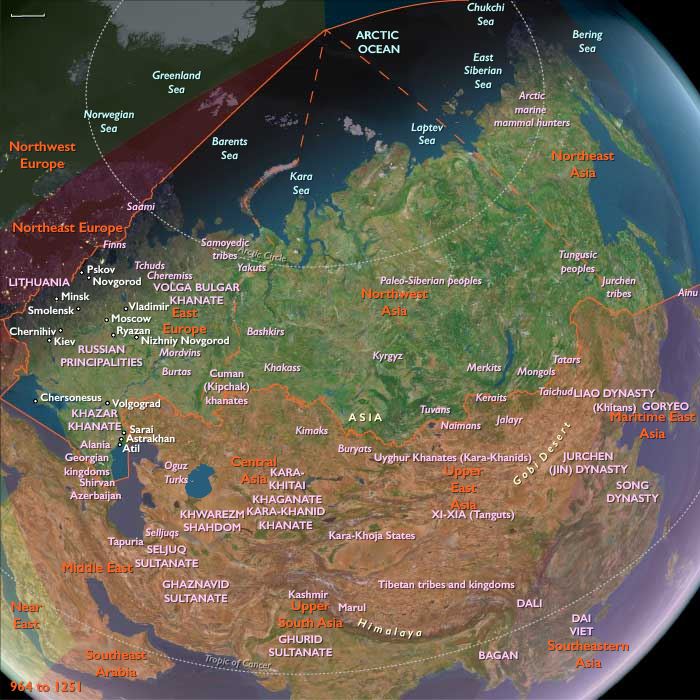
Subregions
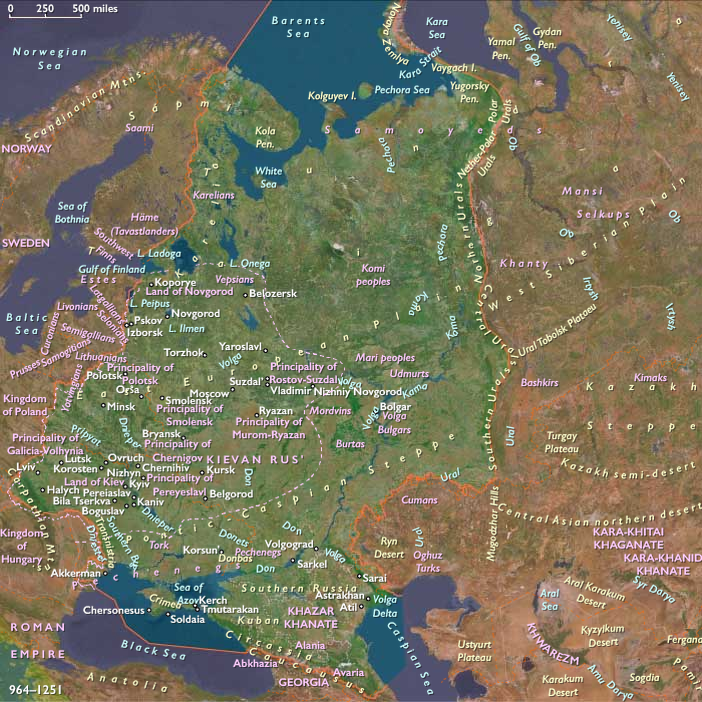
Related Events
Filter results
Showing 10 events out of 216 total
Adalbert cannot stay in Bohemia after the tragedy and escapes from Prague, despite the Pope's call for him to return to his episcopal see.
Strachkvas is eventually appointed to be his successor.
However, when he is about to assume the bishopric, he suddenly dies during the ceremony.
Circumstances of his death remain unclear.
Boleslaus III, called the Red (-haired) or the Blind, the duke of Bohemia since 999, has been called the "worst of all men who ever sat on the Bohemian throne."
The eldest son of Boleslav II the Pious and Adiva of England, Boleslav III is a weak ruler in whose chaotic reign Bohemia will become a pawn in the long war between the Emperor Henry II and Boleslaw the Brave, King of Poland.
The Vrshovici, a noble Czech (Bohemian) family and clan, are the third most powerful political force in newly Christianized Czechia (Bohemia), after the reigning Premyslidi and the contending Slavníki.
They are active in Bohemian conflicts with Poland, Hungary and the Kings and Electors of the Holy Roman Empire, and in the intermittent internal conflicts common for feudally fragmented regimes of this time.
Possessing such towns as Zatec and Litomerice, the Vrshovici have consanguinity with the Premyslidi and provide political services to them, when it suits Vrshovici goals.
A revolt in Bohemia organized in 1002 by Vrshovici grandees (along with Boleslaus's son-in-law) force Boleslaus to flee to …
Boleslaus's kinsman Vladivoj, probably a Přemyslid, or their distant relative, had taken the Bohemian throne, but he is a drunk and dies within a year.
After Vladivoj's death, the nobles invite Boleslaus’s brothers Jaromir and Oldrich from exile, but Jaromir is unable to secure the throne.
Boleslaus the Red, with armed support from Boleslaw the Brave of Poland, is restored to authority on February 9, 1003.
Jaromír and Oldřich flee to Germany and place themselves under the protection of Henry II.
The duke soon undermines his own position by ordering a massacre of the Vršovci, his leading nobles, at Vyšehrad.
According to Thietmar, Boleslaus slashes to death his son-in-law with his own sword.
The tragedy occurs during Lent.
Boleslaw, claiming the ducal throne for himself, invades Bohemia in 1003 and takes Prague without any serious opposition; he will rule as Boleslav IV for a little over a year.
It is also likely that Polish forces take control of Moravia and Upper Hungary (present day Slovakia) in 1003 as well.
Poland’s annexation of Bohemia has brought Boleslaw into direct conflict with Henry.
Although Henry’s first attack had not been successful, the German forces depose the Polish king from the Bohemian throne in the autumn of 1004.
Jaromír, the second son of Bohemian duke Boleslaus II the Pious and Emma of Melník, had rebelled in 1003 against his elder brother Boleslaus III, who had had him emasculated, but was unable to secure the throne, which had subsequently been taken by Boleslaw the Brave, King of Poland.
Jaromír and his brother Oldrich had then sought military backing from the German King Henry II.
At Merseburg, Jaromír had promised to hold Bohemia as a vassal of Henry, placing the country definitively within the jurisdiction of the Holy Roman Empire.
Jaromír had occupied Prague with a German army in 1004 and made himself Duke.
The state he has regained is a small one, as Polish forces still hold Moravia, Silesia, and Lusatia.
Jaromír's reign—like so many of the other early Czech rulers—has been a struggle to regain the lost lands.
On April 12, 1012, Jaromír is dethroned by Oldrich and forced once again into exile.
Oldrich recognizes the suzerainty of the Holy Roman Emperor.
According to legend, Oldrich married a woman known as Božena, daughter of Kresina, after discarding his first wife on the grounds that they were childless.
Judith of Schweinfurt, whose parents were Henry, Margrave of Nordgau (Bavaria), and his wife Gerberga, is a scion of the House of Babenberg.
The House of Premysl wished to confirm its good relationship with the Babenbergs through a marriage to Judith in 1020.
Judith was a desirable bride, but Oldrich of Bohemia had only one son, Bretislaus, and he was of illegitimate birth, thus complicating the prospect of a marriage with the highborn Judith.
Bretislaus had solved the problem by kidnapping Judith from a monastery, although he is never punished for the crime.
He had married Judith some time later.
Their first son, Spytihněv, was born after almost ten years, which led to the hypothesis that the kidnapping happened in 1029, although Judith may have given birth to daughters before her first son.
Oldrich and his son Bretislaus had sought to win back Moravia from the Poles and in 1029 Bretislaus had driven the Poles out of the eastern lands.
Bretislaus' efforts in today’s Slovakia against Hungary had failed in 1030 due to the jealousy of the Emperor Conrad II.
In the following year, Czech forces refuse to take the field for the emperor.
Oldrich had been invited to the Diet of Merseburg in 1032 and had not appeared.
His absence had raised the ire of the emperor and Conrad, busy with events in Burgundy, charges his son Henry VI, Duke of Bavaria, with punishing the recalcitrant Bohemian.
Jaromír, twice Duke of Bohemia and twice deposed, manages, in a surprise campaign, to depose his brother in 1033.
Oldrich is sent to Bavaria.
Years: 976 - 987
People
Groups
- Polytheism (“paganism”)
- Christianity, Chalcedonian
- Rus' people
- Novgorod, Principality of
- Kievan Rus', or Kiev, Great Principality of
