
Vindelicia, in the pre-Roman geography of Europe, …
Years: 15BCE - 15BCE
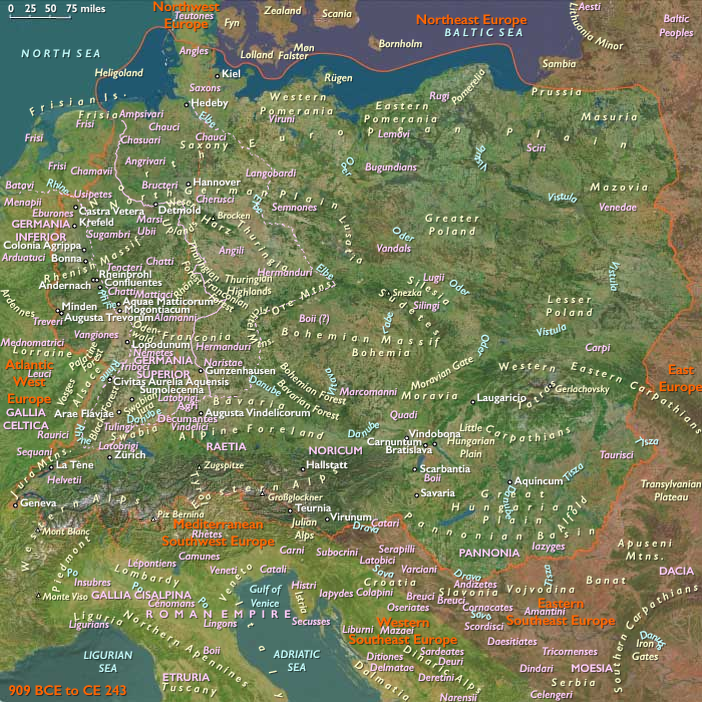
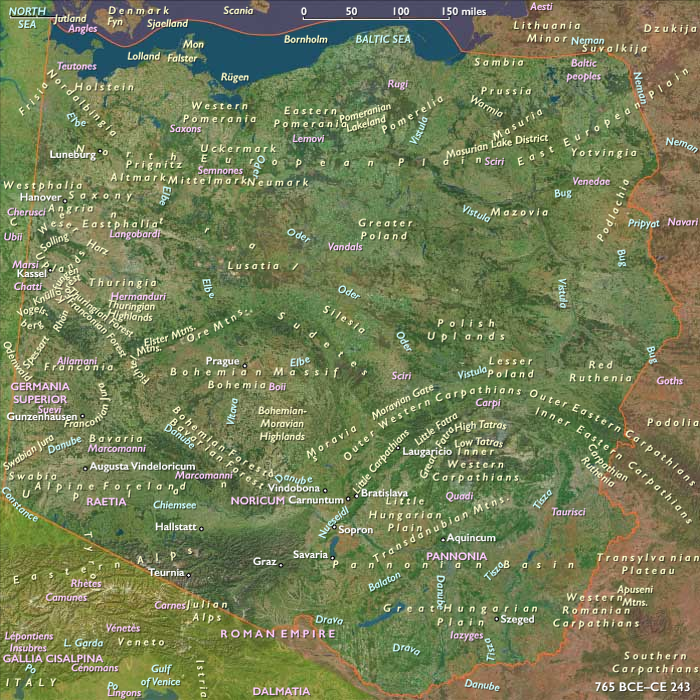
Vindelicia, in the pre-Roman geography of Europe, identifies the country inhabited by the Vindelici, a region bounded on the north by the Danube and (later) the Hadrian's Limes Germanicus, on the east by the Oenus (Inn), on the south by Raetia and on the west by the territory of the Helvetii.
It thus corresponds to the northeast portion of Switzerland, the southeast of Baden, and the south of Württemberg and Bavaria.
The material culture of its inhabitants, the Vindelici, is La Tène.
The ethnic origin of the Vindelici is not certain.
Whether they spoke a Celtic (i.e.
Gaulish), Germanic, or other Indo-European language is unclear.
(A possible etymology of their name includes a Celtic element *windo-, cognate to Irish find- 'white'.)
However, according to a classical source, Servius' commentary on Virgil's Aeneid, the Vindelicians were Liburnians, themselves most probably related to the Veneti.
(A reference in Virgil seems to refer to the Veneti as Liburnians, namely that the "innermost realm of the Liburnians" must have been the goal at which Antenor is said to have arrived.)
Thus, it seems that the ancient Liburnians may have encompassed a wide swathe of the Eastern Alps, from Vindelicia, through Noricum, to the Dalmatian coast.
Together with the neighboring tribes they are subjugated by Tiberius in 15 BCE.
The Augustan inscription of 12 BCE mentions four tribes of the Vindelici among the defeated.
The present city of Augsburg, located at the confluence of the Wertach and Lech rivers in Bavaria, in southern Germany, appears in Strabo as Damasia, a stronghold of the Licatii; in 14 BCE, Drusus and Tiberius, on the orders of their stepfather Emperor Augustus, establish a Roman colony on the site known as Augusta Vindelicorum ("Augusta of the Vindelici").
This garrison camp soon becomes the capital of the Roman province of Raetia.
Locations
People
Groups
Topics
- Classical antiquity
- Roman colonization
- Pre-Roman Iron Age of Northern Europe
- Roman Age Optimum
- Pax Romana
- Roman Northern Frontier Wars of 24 BCE-CE 16
Commodoties
Subjects
- Origins
- Commerce
- Language
- Environment
- Labor and Service
- Conflict
- Faith
- Government
- Technology
- Linguistics
- Geography
Regions
Subregions
Related Events
Showing 10 events out of 62147 total
Years: 15BCE - 15BCE
Locations
People
Groups
Topics
- Classical antiquity
- Roman colonization
- Pre-Roman Iron Age of Northern Europe
- Roman Age Optimum
- Pax Romana
- Roman Northern Frontier Wars of 24 BCE-CE 16
Commodoties
Subjects
- Origins
- Commerce
- Language
- Environment
- Labor and Service
- Conflict
- Faith
- Government
- Technology
- Linguistics
- Geography
Regions
Subregions