
Villard de Honnecourt and His Sketchbook (1220s–1240s): …
Years: 1228 - 1239
Villard de Honnecourt and His Sketchbook (1220s–1240s): A Medieval Polymath
Between the 1220s and 1240s, Villard de Honnecourt compiled a remarkable sketchbook, documenting mechanical devices, architectural details, and artistic studies. Though often described as an itinerant architect, mason, or builder, there is no direct evidence of him working in any specific profession. However, his drawings and notes suggest that he was a keen observer of engineering, construction, and artistic techniques, making him one of the most fascinating figures in medieval science and design.
Villard's Architectural Studies
- Villard traveled to some of the major ecclesiastical building sites of his time, recording architectural innovations in cathedrals such as:
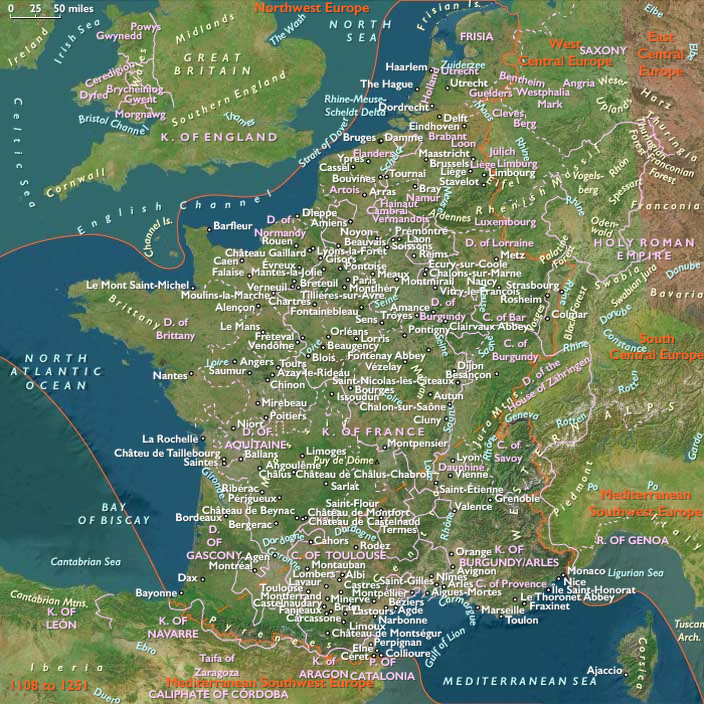
- Laon Cathedral – He sketched one of the west facade towers, documenting Gothic structural elements.
- Reims Cathedral – He made detailed drawings of:
- Radiating chapels.
- A bay of the main vessel (both interior and exterior).
- His sketches serve as valuable records of medieval Gothic architecture, offering insights into construction techniques and stylistic features.
His Possible Mission to Hungary
- Villard proudly claimed to have traveled extensively, including a lengthy stay in Hungary.
- He never specified his purpose, but recent theories suggest he may have been:
- A lay agent of Cambrai Cathedral, possibly tasked with securing a relic of St. Elizabeth of Hungary.
- This theory is supported by the fact that Elizabeth had made a donation to Cambrai Cathedral, which in turn dedicated a radiating chapel to her in its new chevet.
Villard’s Mechanical and Scientific Drawings
Villard’s sketchbook includes a variety of mechanical and engineering devices, demonstrating a broad curiosity beyond architecture. His sketches include:
- Water-driven machinery – A saw powered by water, showing an early understanding of automated industry.
- War engines – A trebuchet, illustrating the advancement of siege warfare in the 13th century.
- Automata – Drawings of self-moving mechanical devices, possibly used for clockwork or church automations.
- Anatomical and geometric sketches – A study of proportions for portraiture and architectural symmetry.
- Perpetual-motion machine – Though physically impossible, this demonstrates medieval interest in energy efficiency and mechanics.
- Escapement mechanism – Villard has been credited with the first known Western drawing of a simple escapement, though this claim is now debated.
A Medieval Renaissance Mind
- Villard’s diverse interests and skill in observation have led scholars to compare him to Leonardo da Vinci, another figure who bridged the gap between art and science.
- His sketchbook provides rare insight into the technological and artistic advancements of the 13th century, demonstrating that medieval scholars engaged in scientific speculation and mechanical innovation.
Though Villard’s exact role in medieval society remains uncertain, his manuscript is a testament to the intellectual curiosity of his age, making him one of the most enigmatic and innovative minds of the High Middle Ages.
Locations
People
Groups
Commodoties
Subjects
Regions
Subregions

Related Events
Showing 3 events out of 3 total
Years: 1228 - 1239
Locations
People
Groups
Commodoties
Subjects
Regions
Subregions