...Vientiane (Lao: "City of Sandalwood"); it is …
Years: 1563 - 1563
...Vientiane (Lao: "City of Sandalwood"); it is today the nation's capital and largest city.
Locations
People
Groups
Commodoties
Subjects
Regions
Subregions
Related Events
Filter results
Showing 10 events out of 35786 total
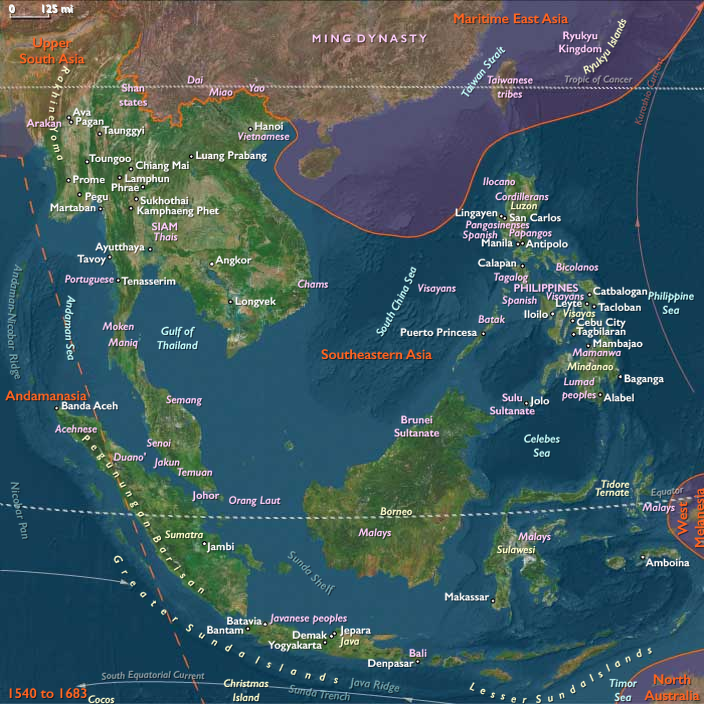
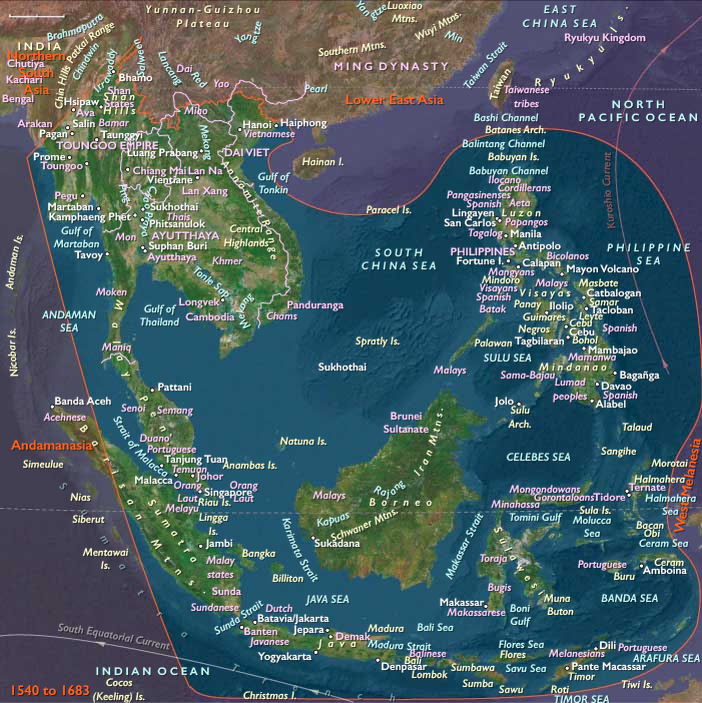
Bayinnaung, advancing southward, his troops using cannon mounted on wooden towers, overruns the Sukhothai area in 1563.
The city of Moung Swa, established as the capital of Laos by King Ngoun in 1353, receives its present name, Luang Prabang (Louangphrabang), in 1563, and continues to serve as the royal residence of the Laotian monarchs.
However, under pressure of the threat from Burma, the Laotians move their capital to ...
Tycho Brahe, born at Knudstrup in Scania, Denmark, has been raised by his uncle, Jorgen Brahe, who had sent the thirteen-year-old in 1559 to Copenhagen to study law.
The observation of a solar eclipse in 1560 had turned Tycho’s interest to observational astronomy and, contrary to his uncle's intentions, he has studied the subject independently, using Ptolemy's Almagest.
Tycho Brahe is sixteen years old in 1563 when he observes the conjunction of Jupiter and Saturn, an event that clearly demonstrates to him the inaccuracy of the existing records of planetary positions.
Giuseppe Arcimboldo, who had painted in his youth for the Milan Cathedral in his native city, had in his middle thirties entered the service of the Habsburgs in Vienna and Prague in 1562, and become court painter to Maximilian.
He paints a Four Seasons series in 1563 in the grotesque style for which he is gaining fame.
Many of his works are paintings of bizarre heads formed by combinations of fruits, flowers, animals, or fish.
Austria and the Ottoman empire conclude a formal peace in 1563 that merely renews the terms of the 1547 accord, perpetuates the three Hungaries: Austrian (Royal), Buda (Ottoman), and Transylvanian.
Menas marches north again, but is defeated at Enderta by Yeshaq.
According to the Royal Chronicle of his reign, which James Bruce follows in his account, the Emperor fell back to Atronsa Maryam to regroup for another assault on the Bahr Negash, but came down with a fever during the march, and died on February 1, 1563, at Kolo.
However, some European writers, such as Hiob Ludolf and Baltazar Téllez, write that Menas was slain fleeing from the battlefield.
Menas’ son Sarsa Dengel is elected king by the Shewan commanders of the army and the Queen Mother.
Upon his coming of age, Bahr negus Yeshaq, who had rebelled against his father, presents himself to Sarsa Dengel and makes peace.
However, Sarsa Dengel has to confront a number of other revolts: his cousin Hamalmal in 1563, another cousin Fasil two years later.
The philanthropist Gracia Mendes Nasi had in 1558 leased Tiberias, in Palestine, from Sultan Suleiman, for a yearly fee of one thousand ducats.
Her nephew and son-in-law Joseph Nasi, a Jewish politician and financier, had in 1561 obtained ruling authority over Tiberias and Safed but fails in his attempts to promote settlement in the area, based on silkworm cultivation and sheepherding.
The "Accademia del Disegno” ("Academy of Design"), the first academy of fine arts, is established in Florence in 1563 under the sponsorship of Duke Cosimo I de' Medici.
Representing an association of thirty-six artists and patrons, including Giorgio Vasari, who has helped to found the institution, the academy concept is an attempt to challenge the powerful and restrictive guild system, in which artists are identified with artisans, and to elevate the status of painters and sculptors.
Such a permanent break requires a drastic revision of the pedagogical system operated by the workshops of the guilds, who offer practical, on-the-job training.
The academy, therefore, formulates a theoretical component they term disegno—the drawing and design that underlie all artistic activity—which embraces the principles of perspective and anatomy.
As the human being is, according to Renaissance humanism, the highest expression of the divine ideal, life drawing anchors academic curricula.
Domenico Campagnola, the only artist of merit working in Padua who represented the new style of the sixteenth century, dies in his late seventies in about 1563.
His painting style, particularly in the handling of large landscapes, had been strongly influenced by the style of Titian, with whom he had worked on the fresco cycle depicting the life of Saint Anthony in Padua’s Scuola di Sant' Antonio.
Campagnola executed three other frescoes in Padua’s Scuola del Carmine.
Also noted as an engraver, Campagnola' landscape drawings are to have the greatest influence on successive generations.
Federico Barocci, born at Urbino, Italy, had received his earliest apprenticeship with his father, Ambrogio Barocci, a sculptor of some local eminence.
He was then apprenticed with the painter Battista Franco in Urbino.
He had accompanied his uncle, Bartolomeo Genga to Pesaro, then in 1548 to Rome, where he had worked in the preeminent studio of the day, that of the Mannerist painters, Taddeo and Federico Zuccari.
After passing four years at Rome, Barocci had returned to his native Urbino, where his first work was a St. Margaret executed for the Confraternity of the Holy Sacrament.
Invited back to Rome by Pope Pius IV to assist in the decoration of the Vatican Belvedere Palace at Rome, he has painted the Virgin Mary and infant, with several Saints and a ceiling in fresco, representing the Annunciation.
While completing the decorations for the Vatican during this second sojourn, Barocci falls ill with intestinal complaints.
Fearing he has been poisoned by jealous rivals, and that his illness is terminal, he leaves Rome in 1563.