
Very few truly believe that rocks found …
Years: 1803 - 1803
Very few truly believe that rocks found on Earth can have extraterrestrial origins.
If they were recognized at all, their origin was controversial, with most commentators agreeing with Aristotle that they were terrestrial, and witnessed meteorite falls had been treated with great skepticism.
There have been anecdotal tales of unusual rocks found on the ground after fireballs had been seen in the sky, but such stories have been often dismissed as fantasy.
Serious debate concerning the unusual rocks had begun in 1794 when German physicist Ernst Florens Friedrich Chladni published a book claiming that rocks had an extraterrestrial origin.(Westrum, Ron. "Science and Social Intelligence about Anomalies: The Case of Meteorites." Social Studies of Science vol. 8, no.4 Nov. 1978. Sage Publications, Ltd. 15 June 2009)
Jean-Baptiste Biot, born in Paris, had served in the artillery before he was appointed professor of mathematics at Beauvais in 1797.
He later went on to become a professor of physics at the Collège de France around 1800, and three years later is elected as a member of the Academy of Sciences.
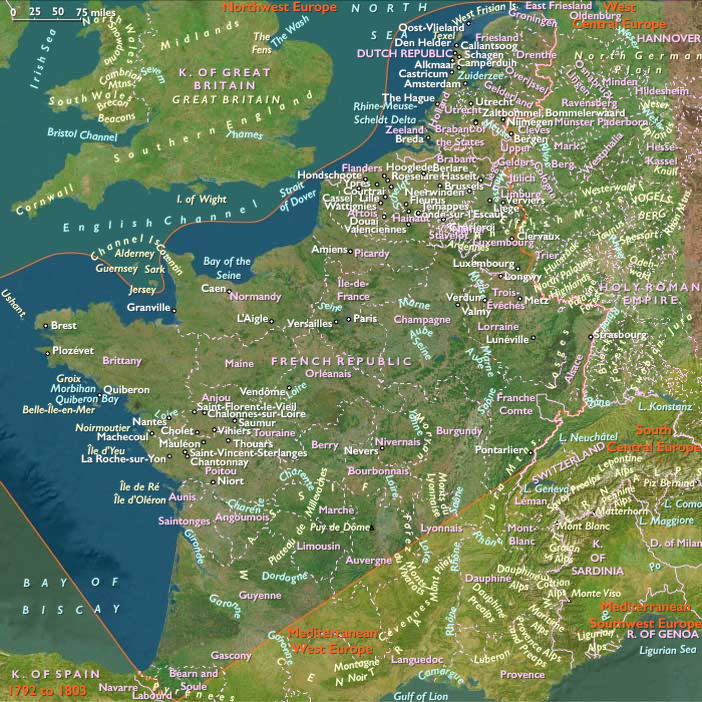
In this year, Biot is sent by the Academy to report back a spectacular meteorite shower of more than three thousand fragments that had fallen upon the town of L'Aigle in Normandy (France) in the early afternoon of April 26, 1803.
After painstaking work in the field, Biot finds that the meteorites, or stones at this time, are from outer space.
Only after he is able to analyze the rocks at l’Aigle is it commonly accepted that the fireballs seen in the sky are meteors falling through the atmosphere.
Since Biot's time, analysis of meteorites has resulted in accurate measurements of the chemical composition of the solar system.
The composition and position of meteors in the solar system have also given astronomers clues as to how the solar system formed.
Locations
People
Groups
Subjects
Regions
Subregions
Related Events
Showing 10 events out of 22565 total
Years: 1803 - 1803
Locations
People
Groups
Subjects
Regions
Subregions