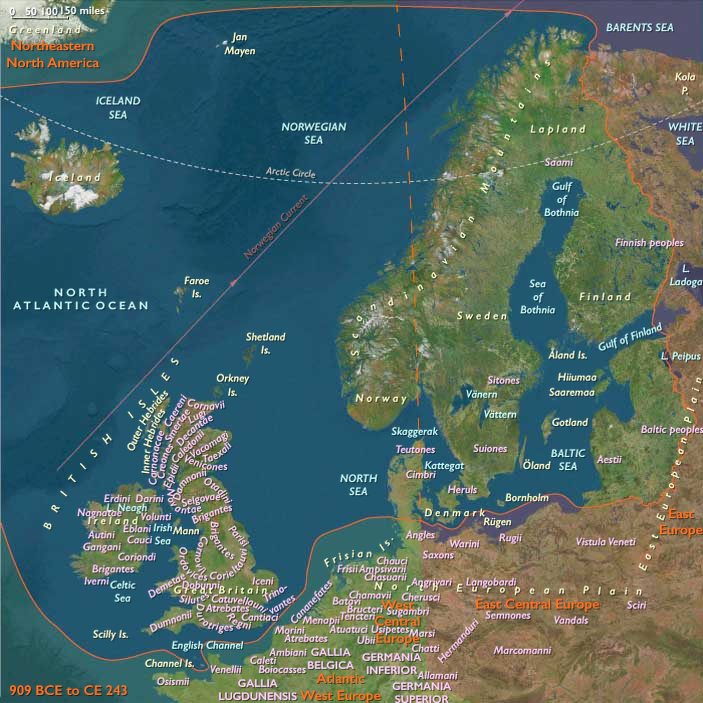
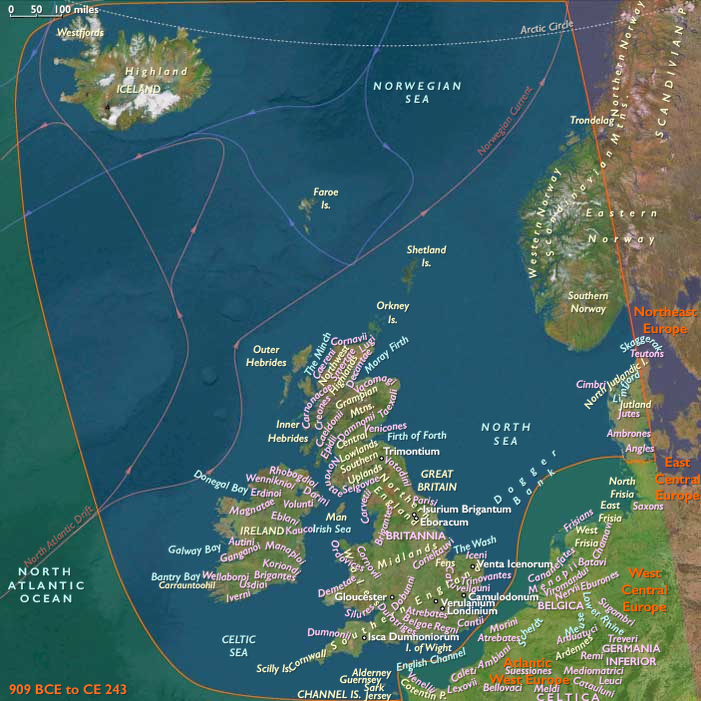
Veranius reverses Didius's policy of maintaining existing …
Years: 58 - 58
Veranius reverses Didius's policy of maintaining existing borders and begins military operations against the troublesome Silures in what is now Wales, but dies within a year.
In his will, he flatters Nero and claims that, had he had another two years, he would have conquered the whole of the island.
He is replaced by Gaius Suetonius Paulinus.
Locations
People
Groups
Topics
- Classical antiquity
- Pre-Roman Iron Age of Northern Europe
- Roman Age Optimum
- Pax Romana
- Roman Conquest of Britain
Commodoties
Subjects
Regions
Subregions
Related Events
Filter results
Showing 7 events out of 7 total
Interior East Africa (1684–1827 CE): Gondarine Splendor, Great Lakes Consolidation, and Expanding Slave Routes
Geographic & Environmental Context
The subregion of Interior East Africa includes Eritrea, Djibouti, Ethiopia, South Sudan, Uganda, Rwanda, Burundi, Zambia, northern Zimbabwe, northern Malawi, northwestern Mozambique, inland Tanzania, and inland Kenya. Anchors include the Ethiopian and Eritrean highlands, the Gondar court, the Great Rift lakes(Victoria, Tanganyika, Turkana, Kivu, Mweru), the interlacustrine plateaus (Rwanda–Burundi–Uganda), and the savanna woodlands of inland Tanzania and Zambia. The Sudd marshes and caravan routes toward the Indian Ocean framed inland polities in both resilience and vulnerability.
Climate & Environmental Shifts
The later Little Ice Age persisted with irregular rains. Ethiopian highlands endured alternating droughts and heavy floods, stressing terrace systems and contributing to famine. Rift lakes fluctuated in volume, influencing fisheries and cropland. Miombo and mopane woodlands in southern zones oscillated between fire-driven openness and denser cover. Pastoral belts in South Sudan and Karamoja experienced pasture shortages in drought years, pushing migration and raiding.
Subsistence & Settlement
-
Highlands (Ethiopia/Eritrea): Terraced plow agriculture of teff, barley, and wheat persisted, supported by oxen traction. Church forests buffered soils; sheep, goats, and cattle remained staples.
-
Great Lakes plateau (Uganda–Rwanda–Burundi): Plantain (matoke), sorghum, millet, beans, and cattle supported dense populations. Tribute systems redistributed grain and livestock to courts.
-
Savannas (Tanzania–Zambia–Malawi–Mozambique): Sorghum, millet, and maize (now firmly entrenched) shaped shifting cultivation. Riverine fisheries and hunting remained important.
-
Pastoral belts (South Sudan–Turkana–Karamoja): Transhumance structured herding calendars; cattle, milk, and meat were central to identity and wealth.
Technology & Material Culture
Stone terraces and canals in the highlands, iron hoes and knives in gardens, barkcloth and raffia weaving in the Great Lakes, and canoe construction for lakes and rivers structured daily life. Court regalia included drums, ivory trumpets, and beaded stools. Firearms appeared more widely by the 18th century, especially along coastal-linked caravan routes, supplementing spears and shields. Manuscript culture thrived in Gondar, where illuminated texts and crosses embodied Christian devotion.
Movement & Interaction Corridors
-
Ethiopian highlands: Caravans carried salt, honey, and grain to Red Sea markets, but civil wars curtailed long-distance trade.
-
Great Lakes: Canoe corridors on Victoria and Tanganyika linked fishing zones to courtly capitals.
-
Savanna caravans: Ivory, slaves, and copper moved from central Zambia and Tanzania toward Indian Ocean entrepôts like Kilwa, Bagamoyo, and Mozambique Island.
-
Lake Chad–Nile corridor: Connected South Sudan cattle zones to northern caravans, exchanging gum, captives, and ivory.
Cultural & Symbolic Expressions
-
Highlands: The Gondarine era (17th–18th centuries) produced stone castles, muraled churches, and court chronicles. Christianity structured feast calendars, monasteries, and pilgrimages.
-
Great Lakes: Courts elaborated kingship with regnal drums, sacred groves, and oral epics. Clientship systems (ubuhake, ubugabire) bound households to lords, while rainmaking rituals legitimated rulers.
-
Pastoral belts: Cattle rituals, age-grade ceremonies, and clan shrines regulated law, fertility, and conflict. Praise songs and cattle names encoded history.
Environmental Adaptation & Resilience
Multicropping, terrace rotation, and communal grain stores buffered highland famine. Plateau cultivators relied on perennial banana gardens, mulch, and intercropping to stabilize soils. Savanna farmers adopted maize into cropping cycles, diversifying risk. Pastoralists expanded dry-season wells and broadened grazing circuits; ritual prohibitions on slaughter preserved herds during scarcity. Fishing communities smoked and dried catches, stabilizing diets.
Technology & Power Shifts (Conflict Dynamics)
-
Ethiopia: After Fasilides expelled Jesuits, the Gondar court flourished architecturally but fractured politically; the 18th century saw the Zemene Mesafint (Era of Princes), when regional lords and Oromo chiefs contested the monarchy. Firearms entered factional wars via Red Sea and Somali corridors.
-
Great Lakes: Buganda expanded aggressively along Lake Victoria, building fleets of canoes and enlarging tributary networks; Bunyoro fought to preserve hegemony. Rwanda centralized hills under Nyiginya rulers through cattle-clientship and intensified tribute. Burundi balanced royal drums and hill chieftaincies.
-
Savannas: Slave and ivory raiding expanded as coastal demand grew. Inland wars supplied captives for Indian Ocean markets.
Transition
By 1827 CE, Interior East Africa stood divided between splendor and strain. The Ethiopian highlands retained Christian identity but endured political fragmentation. The Great Lakes kingdoms—Buganda ascendant, Rwanda consolidating—expanded statecraft and tribute systems. Inland Tanzania and Zambia had become enmeshed in ivory and slave caravans bound for the coast. Pastoralists adapted herds to climatic volatility while facing rising raiding pressures. The region was primed for deeper Indian Ocean entanglement and, by the mid-19th century, for intensified colonial intrusion.

The Emperors become figureheads, controlled by warlords like Ras Mikael Sehul of Tigray, Ras Wolde Selassie of Tigray, and by the Yejju Oromo dynasty, such as Ras Gugsa of Yejju, which later leads to nineteenth-century Oromo rule of Gondar, changing the language of the court from Amharic to Afaan Oromo.
Traditionally, the beginning of this period is set on the date Ras Mikael Sehul deposes Emperor Iyoas (May 7, 1769), and its end to Kassa's coronation as Emperor Tewodros II (February 11, 1855), having defeated in battle all of his rivals.
Some historians date the murder of Iyasu the Great (October 13, 1706), and the resultant decline in the prestige of the dynasty, as the beginning of this period.
Others date it to the beginning of Iyoas's reign (June 26, 1755).
During the Zemene Mesafint, various lords come to abuse their positions by making Emperors and encroach upon the succession of the dynasty, by candidates among the nobility itself: for example, on the death of Emperor Tewoflos in 1711, the chief nobles of Ethiopia fear that the cycle of vengeance that had characterized the reigns of Tewoflos and Tekle Haymanot I (1706–1708) will continue if a member of the Solomonic dynasty is picked for the throne, so they select one of their own, Yostos, to be King of Kings (nəgusä nägäst).
However, the tenure of Yostos from 1711 to 1716 is brief, and the throne comes into the hands of the Solomonic house once again.
Interior East Africa (1780–1791 CE): Transition to the Wara Seh Dynasty
The years between 1780 and 1791 constituted a critical transitional period in Ethiopian history, marked by the further erosion of imperial authority and the rise of influential regional figures who came to dominate the political landscape. Emperor Tekle Giyorgis I, who first ascended the throne in 1779, struggled to reassert imperial dominance and reclaim the central powers traditionally vested in the monarchy. His ambitious efforts, however, soon encountered staunch opposition from powerful regional nobles and military commanders who had grown accustomed to autonomy and resisted any attempts to curtail their influence.
In early 1784, Ras Ali I, the powerful Ras of Begemder, decisively defeated Emperor Tekle Giyorgis at the Battle of Afara Wanat, effectively deposing him and signaling a new phase of Ethiopian politics. In Tekle Giyorgis's place, Ras Ali installed Iyasu III, an emperor who served merely as a puppet, entirely subordinate to the interests of regional strongmen. This event heralded the emergence of the Wara Seh dynasty, originating from the powerful Oromo clan of Yejju, who would dominate the political scene for decades as Enderases—regents wielding actual control behind figurehead emperors.
Following Ras Ali I’s ascent as Ras bitwadad (chief regent), power passed to his brother, Ras Aligaz. After Ras Aligaz's death, control shifted temporarily to Ras Wolde Selassie, the hereditary ruler of Enderta and overlord of Tigray, briefly interrupting the Wara Seh dominion. Upon Ras Wolde Selassie's death, authority reverted to the Wara Seh lineage, with Ras Gugsa, Ras Aligaz's nephew, assuming power. Ras Gugsa’s sons—Ras Yimam, Ras Mariye, and Ras Dori—successively wielded considerable influence, perpetuating the era’s political fragmentation.
Ultimately, the power of the Wara Seh dynasty culminated in the figure of Ras Ali II, Ras Gugsa's nephew, who later became the prominent Enderase. Throughout this era, Amha Iyasus, Meridazmach of Shewa (1744–1775), and his successors strategically remained detached from these tumultuous power struggles, instead concentrating on consolidating their own domains and enhancing the stability of their territory. Amha Iyasus notably founded Ankober, establishing a precedent of relative political independence that his descendants continued to uphold amid the broader imperial chaos.
During this era, regional powers in the interior highlands and along the coast navigated shifting alliances, as local sultanates and pastoral groups sought autonomy from centralized imperial influence, further fragmenting Ethiopia’s traditional unity.
Interior East Africa (1804–1815 CE): Consolidation of Ras Wolde Selassie and Early European Contact
During the early years of the nineteenth century, Ras Wolde Selassie continued to consolidate his position as the dominant political force in Ethiopia. Making Chelekot his administrative center and maintaining his capital at Antalo in Enderta Province, Wolde Selassie undertook significant building projects that underscored his power and influence. Notably, he constructed palaces at Chelekot, Antalo, Felegdaro, and Mekelle, all within Enderta, reinforcing the region's central importance under his rule.
Wolde Selassie's influence extended significantly into imperial politics. He sheltered Emperor Tekle Giyorgis I during turbulent periods between 1799 and 1800 and hosted former Emperor Baeda Maryam in 1813. Although initially cooperative with Ras Aligaz, the Imperial Regent, Wolde Selassie increasingly challenged him for power, particularly after Ras Aligaz’s death in 1803. By this period, Ras Wolde Selassie had become Ethiopia's most formidable leader, surpassing other influential regional rulers such as Ras Gugsa of Gojam, Ras Aligaz of Yejju, and the Oromo chieftain Gojje. His dominion extended across vast provinces, where he personally addressed grievances, rebellions, disputes, and inheritances, further solidifying his authoritative rule.
Significantly, Ras Wolde Selassie was the first major Ethiopian leader of this period to establish close relations with Europeans. In 1805, he hosted British diplomats including George Annesley, Viscount Valentia, his secretary Henry Salt, and adventurer Nathaniel Pearce. Their visit culminated in a treaty of friendship between Ethiopia and Great Britain. Recognizing potential economic benefits, Wolde Selassie actively encouraged British commerce, although he pragmatically expressed concerns regarding Ethiopia's limited exportable commodities and the geopolitical constraints posed by Egyptian control of the vital Red Sea port of Massawa.
Despite these challenges, Ras Wolde Selassie's diplomatic initiatives laid important groundwork for future international relations. His contacts with Britain foreshadowed later interactions and negotiations by successors such as Dejazmatch Wube of Semien and Tigray and ultimately, Emperor Yohannes IV. Nathaniel Pearce’s detailed accounts from his prolonged stay (approximately 1808–1816) with Ras Wolde Selassie provide invaluable insights into daily Ethiopian life and political intricacies, offering a rare, detailed European perspective on this transformative era in Ethiopian history.
He builds four palaces, at Chelekot, Antalo, Felegdaro and Mekelle, all in Enderta.
He plays a role in the politics of the Imperial Throne, in part by providing shelter to Emperor Tekle Giyorgis I in 1799 and 1800, and is visited by the former Emperor Baeda Maryam in 1813.
Although at first he had cooperated with Ras Aligaz, the Imperial Regent, after his power grew, Wolde Selassie had come to challenge Aligaz for that office prior to Aligaz's death in 1803.
Ras Wolde Selassie is known to have had wielded the most power during his reign, exceeding formidable rases such as Ras Aligaz of Yejju, Ras Gugsa of Gojam and the Oromo chieftain Gojje; and throughout his vast provinces and districts, all kinds of crimes, grievances, rebellions, disputes and inheritances are directly referred to him and most wars are carried out by himself in person.
According to Paul Henze, Ras Wolde Selassie is the first ruler of this period to have close contact with Europeans, hosting three British diplomats, George Annesley, Viscount Valentia, his secretary Henry Salt, and Nathaniel Pearce.
Salt's arrival in Abyssinia culminates in the signing of a treaty of friendship with Wolde Selassie representing Abyssinia and the former representing Great Britain in 1805.
Henry Salt also proposes inaugurating trade with Britain; Wolde Selassie is quick to see possible advantages in relations with Britain and promises to encourage such commerce with every means in his power.
Revealing himself a realist, and speaking, Salt says, with 'great sincerity', he nevertheless expresses the fear that his country
might not be able to supply any quantity of valuable commodities sufficient to recompense our merchants for engaging in so precarious a trade; more especially as the Abyssinians were not much acquainted with commercial transactions...Could any plan, however, be arranged for obviating these difficulties...he would most readily concur in carrying it into effect.
Wolde Selassie also touches on a major obstacle that the Ethiopians had faced, the Egyptians have control over the port of Massawa which they have acquired from the Ottoman Empire and remind King George that with their "naval superiority in the red sea" Abyssinia might find it difficult to gain access to the port.
Wolde Sellasie's effort, however, will bear fruit in the long term when his successors Dejazmatch Wube of Semien and Tigray and Emperor Yohannes of Ethiopia follow up on the treaty that is struck between him and the kingdom of Britain.
Nathaniel Pearce lives with Ras Wolde from about 1808 and the warlord's death.
Pearce's diary of his stay is not only valuable for the history of this period, but also provides enormous detail about daily life in Ethiopia.
Interior East Africa (1816–1827 CE): Succession After Ras Wolde Selassie and the Continued Fragmentation of Ethiopia
The death of Ras Wolde Selassie in 1816 at the age of eighty at his residence in Hintalo, Enderta marked the end of a stabilizing period in Ethiopian history. His passing was widely mourned, as Wolde Selassie had been a unifying force who maintained a degree of central authority during an otherwise tumultuous era. With his departure, Ethiopia quickly returned to the patterns of decentralized governance and regional factionalism that characterized the Zemene Mesafint ("Era of Princes").
Political power initially passed to Ras Gugsa, a nephew of the former regent Ras Aligaz, who continued the influential Wara Seh dynasty's dominance. Gugsa swiftly consolidated his position, further empowering his sons—Ras Yimam, Ras Mariye, and Ras Dori—each of whom served as Enderase (regent) at various points. The subsequent period was marked by intensified internal rivalries among powerful regional warlords, who constantly maneuvered for supremacy while the imperial throne remained effectively symbolic.
This persistent political fragmentation deepened the weakening of central authority and intensified local conflicts throughout the Ethiopian highlands. Provinces such as Shewa continued to operate with substantial autonomy under local rulers, notably the descendants of Meridazmach Asfa Wossen, who strengthened Shewa's political and economic position independent of Gondar. Simultaneously, the Yejju Oromo nobility's political ascendancy reaffirmed their pivotal role in the Empire’s governance, perpetuating the instability that prevented any long-term centralization.
The ongoing decentralization and turmoil set the stage for future leaders who would seek to reunify the empire. Among these was Kassa Hailu, who would eventually rise as the future Emperor Tewodros II, determined to restore centralized authority and national unity.
Power is transferred to Ras Aligaz's nephew, Ras Gugsa, who in turn will transfer power to his sons Ras Yimam, Ras Mariye and Ras Dori.
Years: 58 - 58
Locations
People
Groups
Topics
- Classical antiquity
- Pre-Roman Iron Age of Northern Europe
- Roman Age Optimum
- Pax Romana
- Roman Conquest of Britain