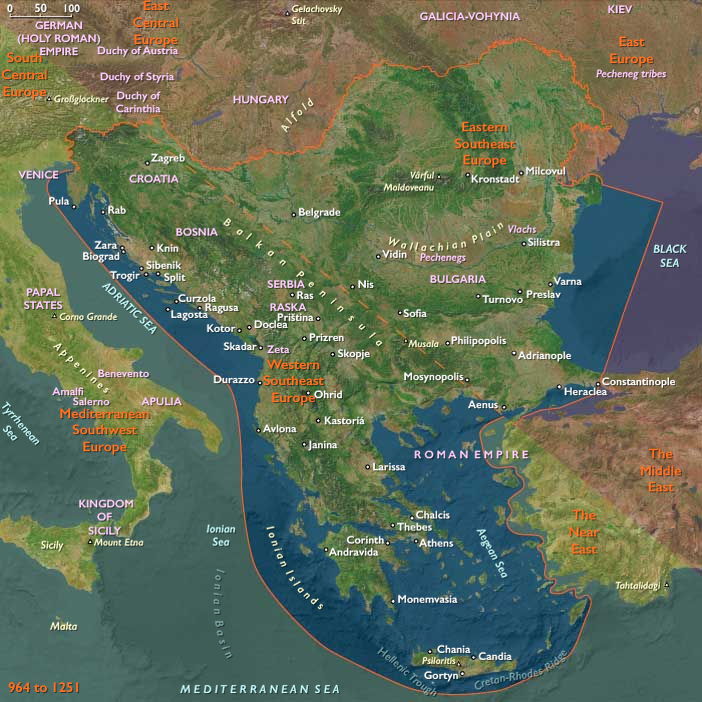
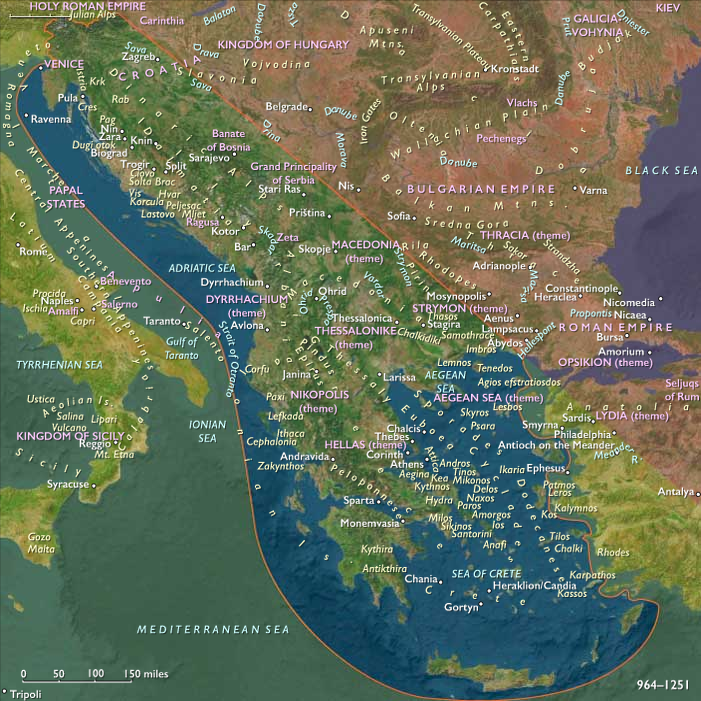
Venice, with aid from the Norman kingdom …
Years: 1172 - 1172
Venice, with aid from the Norman kingdom of Sicily in 1172, seizes Ragusa and …
Locations
People
Groups
- Greeks, Medieval (Byzantines)
- Hungary, Kingdom of
- Dalmatia region
- Roman Empire, Eastern: Komnenos dynasty, restored
- Italo-Normans
- Sicily, Kingdom of
- Venice, (Most Serene) Republic of
Topics
Commodoties
Subjects
Regions
Subregions
Related Events
Filter results
Showing 10 events out of 48349 total
Il-Arslan had in 1152 been made governor of Jand, an outpost on the Syr Darya which had recently been reconquered, by his father, the Shah of Khwarezm.
When Atsïz died in 1156, Il-Arslan had succeeded him as Khwarazm-Shah.
Like his father, he was tributary to both the Seljuq sultan Sanjar and the Kara-Khitai gurkhan.
Il-Arslan had become involved in 1158 in the affairs of another Kara-Khitai vassal state, the Kara-Khanids of Samarkand.
The Karakhanid Chaghrï Khan had been persecuting the Karluks in his realm, and several Karluk leaders had fled to Khwarezm and sought Il-Arslan's help.
He responded by invading the Kara-Khanid dominions, taking Bukhara and besieging Samarkand, where Chaghrï Khan had taken refuge.
The latter appealed to both the Turks of the Syr Darya and the Qara Khitai, and the gurkhan sends an army, but its commander hesitates to enter into conflict with the Khwarazmis.
In the end, a peace is mediated in which Chaghrï Khan is forced to take back the Karluk leaders and restore them to their former positions.
Sanjar had died only a few months after Il-Arslan's ascension, causing Seljuq Khurasan to descend into chaos and allowing Il-Arslan to effectively break off Seljuq suzerainty, although he had remained on friendly terms with Sanjar's successor, Mas'ud.
They are alleged to have attempted to create a joint campaign against the Kara-Khitai, but such an alliance never occurred.
Like his father, Il-Arslan seeks to expand his influence in Khurasan, and in the 1160s had taken an active interest in the area by supplying armies to local allies, but despite the collapse of central Seljuq authority in that area, he had been unable to make any significant headway against the regional rulers.
The Kara-Khitai launch a punitive expedition in 1172 against Il-Arslan, who has not paid the required annual tribute.
The shah collects his army but soon becomes sick and turns over his forces to one of his lieutenants.
The Khwarezmi army is defeated, however, and Il-Arslan dies shortly after.
Following his death, the state briefly becomes embroiled in turmoil, as the succession is disputed between his sons Ala ad-Din Tekish and Sultan Shah.
Sultan Shah is the younger son, but he is considered the formal heir and his mother, Terken Khatun, places him on the throne.
The elder son, Ala ad-Din Tekish, flees to the Kara-Khitai and asks for them to enthrone him in place of his brother, promising an annual tribute in exchange.
He is given a large army, and he soon sets off for Khwarezm.
Sultan Shah and his mother, upon hearing of Tekish's approach, decide to flee, and Tekish installs himself in Khwarazm unopposed in December 1172.

Stephen III of Hungary had married a daughter of Yaroslav Osmomysl of Halych, in 1167 but he had repudiated her in 1168 and sent her back to her father.
Stephen had then married Agnes of Austria, a daughter of Duke Henry II of Austria, shortly after and launched a campaign against the Constantinople with the support of his father-in-law, but their troops had been defeated near Zimony.
Stephen has raised money to fund the expenses of his continuous wars with the Empire by using the goods of the Church, which had resulted in a conflict with Archbishop Lukas, who imposed ecclesiastical punishment on him.
The conflict had been solved by the Papal Legate Manfred, who had persuaded Stephen to renounce the right of investiture.
Stephen has granted estates to the Knights Templar in Hungary, and he is the first king of Hungary to issue a charter for a town, i.e., for the Walloon hospes of Székesfehérvár.
Stephen meets his father-in-law, who is on a pilgrimage to the Holy Land, in 1172, but during the meeting the Hungarian monarch suddenly falls ill and dies.
He is buried in Esztergom.
Manuel, interfering forcefully in Hungarian dynastic struggles that follow the death of King Stephen III, is rewarded when his candidate, Béla, is elected king in 1172.
Béla is the second son of King Géza II of Hungary by his wife Euphrosyne of Kiev.
In 1161, his father had granted him the Duchies of Croatia and Dalmatia as appanage, which was later confirmed by his brother, King Stephen III, who had ascended the throne after their father's death on 31 May 1162.
In 1164, Emperor Manuel I Komnenos had concluded a treaty with King Stephen, and according to the treaty, Béla had been sent to Constantinople to be educated at the imperial court.
The emperor, who had no legitimate sons, had intended that Béla should marry his daughter, Maria Komnene, and eventually succeed him as Emperor.
Béla has received a Greek name, Alexios, and the newly created courtly title of despotes, which enjoys the highest position of honor below the emperor.
Béla had followed the Emperor in 1164 and 1165 on his campaigns against Hungary, which had aimed at the occupation of Béla's "paternal inheritance", i.e., Croatia, Dalmatia and Syrmia.
However, when King Stephen III transferred the three provinces to Manuel I, they had been incorporated into the Empire.
In the autumn of 1165, Mánuel had officially assigned his daughter and Béla as his heirs.
In the beginning of 1166, Manuel I and Béla had co-chaired the synod of the Orthodox Church in Constantinople.
When Alexios II was born as a son of Manuel and his second wife Maria of Antioch in 1169, Béla's engagement to Maria had been canceled.
Béla had been deprived also of his title, and he was granted the lower title of kaisar, but Manuel had helped negotiate another marriage for him, this time to Agnes of Antioch, who is the half-sister of Maria of Antioch; therefore by this marriage Manuel I and Béla have become brothers-in-law.
After their marriage, Béla (Kaisar Alexios) and his wife go on a pilgrimage to Jerusalem, where he makes a donation for the Knights Hospitaller.
…sacks the imperial possessions of Chios and …
…Lesbos.
Ramon Berenguer III, Count of Barcelona, had in 1111 inherited the fief of Besalú, to which Cerdanya had been added in 1117.
The possession of Roussillon by its last count, Girard II, had been challenged by his illegitimate brothers.
To ensure that his brothers would not inherit his territories, in his will Girard II leaves all his lands to Alfonso II of Aragon, who takes possession in 1172.
Under the Aragonese monarchs, economic and demographic growth of the region will continue, and Collioure, the port of Perpignan, will become an important locus of Mediterranean trade.
It is widely believed that Murcia's name is derived from the Latin words of Myrtea or Murtea, meaning land of Myrtle (the plant is known to grow in the general area), although it may also be a derivation of the word Murtia, which would mean Murtius Village (Murtius was a common Roman name).
Other research suggests that it may owe its name to the Latin Murtae (Mulberry), which covered the regional landscape for many centuries.
The Latin name eventually changed into the Arabic Mursiya, and then, Murcia.
The city in its present location was founded with the name Madinat Mursiyah (city of Murcia) in 825 by Abd ar-Rahman II, who was then the emir of Córdoba.
Muslim planners, taking advantage of the course of the river Segura, had created a complex network of irrigation channels that make the town's agricultural existence prosperous.
After the fall of the Caliphate of Cordoba in 1031, Murcia had passed under the successive rules of the powers seated variously at Almería, Toledo and Seville.
After the fall of Almoravid empire, Muhammad Ibn Mardanis had made Murcia the capital of an independent kingdom.
At this time, Murcia is a very prosperous city, famous for its ceramics, exported to Italian towns, as well as for silk and paper industries, the first in Europe.
The coinage of Murcia is considered as model in all the continent.
The mystic Ibn Arabi (1165–1240) and the poet Ibn al-Jinan (d.1214) are born in Murcia during this period.
The twelfth century traveler and writer Muhammad al-Idrisi describes the city of Murcia as populous and strongly fortified.
Murcia’s ruler ibn-Mardinish, at his death in 1172, advises his son to accept the suzerainty of the Almohad caliph, thereby bringing al-Andalus entirely under Almohad rule.
Murcia becomes a province of the Almohad empire, which allows it much autonomy.
The Venetian doge, in financing an expedition to retake the Dalmatian coastal cities of Zara (Zadar) and Ragusa (Dubrovnik) and the Aegean seaport of Negropont (Chalcis), issues the first government bonds.
Construction begins in 1172 on the “campanile” (bell tower) of the Cathedral of Pisa, executed in the Tuscan Romanesque style and incorporating wood ceilings and classical forms.
Years: 1172 - 1172
Locations
People
Groups
- Greeks, Medieval (Byzantines)
- Hungary, Kingdom of
- Dalmatia region
- Roman Empire, Eastern: Komnenos dynasty, restored
- Italo-Normans
- Sicily, Kingdom of
- Venice, (Most Serene) Republic of