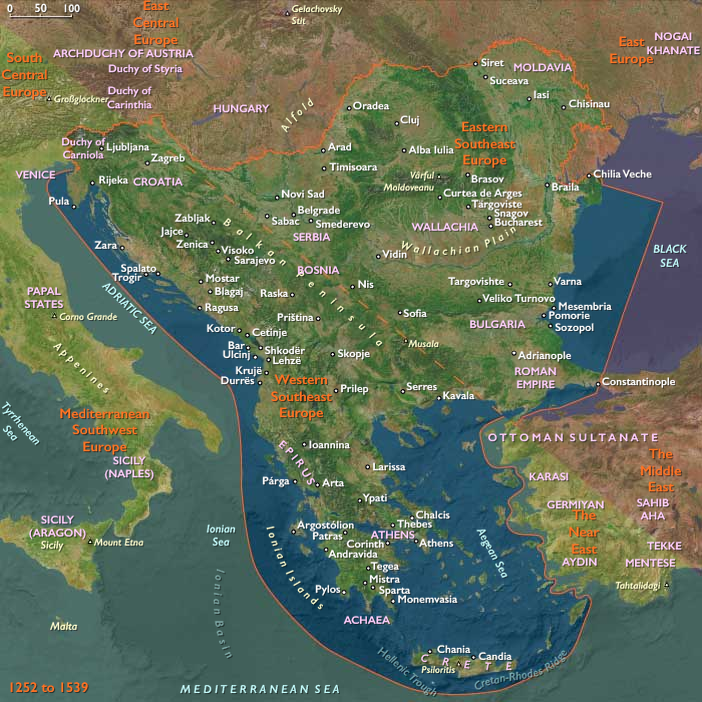
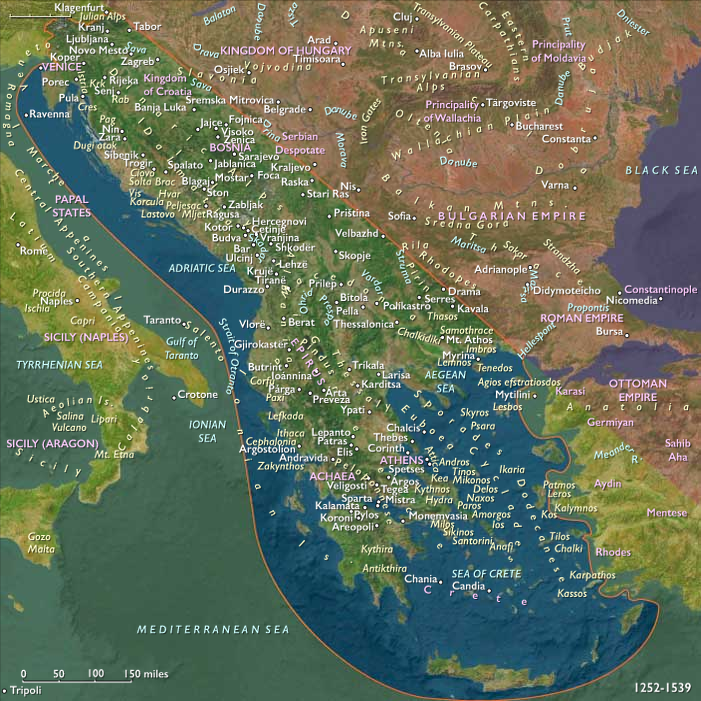
Venetian raiders capture Chios from its Genoese …
Years: 1285 - 1285
Venetian raiders capture Chios from its Genoese lords in April 1285; it is later retaken.
Locations
Groups
Topics
Commodoties
Subjects
Regions
Subregions
Related Events
Filter results
Showing 10 events out of 45431 total
Kublai Khan demands passage through Dai Viet for his Yuan army in order to invade of the Kingdom of Champa (in modern central Viet Nam) in 128.
When the Dai Viet Emperor Tran Nhan Tông refuses, the Mongol army, led by Prince Toghan, attacks Dai Viet and captures the imperial capital Thăng Long (modern day Hanoi).
The Viet nobility retreats to the south after burning down the city, depriving the Mongol army of spoils.
Tran Hung Dao and other generals escort the royal family, staying just ahead of the Mongol army in hot pursuit.
When the Mongol army has exhausted their supplies and succumb to tropical diseases, Tran Hung Dao exploits the Mongol's weaknesses and launches counteroffensive strikes.
He manages to draw the Mongol armies into naval battles, leaving the Mongols unable to launch their overpowering cavalry effectively.
The Viet naval force's excellent marine warfare skills are a tactical advantage for the Dai Viet’s military campaign.
The Mongol cavalry commander Sogetu of the southern front is killed in the battle.
In their withdrawal from Dai Viet, the Mongols are also attacked by the Hmong and Yao minorities in the northern regions during their retreat back to Yuan China.
The period between 1281/1282 (Traidenis's death) and 1289 (rule of Butegeidis) is one of the most poorly documented periods in the history of Lithuania.
The only recorded information about the Grand Duke of Lithuania during this time is a short note from 1285.
Seven Russian chronicles—Laurentian, Simeon, Typographical, Nikon, Resurrection, Avraamki, Yermolin—record the same brief story that in March or August 1285 Lithuanians, led by Grand Duke Daumantas, attacked the domain of Simeon, Bishop of Tver.
In particular, the Lithuanians attacked the Oleshnya volost of the Principality of Tver.
The location of the Oleshnya volost is unknown, but historians have identified three possibilities – Vladimir Borzakovskiy argued for the village of Aleshevo in Zubtsov uyezd, Vladimir Kuchkin argued for the area between the Sheshma and Vazuza Rivers, local historian Leletsky argued for area around the Aleshnya River, tributary oft he Gzhat River.
A day before the feast of the Transfiguration of Jesus (August 6), the Lithuanian army is defeated by united forces of Tver, Moscow, Volokolamsk, Torzhok, Dmitrov, Zubtsov, and Rzhev.
Four chronicles mention that Daumantas was taken into captivity, while others say he was killed.
That is all the information that is available about Daumantas.
The reason for Daumantas' invasion of Tver is not known.
Chronicles also record another raid by the Lithuanians to Novgorod Republic in winter 1285, but it is possible that the dates were mixed up and the raid took place before Daumantas' invasion.
These two raids into Russian lands indicate a new direction in Lithuanian interests as Traidenis had concentrated on the Livonian Order, Black Ruthenia, and Galicia–Volhynia.
Historians attempted to place the two raids in the context of sibling rivalry in Novgorod between Dmitry and Andrei, sons of Alexander Nevsky, or succession in Tver by fourteen-year old Mikhail of Tver, but no definite conclusions can be made due to lack of written sources.
Nogai Khan and Talabuga Khan invade Hungary with Mongol and Cuman troops in 1284-1285, but, unlike Subutai forty years earlier, they are defeated.
The Mongols ravage Transylvania, but are beaten by the Hungarian royal army under Ladislaus IV of Hungary near Pest, and the retreating Mongol forces are ambushed by the Szekely.
An emission of life annuities is first recorded in 1285 by the city of Lübeck.
The first instance of issue of public debt in Germany, it confirms a trend of consolidation of local public debt over northwestern Europe. (Zuijderduijn, Jaco (2009). Medieval Capital Markets. Markets for renten, state formation and private investment in Holland (1300-1550). Leiden/Boston: Brill.)
Archbishop Jakub Świnka, on January 6, 1285, orders all priests subject to his bishopry in Poland to deliver sermons in Polish rather than German, thus further unifying the Catholic Church in Poland and fostering a national identity.
Margat is located on a hill formed by an extinct volcano about three hundred and sixty meters (1,180 ft) above sea level on the road between Tripoli and Latakia, overlooking the Mediterranean Sea.
According to Arab sources, the site of Margat Castle was first fortified in 1062 by Muslims who continued to hold it within the Christian Principality of Antioch in the aftermath of the First Crusade.
When the Principality was defeated at the Battle of Harran in 1104, the East Roman Empire took advantage of their weakness and captured Margat from the Muslims.
A few years later it was captured by Tancred, Prince of Galilee, regent of Antioch, and became part of the Principality.
It was controlled in the 1170s by Reynald II Mazoir of Antioch as a vassal of the count of Tripoli.
The fortress was so large that it had its own household officials and a number of rear-vassals.
Reynaud's son Bertrand sold it to the Hospitallers in 1186 as it was too expensive for the Mazoir family to maintain.
After some rebuilding and expansion by the Hospitallers it became their headquarters in Syria.
Under Hospitaller control, its fourteen towers were thought to be impregnable.
Saladin marched on Margat in 1188, having left Krak des Chevaliers in search of easier prey.
According to Abu'l-Fida, "Recognizing that Maqab was impregnable and that he had no hope of capturing it, he passed on to Jabala".
(Kennedy, Hugh (1994), Crusader Castles, Cambridge: Cambridge University Press, p. 164) It was one of the few remaining territories left in Christian hands after Saladin's conquests.
By the beginning of the thirteenth century, the Hospitallers controlled the surrounding land and roads and made a large profit from travelers and pilgrims passing through.
Isaac Komnenos of Cyprus was imprisoned here after Richard I of England captured Cyprus from him during the Third Crusade.
The bishop of nearby Valenia also used Margat as his headquarters after around 1240.
Margat is second in size and power only to the other Hospitaller fortress to the south, Krak des Chevaliers.
In September 1281 the Hospitallers of Margat had dispatched a contingent of troops to support the Mongol invasion of Syria, which the Mamluk sultan of Egypt Qalawun had successfully prevented after defeating the coalition at Homs.
To punish the Hospitallers, Qalawun clandestinely raises an army in Damascus and besieges Margat on April 17, 1285.
After a thirty-eight day siege, during which sappers and miners manage to dig several tunnels underneath the fortress's walls, a mine destroys a salient of the southernmost wall.
The defenders panic and on discovering the numerous tunnels around the fortress, surrender to the Mamluk commander Fakhr al-Din Mukri on May 23, with Qalwun entering Margat two days later.
The siege was witnessed by eleven-year old Abu'l Fida and his father, the Ayyubid governor of Hama.
Qalawun allows the Hospitallers to leave with everything they can carry.
Rather than destroy Margat as he did with other fortresses, he repairs its defenses and places a strong garrison here due to its strategic value.

John II of Jerusalem had succeeded his father Hugh III as King of Cyprus (as John I) on March 24 and was crowned at Santa Sophia, Nicosia on May 11, 1284.
His succession as King of Jerusalem had been opposed by Charles of Anjou, who had also disrupted his father's succession.
John died the following year on May 20, having never married and leaving no children.
He is buried in the church of St. Demetrius or according to some Santa Sophia, in Nicosia.
According to some authors he was poisoned by his brothers, one of whom, Henry II, succeeds him in Cyprus and Jerusalem.
Henry II is crowned at Santa Sophia, Nicosia, June 24, 1285.
Charles of Anjou, who contested John's claim to the throne, had died earlier on the year 1285, allowing Henry to recover Acre from the Angevins.
The French camp is hit hard by an epidemic of dysentery on the heels of the naval loss.
Philip himself is afflicted.
The heir to the French throne, the future Philip IV, opens negotiations with Peter for free passage for the royal family through the Pyrenees,.
The pass around the massif of Albères (five hundred and sixty-eight meters) was the main route through the Pyrenees in Antiquity.
The Romans called it the Summum Pyrenæum.
It had since been superseded by the Col de Perthus one kilometer to the northeast.
The Aragonese troops, saving promised to leave the passage to the French king and his family, content themselves with attacking the retreating French army, decimated by dysentery.
Peter entrusts the vanguard to Ramon de Montcada and his Almogàvers, who massacre the fatigued French but spare the royal family.
This first attack is followed up by a second attack by Roger de Lauria, the admiral of the fleet which had defeated the French at Les Formigues and had then disembarked to fight on land.
The result of all this is a rout: the French are decimated further and it is a complete Aragonese victory.
According to the chronicle of Ramon Muntaner, the festivities of celebration last eight days in Barcelona.
The king of France himself dies on October 5 at Perpignan, the capital of James of Majorca, and is buried in …
…Narbonne.