
Veleda, a völva (priestess and prophet) of …
Years: 69 - 69
December
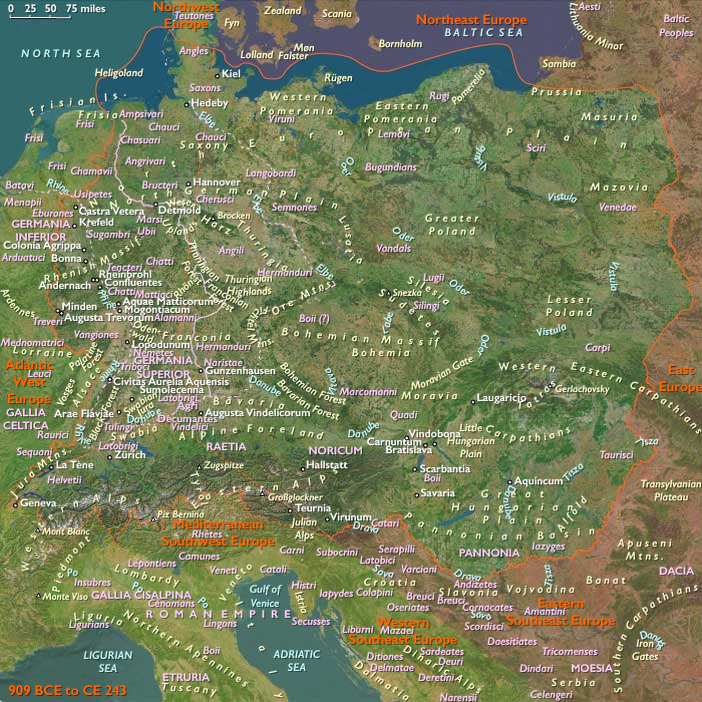
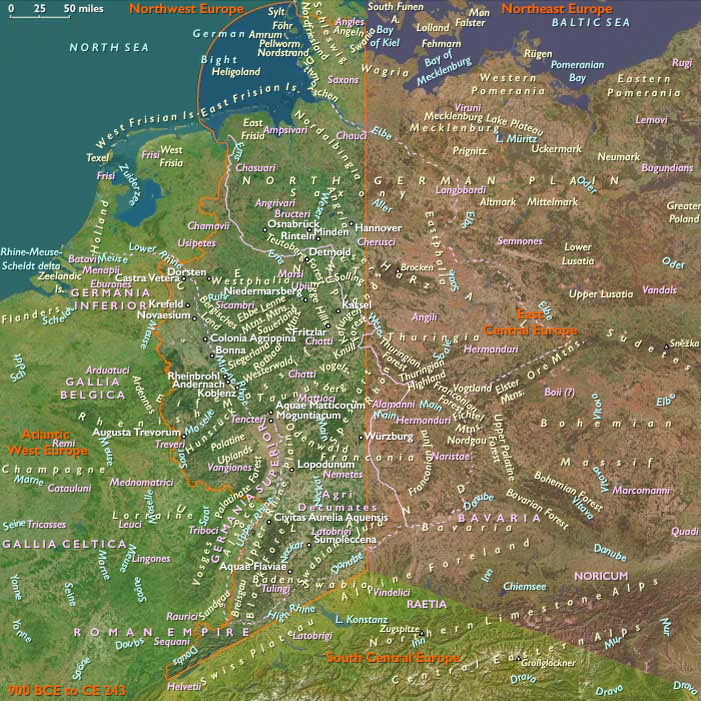
Veleda, a völva (priestess and prophet) of the Germanic tribe of the Bructeri, predicts the complete success of Civilis and the fall of the Roman Empire.
It is not clear whether Veleda merely prophesied the rebellion or actively incited it; given the Germans' adoration of her as a goddess, remote in her tower, the distinction may not have been clear at the time.
People
- Domitian
- Gaius Julius Civilis
- Julius Sabinus
- Mucianus
- Quintus Petilius Cerialis
- Veleda
- Vespasian
- Vitellius
Groups
- Lingones (Celtic tribe)
- Frisii (East Germanic tribe)
- Chatti (Germanic tribe)
- Batavi (Germanic tribe)
- Bructeri (Germanic tribe)
- Roman Empire (Rome): Julio-Claudian dynasty
Topics
- Classical antiquity
- Pre-Roman Iron Age of Northern Europe
- Roman Age Optimum
- Pax Romana
- Year of the Four Emperors, or Roman Civil War of 68-69
- Batavi, Revolt of the
Commodoties
Subjects
Regions
Subregions
Related Events
Filter results
Showing 10 events out of 61622 total
Great events were occurring in Rome while the war in Judea was being won.
The emperor Nero's increasingly erratic behavior in the middle of 68 CE had finally lost him all support for his position.
The Roman Senate, the praetorian guard and several prominent army commanders had conspired for his removal.
When the senate declared Nero an Enemy of the people, he fled Rome and committed suicide.
The newly installed emperor Galba is murdered after just a few months by Otho, a rival, triggering a civil war that comes to be known as the Year of the Four Emperors.
While the Jewish Revolt continues to rage in Palestine, Joseph has remained a prisoner in the Roman camp for two years; his prediction had gained in credibility after the death of Nero in 68, and comes true late in 69, when the popular Vespasian, though previously uninvolved, is also hailed emperor by the legions under his command.
Vespasian decides, upon gaining further widespread support, to return to Rome to claim the throne from the usurper Vitellius, leaving his son Titus to finish the war in Judea.
The agreeable Jewish prisoner is given his freedom and attaches himself to the Roman cause.
Venutius of the Brigantes, as civil war rages in Rome in 69, the “year of four emperors”, takes advantage of Roman instability and weak governors unable to control the legions in Britain, by staging another revolt, again with help from other nations.
His ex-wife, Queen Cartimandua, appeals for troops from the Romans, who had previously defended her but are now only able to send auxiliaries.
Cartimandua is evacuated, leaving her ex-husband Venutius in control of the north of the country and a kingdom at war with Rome.
After this, Cartimandua disappears from the sources.
This turn of events had given the German legions not the reward for loyalty that they had expected but rather accusations of having obstructed Galba's path to the throne.
Their commander, Rufus, had immediately been replaced by the new emperor.
The loss of political confidence in Germania's loyalty has also resulted in the dismissal of the Imperial Batavian Bodyguards and rebellion.
The respected Galba, noted for his integrity and extreme thriftiness, appears to have quickly stabilized a dangerous situation, but he does not remain popular for long.
On his march to Rome, he had either destroyed or taken enormous fines from towns that did not accept him immediately.
In Rome, Galba has canceled all the reforms of Nero, including benefits for many important persons.
Like his predecessor, Galba has a fear of conspirators and has executed many senators and equites without trial.
The Praetorian Guard are not happy either.
After his safe arrival in Rome, Galba had refused to pay them the rewards that the prefect Nymphidius had promised them in the new emperor's name.
Moreover, in the start of the civil year of 69 on January 1, the legions of Germania Inferior had refused to swear allegiance and obedience to Galba, and on the following day had acclaimed Vitellius, their governor, as emperor.
Hearing the news of the loss of the Rhine legions, Galba panics.
He adopts a young senator, the late Piso's brother, Lucius Calpurnius Piso Licinianus, as his successor.
By doing this, he offends many people, and above all Otho, an influential and ambitious man who desires the honor for himself.
Otho bribes the fickle Praetorian Guard, already very unhappy with the emperor, to his side.
When Galba hears about the coup d'état he goes to the streets in an attempt to stabilize the situation.
It proves a mistake, because he can attract no supporters.
Shortly afterwards, the Praetorian Guard kills him in the Forum.
Otho is recognized as emperor by the Senate the same day.
The new emperor is saluted with relief.
Aulus Vitellius, consul in 48, and Proconsul of Africa in either 60 or 61, in which capacity he is said to have acquitted himself with credit, has, to the general astonishment, been appointed legate of Germania Inferior.
Vitellius has meanwhile made himself popular with his subalterns and with the soldiers by outrageous prodigality and excessive good nature, which soon proves fatal to order and discipline.
He owes his elevation to the throne to Caecina and Fabius Valens, commanders of two legions on the Rhine.
Through these two men a military revolution is speedily accomplished; they refused to renew their vows of allegiance to Emperor Galba on January 1, 69, and early in 69 Vitellius is proclaimed emperor at Cologne.
More accurately, he is proclaimed Emperor of the armies of Germania Inferior and Superior.
The armies of Gaul, Brittania and Raetia side with them shortly afterwards.
By the time that they march on Rome, however, it is Otho, and not Galba, whom they have to confront.
Otho, although ambitious and greedy, does not have a record for tyranny or cruelty and is expected to be a fair emperor; however, trouble is marching down on Italy from Germany in the form of Vitellius, who has behind him the finest legions of the empire, composed of veterans of the Germanic Wars, such as I Germanica and XXI Rapax.
These will prove to be his best arguments in his bid for power.
Otho is not keen to begin another civil war and sends emissaries to propose a peace and convey his offer to marry Vitellius' daughter.
It is too late to reason; Vitellius' generals have half of his army heading to Italy.
After a series of minor victories, Otho is defeated on April 16, 69, in the Battle of Bedriacum, near present Cremona in northern Italy.
Rather than flee and attempt a counterattack, Otho decides to put an end to the anarchy and commits suicide.
He had been emperor for a little more than three months.
On the news of Otho's suicide, Vitellius is recognized as emperor by the Senate.
Granted this recognition, Vitellius sets out for Rome.
Simon's success had meanwhile begun worrying the Zealots in Jerusalem.
Since they do not dare fight in open battle, they lay an ambush, capturing his wife and some of her entourage.
They expect Simon to lay down his weapons in exchange for her freedom.
Simon grows very angry, however, goes to Jerusalem and takes everybody leaving the city captive.
Some he tortures, some he kills; he cut off the hands of others, sending them back into the city with the message that he will do likewise to all Jerusalem if his wife is not released.
This frightens the Zealots so immensely that they eventually let her go.
Jerusalem has had unstable leadership from 68 to 69 under the alliance between Simon ben Eleazar and his Zealots, John of Giscala, and the Idumeans.
Eleazar and John, in a misguided attempt to unite the city under their complete control exploit their power and slaughter the remnants of Ananus' moderate party in Jerusalem.
John during this period has distanced himself from Eleazar and the Zealots in order to avoid association with their tyrannical behavior and claim sole leadership.
As a result of this despotic turn and their insufficient representation in the government, many Idumeans defect to a violent extremist group outside the city walls known as the Sicarii, led by Simon ben Gioras.
The advancing Roman army in April 69 had forced Simon to retreat to Jerusalem, where he has camped outside the city walls and once again begun harassing people.
Within Jerusalem, John of Giscala has set himself up as a despotic ruler after overthrowing lawful authority in the Zealot Temple Siege.
The Jerusalem authorities in order to get rid of him decide to ask Simon to enter the city and drive John away.
Simon, with the support of most Idumeans, is admitted, cclaimed by the people as their savior and guardian.
With fifteen thousand soldiers at hand Simon soon controls the whole upper city and some of the lower city.
John holds parts of the lower city and the temple's outer court with six thousand men and a third splinter group of twenty-four hundred Zealots, led by Eleazar ben Simon, controls the temple's inner court.
Just as Ananus' forces had surrounded him, Eleazar finds himself in a similar situation of helplessness.
This year is marked by bitter civil war between the three factions under Simon, John, and Eleazar.
The three factions fight vigorously over the control of Jerusalem, always trying to destroy each others grain stores to starve each other into submission.
According to Tacitus, "there were three generals and three armies, and between these three there was constant fighting, treachery, and arson" (Histories 5.12.3).
This internal fighting will later prove disastrous: not only is this a sabbatical year (with less grain available), but the city is under siege by the time the harvest begins.
The leaders of the rebellion, Simon in particular, are nevertheless regarded with reverence and awe.
Coins are minted by his authority declaring the redemption of Zion.
Vitellius faces problems from the start of his reign.
The city is left very skeptical after Vitellius chose the anniversary of the Battle of the Allia (in 390 BCE), a day of bad auspices according to Roman superstition, to accede to the office of Pontifex Maximus.
Events will seemingly prove them right.
With the throne tightly secured, Vitellius engages in a series of feasts, banquets (Suetonius refers to three a day: morning, afternoon and night) and triumphal parades that drive the imperial treasury close to bankruptcy.
Debts are quickly accrued and moneylenders start to demand repayment.
Vitellius shows his violent nature by ordering the torture and execution of those who dare to make such demands.
With financial affairs in a state of calamity, Vitellius takes the initiative of killing citizens who name him as their heir, often together with any co-heirs.
Moreover, he engages in a pursuit of every possible rival, inviting them to the palace with promises of power only to have them assassinated.
Suetonius, whose father had fought for Otho at Bedriacum, gives an unfavorable account of Vitellius' brief administration: he describes him as unambitious and notes that Vitellius showed indications of a desire to govern wisely, but that Valens and Caecina encouraged him in a course of vicious excesses which threw his better qualities into the background.
Vitellius is described as lazy and self-indulgent, fond of eating and drinking, and an obese glutton, eating banquets four times a day and feasting on rare foods he would send the Roman navy to procure.
For these banquets, he had himself invited over to a different noble's house for each one.
He is even reported to have starved his own mother to death—to fulfill a prophecy that he would rule long if his mother died first.
Other writers, namely Tacitus and Cassius Dio, disagree with some of Suetonius' assertions, even though their own accounts of Vitellius are scarcely positive ones.
Despite his short reign he makes two important contributions to Roman government which outlasted him.
Tacitus describes them both in his Histories: Vitellius ends the practice of Centurions selling furloughs and exemptions of duty to their men, a change Tacitus describes as being adopted by 'all good emperors'.
He also expands the offices of the Imperial Administration beyond the imperial pool of Freedmen allowing those of the Equites to take up positions in the Imperial Civil service.
Vitellius also bans astrologers from Rome and Italy from October1, 69.
Some astrologers respond to his decree by anonymously publishing a decree of their own: "Decreed by all astrologers in blessing on our State Vitellius will be no more on the appointed date."
In response, Vitellius executes any astrologers he encounters.
The Batavi, a sub-tribe of the Germanic Chatti tribal group who had rendered valuable aid under the early emperors, had been well treated in order to attach them to the cause of Rome.
They are exempt from tribute, but are obliged to supply a large number of men for the army.
Gaius Julius Civilis, a hereditary prince of the Batavi, the prefect of a Batavi cohort, and a veteran of twenty-five years' service, had distinguished himself by service in Britain, where he and the eight Batavi cohorts had played a crucial role in both the Roman invasion in 43 CE and the subsequent subjugation of southern Britain.
Before and during the disturbances that followed the death of Nero, Civilis had been twice imprisoned on a charge of rebellion, and narrowly escaped execution.
Civilis in early 69 had been released by Vitellius, when the latter, having launched his mutiny against Otho, was in urgent need of the Batavi's military support.
The Batavi regiments, having duly helped Vitellius overthrow Otho at the Battle of Bedriacum, were then ordered to return home, but at this point came the mutiny of Vespasian, commander of forces in Syria.
Vitellius' general in Germania Inferior, ordered to raise more troops, squanders the goodwill of the Batavi by attempting to conscript more Batavi than the maximum stipulated in their treaty.
The brutality and corruption of the Roman recruiting centurions bring already deep discontent in the Batavi homeland to the boil.
Civilis, commanding the Batavian auxiliary troops allocated in the summer of 69 to the Rhine legions, takes up arms under the pretense of siding with Vespasian and induces the inhabitants of his native country to rebel.
The Batavi are immediately joined by several neighboring German tribes, the most important of whom are the Frisii.
Vespasian, who is fighting Vitellius for the imperial throne, salutes the rebellion that keeps his enemy from calling the Rhine legions to Italy.
The Batavi are promised independence and Civilis is on his way to becoming king, but, for unknown reasons, this is not enough for the Batavi.
Civilis chooses to pursue vengeance and swears to destroy the two Roman legions.
The timing is well chosen: with the civil war of the Year of the Four Emperors at its peak, it will take some time before Rome can produce an effective counterattack.
Moreover, the eight Batavian auxiliary units of Vitellius' army are on their way home and can be easily persuaded to join the rebellion for an independent Batavia.
This is an important reinforcement.
Apart from being veteran troops, their numbers are greater than the combined Roman troops stationed in Moguntiacum (Mainz) and …
…Bonna (Bonn).
The tribe of the Cananefates lives in lands between the Batavians and the North Sea.
The inducements used by Civilis to instigate rebellion are not known, but the Cananefates, led by their chief Brinno, attack several Roman forts, including Traiectum, modern Utrecht.
With most of the troops in Italy fighting in the civil war, the Romans are caught off guard.
Flaccus, commander of the Rhine legions, sends auxiliary troops to control the situation.
The result is another disaster for the Romans.
Civilis assumes the role of mastermind of the rebellion and defeats the Romans near modern Arnhem.
Flaccus orders the V Alaudae and the XV Primigenia legions to deal with the problem.
Accompanying them are three auxiliary units, including a Batavian cavalry squadron, commanded by Claudius Labeo, a known enemy of Civilis.
The battle takes place near modern Nijmegen.
The Batavian regiment deserts to their countrymen, dealing a blow to the already feeble morale of the Romans.
The result is disastrous: a Roman army is beaten and the legions forced to retreat to their base camp of Castra Vetera (modern Xanten).
Years: 69 - 69
December
People
- Domitian
- Gaius Julius Civilis
- Julius Sabinus
- Mucianus
- Quintus Petilius Cerialis
- Veleda
- Vespasian
- Vitellius
Groups
- Lingones (Celtic tribe)
- Frisii (East Germanic tribe)
- Chatti (Germanic tribe)
- Batavi (Germanic tribe)
- Bructeri (Germanic tribe)
- Roman Empire (Rome): Julio-Claudian dynasty
Topics
- Classical antiquity
- Pre-Roman Iron Age of Northern Europe
- Roman Age Optimum
- Pax Romana
- Year of the Four Emperors, or Roman Civil War of 68-69
- Batavi, Revolt of the
