
The European factories in India serve during …
Years: 1684 - 1827
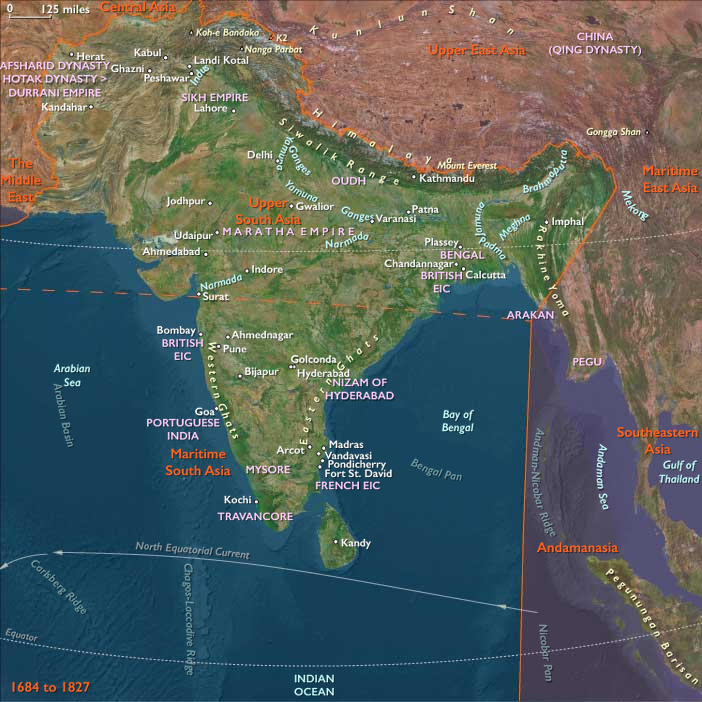
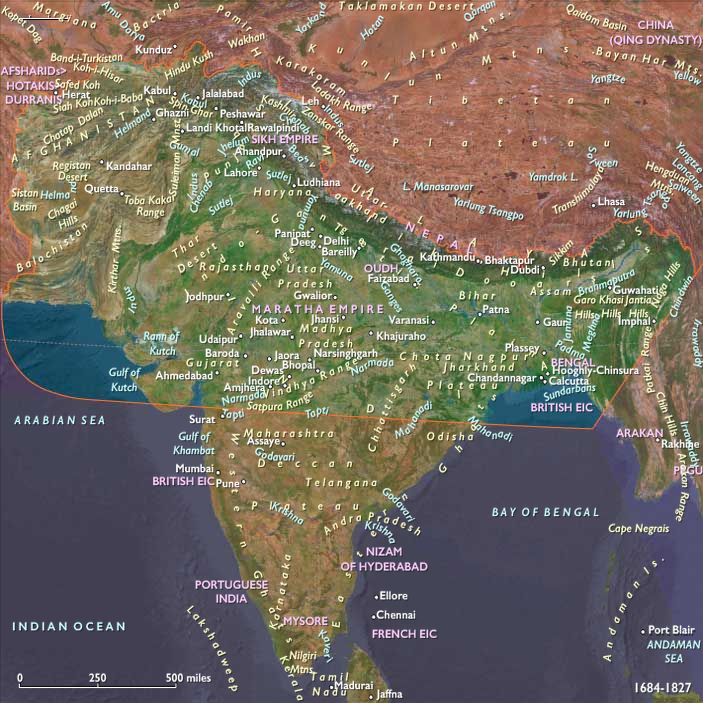
The European factories in India serve during the wars of the eighteenth century not only as collection and transshipment points for trade but also increasingly as fortified centers of refuge for both foreigners and Indians.
British factories gradually begin to apply British law to disputes arising within their jurisdiction.
The posts also begin to grow in area and population.
Armed company servants are effective protectors of trade.
As rival contenders for power call for armed assistance and as individual European adventurers find permanent homes in India, British and French companies find themselves more and more involved in local politics in the south and in Bengal.
Plots and counterplots climax when British East India Company forces, led by Robert Clive, decisively defeat the larger but divided forces of Nawab Siraj-ud-Dawlah at Plassey (Pilasi) in Bengal in 1757.
People
Groups
- Hinduism
- Indian people
- Dutch people
- Islam
- Muslims, Sunni
- Muslims, Shi'a
- Portuguese Empire
- India, Portuguese State of
- Jesuits, or Order of the Society of Jesus
- Netherlands, United Provinces of the (Dutch Republic)
- France, (Bourbon) Kingdom of
- East India Company, British (The Company of Merchants of London Trading into the East Indies)
- Dutch East India Company (Vereenigde Oostindische Compagnie or VOC in Dutch, literally "United East Indies Company")
- Mughal Empire (Delhi)
- French East India Company
- Britain, Kingdom of Great
Topics
- Colonization of Asia, Portuguese
- Colonization of Asia, Dutch
- Colonization of Asia, French
- India, Modern
- Colonization of Asia, British
- Bengalese-British War of 1756-57
Commodoties
Subjects
Regions
Subregions
Years: 1684 - 1827
People
Groups
- Hinduism
- Indian people
- Dutch people
- Islam
- Muslims, Sunni
- Muslims, Shi'a
- Portuguese Empire
- India, Portuguese State of
- Jesuits, or Order of the Society of Jesus
- Netherlands, United Provinces of the (Dutch Republic)
- France, (Bourbon) Kingdom of
- East India Company, British (The Company of Merchants of London Trading into the East Indies)
- Dutch East India Company (Vereenigde Oostindische Compagnie or VOC in Dutch, literally "United East Indies Company")
- Mughal Empire (Delhi)
- French East India Company
- Britain, Kingdom of Great
Topics
- Colonization of Asia, Portuguese
- Colonization of Asia, Dutch
- Colonization of Asia, French
- India, Modern
- Colonization of Asia, British
- Bengalese-British War of 1756-57
Commodoties
Subjects
Regions
Subregions