Various radical Jewish elements, some of which …
Years: 4BCE - 4BCE
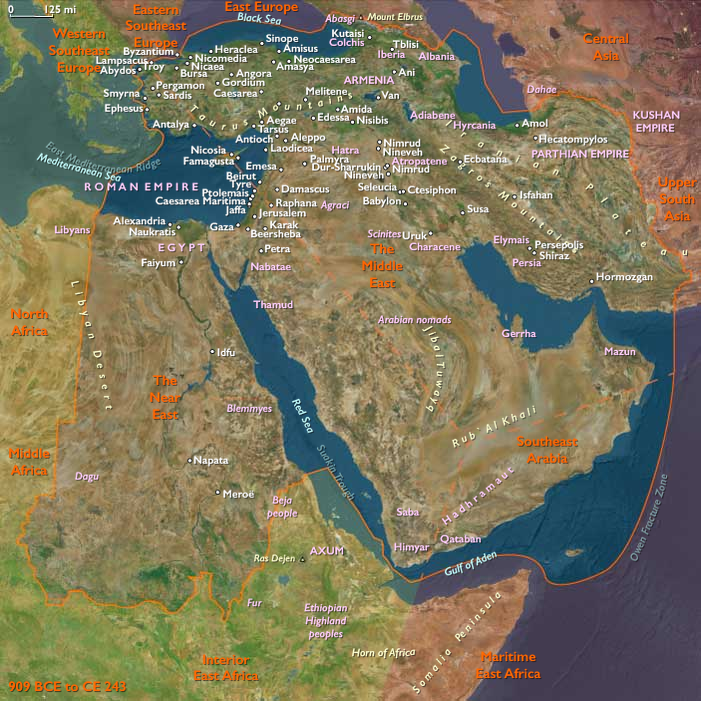
Various radical Jewish elements, some of which are messianic, rise in revolt after Herod's death.
Threats to stability in both Galillee and Pearea would have been clear to Antipas when he took office.
While he has been making his case to Augustus in Rome, dissidents led by one Judas son of Hezekiah, whose followers tear down the Roman Eagle that had adorned the Temple, attack the palace of Sepphoris in Galilee, seizing money and weapons with which they terrorize the area.
In a counterattack ordered by Quinctilius Varus, Roman governor of Syria, Sepphoris is destroyed by fire and its inhabitants sold as slaves.
Locations
People
- Aretas IV Philopatris
- Augustus
- Herod Antipas
- Herod Archelaus
- Philip the Tetrarch
- Publius Quinctilius Varus
Groups
Topics
Commodoties
Subjects
Regions
Subregions
Related Events
Filter results
Showing 10 events out of 62094 total
The Pharisees, according to Josephus, ultimately opposed Herod and thus in 4 BCE fell victims to his bloodthirstiness ("The Antiquities of the Jews, xvii. 2, § 4; 6, §§ 2–4).
Young students of the Torah smash the golden eagle over the main entrance of the Temple of Jerusalem after the Pharisee teachers claim that is a Roman symbol.
Herod has the students arrested, brought to trial, and punished.
The family of Boethus, whom Herod had raised to the high-priesthood, revives the spirit of the Sadducees, and henceforth the Pharisees will again have them as antagonists (The Antiquities of the Jews, xviii. 1, § 4).
Augustus in this year approves of the death penalty for Antipater, who Herod executes.
Having thus executed his sole heir, Herod again changes his will: Archelaus (from the marriage with Malthace) is to rule as king over Herod's entire kingdom, while Antipas (from Malthace) and Philip (from the fifth marriage with Cleopatra of Jerusalem) as Tetrarchs over Galilee and Peraea, also over Gaulanitis (Golan), Trachonitis (Hebrew: Argob), Batanaea (now Ard-el-Bathanyeh) and Panias.
Salome I is also given a small toparchy in the Gaza region.
Since the work of Emil Schürer in 1896 (Emil Schürer, A History of the Jewish People in the Time of Jesus Christ, 5 vols. New York, Scribner’s, 1896) most scholars have agreed that Herod died at the end of March or early April in 4 BCE.
However, Schürer's consensus did not go unchallenged in the twentieth century, with several scholars endorsing 1 BCE as the year of Herod's death.
Evidence for the 4 BCE date is provided by the fact that Herod's sons, between whom his kingdom is divided, date their rule from 4 BCE, and Archslaus apparently also exercised royal authority during Herod's lifetime.
Josephus states that Philip the Tetrarch's death took place in 34 CE after a thirty-seven-year reign, in the twentieth year of Tiberius; he also writes that Herod's final illness was excruciating.
Modern scholars agree he suffered throughout his lifetime from depression and paranoia.
More recently, others report that the visible worms and putrefaction described in his final days are likely to have been scabies; the disease might have accounted for both his death and psychiatric symptoms.
Similar symptoms will attend the death of his grandson Agrippa I in CE 44.
Josephus also states that Herod was so concerned that no one would mourn his death, that he commanded a large group of distinguished men to come to Jericho, and he gave order that they should be killed at the time of his death so that the displays of grief that he craved would take place.
Fortunately for them, Herod's son Archelaus and sister Salome do not carry out this wish.
Archelaus is proclaimed king by the army, but declines to assume the title until he has submitted his claims to Augustus in Rome.
Before setting out, he quells with the utmost cruelty a sedition of the Pharisees, slaying nearly three thousand of them.
Herod's plans for the succession have to be ratified by Augustus because of Judea's status as a Roman client kingdom,
The three heirs therefore travel to Rome to make their claims, Antipas arguing he ought to inherit the whole kingdom and the others maintaining that Herod's final will ought to be honored.
Despite qualified support for Antipas from Herodian family members in Rome, who favor direct Roman rule of Judea but consider Antipas preferable to his brother, Augustus largely confirms the division of territory set out by Herod in his final will.
Archelaus has, however, to be content with the title of ethnarch rather than king.
Augustus allots to Archelaus the greater part of the kingdom (Judea and Idumea, which are Jewish, and Samaria, which is not).

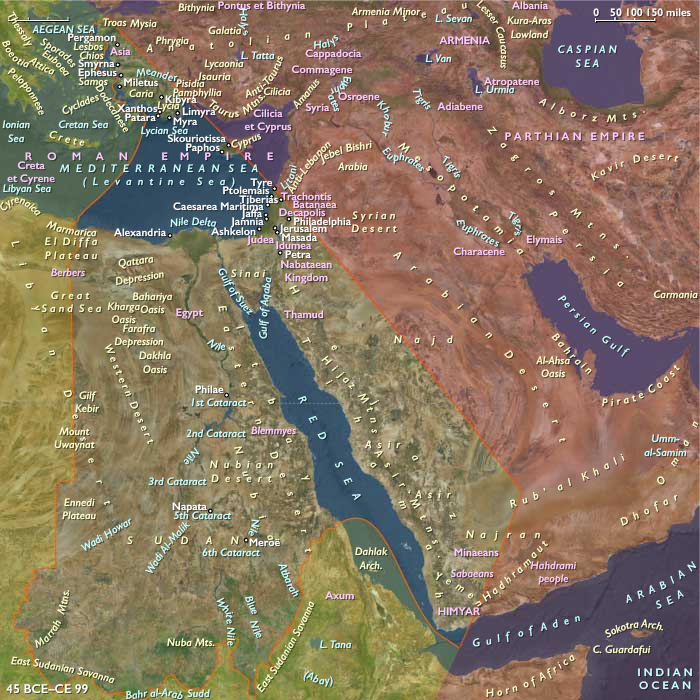
Antipas, as tetrarch, receives Galilee and Peraea (east of the Jordan River).
These territories are separated by the region of the Decapolis, with Galilee to the north and Perea to the south.
The non-Jewish areas (except Samaria) are assigned to a third son, Philip, to Herod's sister Salome, or to the province of Syria.
Philip is to rule Trachonitis, Batanaea, and Auranitis, the area between the Decapolis and Damascus.
Salome is given a toparchy including the cities of Jabneh, Ashdod, Phasaelis, and five thousand drachmae.
Augustus supplements this with a royal habitation at Ashkelon.
While she is nominally queen of these areas, they are ultimately subject to the Judaean prefect.
Perea borders on the kingdom of Nabatea, which has long had uneasy relations with Romans and Jews.
Here, one Simon, a former slave of Herod the Great, burns down the royal palace at Jericho.
Athronges, a shepherd, inaugurates, with his four brothers, a two-year rebellion in Judea.
Herod the Great, after annexing the Golan in 20 BCE, had erected here a temple of "white marble" in honor of his patron, Augustus.
Philip the Tetrarch of Batanaea, which encompasses the Golan and the Hauran, in the year 3 BCE, founds a city at Paneas, which becomes the administrative capital of Philip's large tetrarchy
Flavius Josephus, in The Antiquities of the Jews, refers to the city as Caesarea Paneas; the New Testament as Caesarea Philippi (to distinguish it from Caesarea Maritima on the Mediterranean coast).
Publius Quinctilius Varus, whose paternal grandfather was senator Sextus Quinctilius Varus, is a patrician, born to an aristocratic but long-impoverished and unimportant family in the Quinctilia gens.
His mother is a daughter from consul Gaius Claudius Marcellus Minor's first marriage.
His father was Sextus Quinctilius Varus, a senator aligned with the conservative republicans in the civil war against Julius Caesar.
Sextus had survived their defeat, but it is unknown whether he was involved in Caesar's assassination.
He had committed suicide in 42 BCE after the Battle of Philippi.
Varus, despite his father's political allegiances, had become a supporter of Caesar's heir, Octavian, later known as Augustus.
He had in about 14 BCE married Vipsania Marcella, the daughter of Marcus Vipsanius Agrippa and Claudia Marcella Major, and had become a personal friend of both Agrippa and Augustus.
Vipsania Marcella is a grandniece of Augustus; when Agrippa died in 12 BCE, it was Varus who delivered the funeral eulogy.
Thus, his political career was boosted and his cursus honorum finished as early as 13 BCE, when he was elected consul junior partner of Tiberius, Augustus' stepson and future emperor.
Following the consulship, Varus was between 9 and 8 BCE governor of the province of Africa.
He had gone after this to govern Syria, with four legions under his command.
As governor of Syria, Varus is known for his harsh rule and high taxes.
The Jewish historian Josephus mentions the swift action of Varus against a messianic revolt in Judaea after the death in 4 BCE of Rome's client king Herod the Great.
After occupying Jerusalem, he had crucified two thousand Jewish rebels, and may have thus been one of the prime objects of popular anti-Roman sentiment in Judaea, for Josephus, who made every effort to reconcile the Jewish people to Roman rule, felt it necessary to point out how lenient this judicial massacre had been.
Indeed, at precisely this moment, the Jews, nearly en masse, begin a full-scale boycott of Roman pottery (Red Slip Ware).
The archaeological record thus seems to verify mass popular protest against Rome because of Varus' cruelty.
Aretas IV Philopatris, the King of the Nabataeans from roughly 9 BCE and the most powerful neighbor of Judea, frequently takes part in the state affairs of this country, and is to be influential in shaping the destiny of its rulers.
While on not particularly good terms with Rome—as intimated by his surname, "Friend of his People", which is in direct opposition to the prevalent "Friend of the Romans" and "Friend of the Emperor"), and though it was only after great hesitation that Augustus had recognized him as king—had nevertheless taken part in the expedition of Varus against the Jews, and has placed a considerable army at the disposal of the Roman general.
Together with the kidnapped Parthian prince Augustus had given in exchange for the legion standards captured by the Parthians at Carrhae in 53 BCE, he also had given Phraates IV an enslaved Italian girl, "Thea Muse", who has become Queen Musa of Parthia.
To ensure that her child Phraataces will inherit the throne without incident, Musa persuades Phraates IV, whose greatest enemies are his own family, to give his other five sons to Augustus as hostages, thus acknowledging his dependence on Rome.
Again, Augustus uses this as propaganda depicting the submission of Parthia to Rome; he will list it as a great accomplishment in his funerary inscription, Res Gestae Divi Augusti. (The hostages include Tiridates III, whom the Romans will later try to install as a vassal king in CE 35).
He appoints Phraates V successor and in about 2 BCE is murdered by Musa.
Imperial compliments are paid also to Gaius’ younger Lucius in 2 BCE, the year in which their grandfather Augustus receives his climactic title “father of the country” (pater patriae).
As the Augustan building boom continues, many older temples are refaced with marble, and new shrines, such as the Temple of Mars Ultor in the Forum Augusti, are erected at the focal points of forum complexes.
In the battle of Philippi in 42 BCE, in which Augustus and Mark Antony had worked together and avenged Caesar's death, Augustus had vowed to build a temple dedicated to Mars the avenger.
after forty years of construction, the incomplete forum and its Temple of Mars Ultor are inaugurated in 2 BCE as the Forum of Augustus.
The temple consists of a very tall fire wall, and this still distinguishes itself from the neighborhood of Suburra, a notoriously poor district of Rome quite prone to fires.
The tall solid stone wall has been built to protect the marble architecture of the forum from fire, as marble quickly turns to lime once exposed to fire.
The forum consists of a large open space framed by colonnades with semicircular exedrae beyond.
These exedrae honor the founders of Rome, the Julian family, and the leading men of Rome with portrait busts.
In addition to statues of all the Roman triumphatores, which are either made of bronze or marble and are placed along the left side of the Forum and in the left exedrae, the entire right side and right exedrae are full of statues of men in the Julian-Claudian family.
They trace Augustus’s lineage down through the fourteen Alban kings to the founding ancestors Aeneas and Romulus.
According to myth, Rome herself had been born from the god Mars through Romulus.
These figures collectively reinforce the importance of both Roman lineage but also of the prestigious lineage that Augustus himself holds.
By advertising this lineage, he reinforces his power and authorities as a leader.
Also, by placing himself among great figures and heroes, he further portrays himself and his own importance.
He paints himself as one of ‘the greats’ worthy of the power he holds.
The entire decoration of the Forum is tightly connected to the ideology of Augustus.
The open courtyard is dominated by a single octastyle temple, accessible only from the front and with columns on only the front facade.
In addition to Mars Ultor, this temple also honors Venus.
On the left side of the Forum is the Hall of the Colossus, a small room that holds a large cult statue, presumably of Augustus.
Years: 4BCE - 4BCE
Locations
People
- Aretas IV Philopatris
- Augustus
- Herod Antipas
- Herod Archelaus
- Philip the Tetrarch
- Publius Quinctilius Varus