
Jan van Eyck and the Mastery of …
Years: 1434 - 1434
Jan van Eyck and the Mastery of Oil Painting: The Arnolfini Portrait (1434)
Jan van Eyck, the celebrated Flemish painter active in the prosperous commercial centers of the Low Countries, profoundly transformed the trajectory of Western art through his innovative use of oil painting. Although traditionally credited with inventing the oil medium—a technique actually developed earlier—Van Eyck unquestionably perfected and popularized its use, achieving previously unmatched realism through the meticulous application of translucent, superimposed glazes. His technique yielded unprecedented depth, luminosity, and vibrant colors, bringing painted jewels and precious metals to life with an almost tangible glow.
Like his Flemish contemporary Robert Campin, Van Eyck meticulously arranged scenes and objects within his compositions, embedding layers of subtle symbolic meaning beneath their strikingly realistic surfaces. His portraits, landscapes, and interior scenes alike share a dedication to detailed observation, reflecting textures, surfaces, and lighting conditions with remarkable precision and clarity.
Van Eyck’s most famous work, completed in 1434, is the extraordinary wedding portrait known today as The Arnolfini Portrait. Also referred to as The Arnolfini Wedding, The Arnolfini Marriage, The Arnolfini Double Portrait, or Portrait of Giovanni Arnolfini and His Wife, this oil painting on oak panel depicts the Italian merchant Giovanni Arnolfini and his wife, likely within their residence in the Flemish trading city of Bruges. The painting bears a distinctive inscription, "Johannes de Eyck fuit hic 1434" ("Jan van Eyck was here"), serving as a remarkable assertion of the artist’s presence and witnessing of the depicted moment.
This iconic work stands as one of the earliest masterpieces executed entirely in oils—rather than the more traditional tempera—alongside the famed Ghent Altarpiece, a monumental polyptych produced in collaboration with his brother Hubert. Van Eyck’s Arnolfini Portrait is renowned not only for its artistic quality but also for its groundbreaking use of illusionistic depth and interior lighting. Through skillful manipulation of natural light entering from a side window and the precise depiction of reflections in a convex mirror, Van Eyck dramatically expands the perceived spatial reality of the painting. The carefully rendered chandelier, with one candle lit and another burned out, further enhances the meticulous realism and symbolic complexity characteristic of Van Eyck's artistic approach.
Having established himself in Bruges around 1432–1433, Van Eyck continued to create and sign a number of significant oil paintings through 1439, each characterized by his innovative use of color, meticulous detail, and translucent glazing. Although later scholarship clarified that Van Eyck did not invent oil painting, his mastery and refinement of the medium revolutionized European art, significantly influencing subsequent generations of artists across Atlantic West Europe and beyond.
(The Arnolfini Portrait eventually entered the collection of the National Gallery in London in 1842, where it remains one of the most celebrated artworks of the Northern Renaissance.)
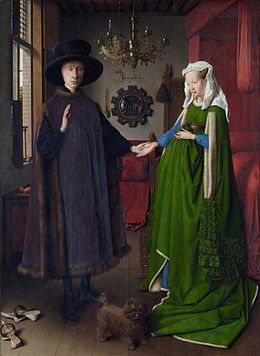
Jan van Eyck: The Arnolfini Portrait (1434), Oil on oak panel of 3 vertical boards, 82.2 (panel 84.5) cm × 60 (panel 62.5) cm (32.4 in × 23.6 in), National Gallery, London
Locations
People
Groups
Topics
Commodoties
Subjects
Regions

Subregions
Years: 1434 - 1434
Jan van Eyck: The Arnolfini Portrait (1434), Oil on oak panel of 3 vertical boards, 82.2 (panel 84.5) cm × 60 (panel 62.5) cm (32.4 in × 23.6 in), National Gallery, London
Locations
People
Groups
Topics
Commodoties
Subjects
Regions
Subregions