
Valerian’s son and co-emperor Gallienus fights a …
Years: 259 - 259
Valerian’s son and co-emperor Gallienus fights a series of campaigns against the Goths on the Upper Rhine.
While Valerian is fighting against the Sassanid Empire and the Goths, who by this time have sacked Thrace and Asia Minor, Gallienus will be in charge of defending the Roman Empire's border.
In the Western half of the Empire, the situation is difficult.
The Danubian border resists continuous barbarian attacks.
Gallienus has to march with military reinforcements from Gaul towards Dacia and Moesia to fight the barbarians.
The situation is so severe that in 259, the legions of Pannonia and Moesia rebel and choose to make Ingenuus the emperor.
Gallienus reunites the Rhine, leaves a Roman legion their to defend it and goes off to do battle.
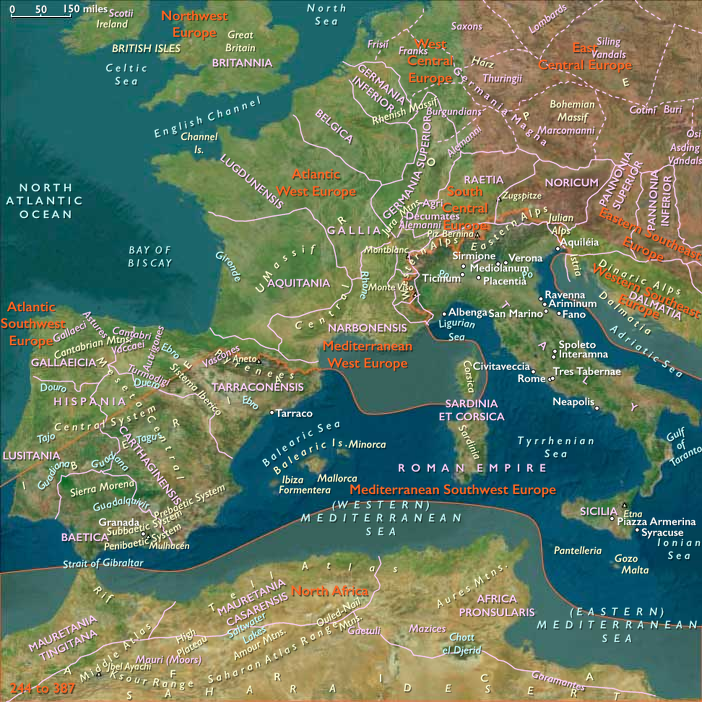
Within the borders of the Rhine and the Alps, a Germanic confederation, the Alamanni, who occupy a good part of the Agri Decumates (a region of the Roman Empire's provinces of Germania Superior and Raetia, covering the Black Forest, Swabian Jura, and Franconian Jura areas between the Rhine, Main, and Danube rivers), cross the Alps and attack the fertile plain of the Po river.
The sacking of the area instills terror in Rome, as the city remains unwalled.
The Senate of Rome hastily prepares a crowd of plebs for combat in an attempt to ensure that its shrinking army is capable of protecting the city.
Gallienus had just defeated the pretender Ingenuus when the news arrives of the invasion by the Alamanni.
He marches off with three legions to intercept the barbarians in Italy.
By then, according to the Byzantine historian Joannes Zonaras, the Alamanni had retreated before the unexpected resistance of the citizens of Rome and its Senate.
When Gallienus arrives in the valley of the Po, he finds the Alamanni in the vicinity of Mediolanum, present day Milan.
The victory is total: according to Zonaras three hundred thousand Alamanni fell that day and the emperor received the title Germanicus Maximus.
The Alamanni's success in reaching into the Roman Empire once more reveals the weakness of the centuries-old tradition of posting Rome's legions near the borders without providing for defense within the empire.
The battle of Mediolanum demonstrates to the Romans the value of swift, flexible military units.
Afterward, Gallienus enacts a major reform by introducing a highly mobile field army composed mainly of cavalry (vexillationes).
The main units are under the control of his general, Aureolus, and headquartered in Mediolanum, with the mission to protect Italy.
Finally, the invasion by the Alamanni demonstrates the vulnerability of Italy and especially Rome.
This later causes Emperor Aurelian to have a strong wall built to defend the capital of the Empire.
Locations
People
Groups
- Germania
- Asia (Roman province)
- Germania Superior (Roman province)
- Raetia (Roman province)
- Italy, Roman
- Goths (East Germanic tribe)
- Thracia (Roman province)
- Moesia Inferior (Roman province)
- Moesia Superior (Roman province)
- Dacia, Roman
- Pannonia Inferior (Roman province)
- Pannonia Superior (Roman province)
- Alamanni (Germanic tribal alliance)
- Roman Empire (Rome): Non-dynastic
Topics
- Classical antiquity
- Roman Age Optimum
- Crisis of the Third Century (Roman Civil “War” of 235-84)
- Roman Gothic War, Second
- Roman-Persian War of 257-61
- Mediolanum, Battle of
Subjects
Regions

Subregions
Related Events
Showing 4 events out of 4 total
Years: 259 - 259
Locations
People
Groups
- Germania
- Asia (Roman province)
- Germania Superior (Roman province)
- Raetia (Roman province)
- Italy, Roman
- Goths (East Germanic tribe)
- Thracia (Roman province)
- Moesia Inferior (Roman province)
- Moesia Superior (Roman province)
- Dacia, Roman
- Pannonia Inferior (Roman province)
- Pannonia Superior (Roman province)
- Alamanni (Germanic tribal alliance)
- Roman Empire (Rome): Non-dynastic
Topics
- Classical antiquity
- Roman Age Optimum
- Crisis of the Third Century (Roman Civil “War” of 235-84)
- Roman Gothic War, Second
- Roman-Persian War of 257-61
- Mediolanum, Battle of
Subjects
Regions
Subregions