
Valdemar IV’s capture of Gotland had allowed …
Years: 1361 - 1361
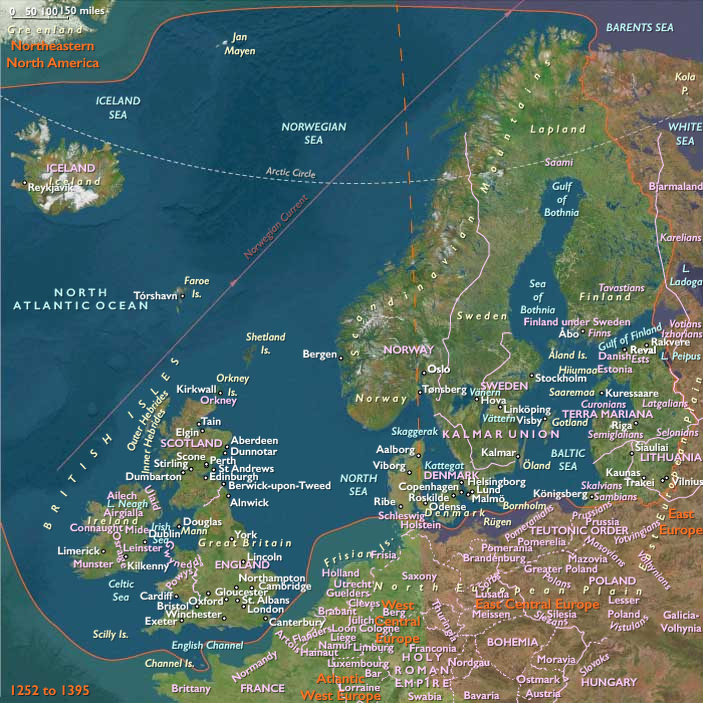
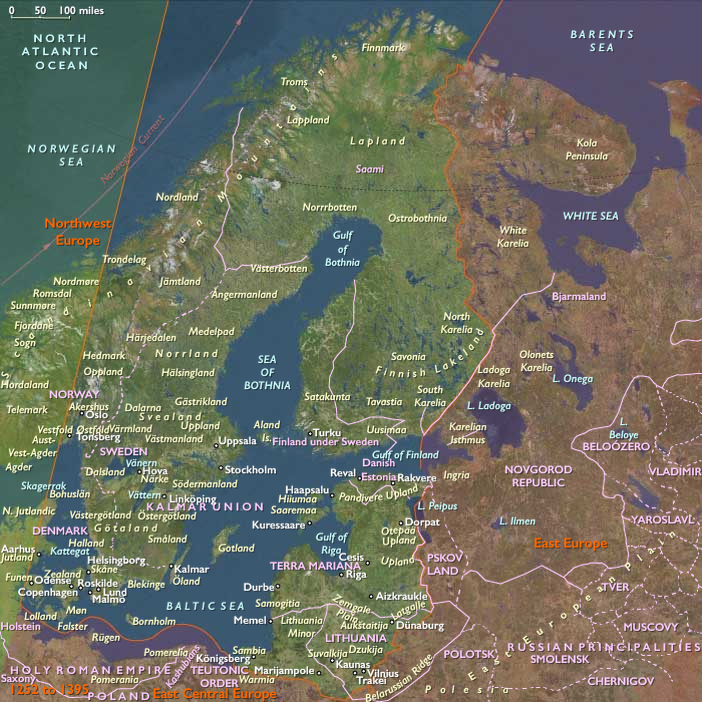
Valdemar IV’s capture of Gotland had allowed the Danes to take the wealthy city of Visby, but a coalition of the Hanseatic League, Sweden, Mecklenburg, and Holstein opposes the conquest, and war breaks out.
Coalition forces in 1361 sack Copenhagen in 1361.
Locations
People
Groups
Topics
Commodoties
Subjects
Regions
Subregions
Related Events
Filter results
Showing 10 events out of 43980 total
A Danish army defeats a Swedish peasant force to capture Gotland, the largest island in the Baltic Sea in 1361.
A low, undulating limestone plateau located fifty miles (eighty kilometers) off the Swedish coast and settled during the Stone Age, Gotland had early developed extensive commerce with northern Europe.
Wisby (Visby), its major center, had by the twelfth century become an important trading town of the Hanseatic League.
Murad's initial conquests extend northward into Thrace, culminating with the capture in 1361 of Adrianople, the second city of the Empire.
Renamed Edirne, the city becomes the new Ottoman capital, providing the Ottomans with a center for the administrative and military control of Thrace.
As the main fortress between Constantinople and the Danube, it controls the principal invasion road through the Balkan Mountains, assures Ottoman retention of their European conquests, and facilitates further expansion to the north.
King Peter of Cyprus, having made Philippe de Mézières chancellor, devotes himself to organizing a crusade; in 1361, he captures the Mamluk-held town of Adalia (Antalya) on the Cilician coast of Anatolia.
An edict issued by the Frankish king of Italy Lothar I (ruled 818-55) mentions the existence of a higher education institution at Pavia as early as 825.
This institution, mainly devoted to ecclesiastical and civil law as well as to divinity studies, had then been selected as the prime educational center for northern Italy.
Officially established as a studium generale by the Holy Roman emperor Charles IV (r. 1355-78) in 1361, the institution will be enlarged and renovated by the duke of Milan, Gian Galeazzo Visconti (ruled 1385-1402), becoming the sole university in the Duchy of Milan until the end of nineteenth century.
English Control of Angoulême: John Chandos and the Implementation of the Treaty of Brétigny (1361)
Following the Treaty of Brétigny-Calais (1360), which expanded English sovereignty over large territories in France, the city of Angoulême, along with the entire region of Angoumois, was formally ceded to Edward III of England. In October 1361, Sir John Chandos, Edward’s Lieutenant in France and Constable of Aquitaine, arrived to implement English rule over the newly acquired territory.
John Chandos Takes Possession of Angoulême (October 16–22, 1361)
- From October 16 to 22, 1361, John Chandos formally took possession of Angoulême, securing control over:
- The city and its fortifications.
- The castles of the region.
- The monastery of Saint-Pierre, a key religious and political institution.
- As part of the transition of power, he received oaths of allegiance from the leading figures of Angoulême, formally swearing loyalty to King Edward III of England.
Strategic Importance of Angoulême
- The city was centrally located in southwestern France, making it a valuable stronghold in English-controlled Aquitaine.
- It reinforced English dominance in the region, ensuring a key administrative and military presence.
- Control over Angoumois helped secure English trade routes and supply lines, further integrating the region into Plantagenet rule.
Consequences and Legacy
- The English governed Angoulême for nearly a decade, but tensions remained high due to local resistance.
- By 1369, when the Hundred Years’ War resumed, the city and much of Angoumois were recaptured by the French under King Charles V, reversing the territorial gains of the Treaty of Brétigny.
- John Chandos, a brilliant military commander, would continue to play a key role in the war, but his death in 1370 marked a turning point in the decline of English fortunes in France.
The occupation of Angoulême in 1361 was part of England’s efforts to consolidate its holdings in France, but the region’s ultimate return to French control in 1369 underscored the fragility of Plantagenet rule on the continent.
The Death of Philippe de Vitry and France’s First Peacetime Taxes (1361)
Philippe de Vitry’s Death and Legacy in Music (June 9, 1361)
On June 9, 1361, Philippe de Vitry, the French composer, poet, and music theorist, died in Paris, leaving behind his influential treatise Ars Nova (The New Art). His contributions to musical theory and notation shaped the evolution of Western music, particularly in the treatment of rhythm and meter.
- Ars Nova (The New Art) codified:
- A new system of musical notation, which allowed for greater rhythmic flexibility.
- The introduction of duple time (binary rhythm) alongside triple time, expanding beyond the earlier Ars Antiqua system, which primarily used tripartite rhythmic divisions.
- Vitry is also credited with originating the isorhythmic motet, a form in which:
- Rhythmic and melodic patterns are repeated independently, creating a structured yet dynamic musical composition.
- Few of Vitry’s actual musical works survive, but his theoretical contributions profoundly influenced medieval and Renaissance composers.
The First Peacetime Taxes in France (1360–1361)
- As part of the Treaty of Brétigny (1360), France agreed to pay a massive ransom to the English for the release of King John II, who had been captured at the Battle of Poitiers (1356).
- To fund the astronomical sum of 3 million gold crowns, the first regular peacetime taxes in French historywere introduced.
- This taxation marked a major shift in French governance, as:
- Previously, taxes were levied mainly in wartime or for specific purposes.
- Now, taxation became a permanent fixture, providing the crown with a steady revenue stream.
- The heavy financial burden sparked resentment among the nobility and commoners alike, fueling future tensions that would lead to further conflicts and revolts.
Impact and Legacy
- Vitry’s Ars Nova defined the rhythmic and notational foundations of modern Western music, influencing Renaissance and Baroque composers.
- The introduction of regular taxation in 1360–1361 reshaped France’s financial system, enabling the monarchy to raise standing armies and consolidate power, but at the cost of future unrest and social tensions.
The year 1361 thus marked a turning point both in cultural history, with the death of a major musical innovator, and in France’s political landscape, with the establishment of the first permanent taxation system.
Lancaster, after returning to England in November 1360, falls ill early the next year, and on March 23 dies at Leicester Castle.
It is likely that the cause of death is the plague, which this year is making a second visitation of England.
Lancaster was married in 1330 to Isabella, daughter of Henry, Lord Beaumont.
The two had no sons, but two daughters: Maud and Blanche.
While Maud is married to William I, Duke of Bavaria, Blanche had married Edward III's son John of Gaunt.
Gaunt ends up inheriting Lancaster's possessions and ducal title, but it will not be until 1377, when the dying King Edward III is largely incapacitated, that he is able to restore the palatinate rights for the county of Lancaster.
When Gaunt's son Henry of Bolingbroke usurps the crown in 1399 and becomes Henry IV, the vast Lancaster inheritance, including the Lordship of Bowland, will be merged with the crown as the Duchy of Lancaster.
Valdemar IV defeats a Hanseatic fleet that is besieging Helsingborg in 1362 and forces Lübeck to conclude peace.
Murad is the first Ottoman emperor to use Gallipoli for permanent conquests in Europe.
Constantinople itself is bypassed, despite the weakness and disorganization of its defenders, because its thick walls and well-placed defenses remain too strong for the nomadic Ottoman army, which continues to lack siege equipment.
Orhan, second emir of the burgeoning Ottoman empire, has built mosques, medreses (theological colleges), and caravansaries in the newly conquered towns, particularly the Ottoman capital, Bursa, which will later became a major Islamic center.
At his death in 1362, his son Murad, the son of the Greek imperial princess Nilüfer Hatun (the former Theodora), succeeds him.
