Uzziah, the son and successor of Amaziah, …
Years: 789BCE - 778BCE
Uzziah, the son and successor of Amaziah, is king of Judah for fifty-two years from about 791 to 739 BCE according to the Hebrew Bible; Assyrian records indicate that Uzziah reigns for forty-two years, from about 783 to 742 BCE.
Locations
People
Groups
- Hebrews
- Judah, Kingdom of
- Israel (Northern Kingdom of)
- Assyria, (New) Kingdom of (Neo-Assyrian Empire)
Topics
Commodoties
Subjects
Regions
Subregions
Related Events
Filter results
Showing 10 events out of 66544 total
The Middle East, 789 to 778 BCE: Assyrian Expansion into Armenia
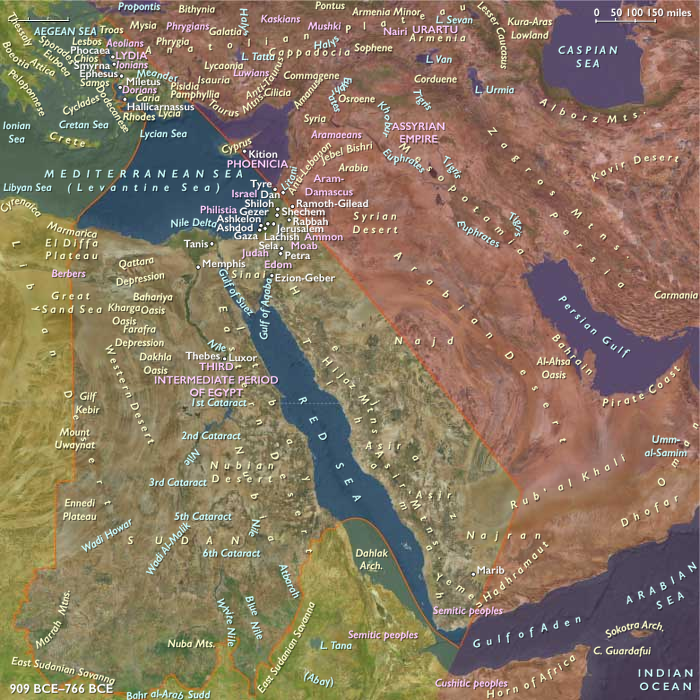
During the brief era of 789 to 778 BCE, the Assyrian Empire, under the reign of Shalmaneser IV, continues its assertive territorial expansion, notably extending into regions of what is today modern Armenia. Shalmaneser IV, succeeding the military-focused policies of his predecessors, consolidates Assyrian power in strategically significant northern territories, thus solidifying Assyrian control over critical borderlands.
The incorporation of Armenian territories represents both a strategic and economic achievement for Assyria. These newly conquered areas offer valuable resources, including metal deposits and fertile land, crucial for maintaining Assyria's expansive military and construction activities. Shalmaneser IV's success in Armenia further underscores Assyria's dominance over neighboring kingdoms and reinforces its reputation as a formidable military power capable of projecting influence far beyond its core region.
Despite the brevity of this era, the territorial acquisitions in Armenia under Shalmaneser IV have lasting implications for regional dynamics. The strengthening of Assyrian presence in the north effectively counters the rising influence of Urartu, Assyria's principal rival in the region, setting the stage for ongoing geopolitical tensions in subsequent decades.
Thus, the era from 789 to 778 BCE highlights Assyria’s continued territorial ambitions and strategic military successes, significantly shaping the evolving political landscape of the Middle East.
Shalmaneser IV, who reigns from at least 824 BCE, successfully incorporates portions of what is today Armenia into the Assyrian empire.
The Near East (789–778 BCE): Expansion of Judah under Uzziah
The period 789–778 BCE in the Near East witnesses the long and influential reign of Uzziah (also known as Azariah), king of Judah. According to the Hebrew Bible, Uzziah ascends the throne around 791 BCE, ruling for an impressive fifty-two years; however, Assyrian records present a slightly shorter reign of approximately forty-two years, spanning 783–742 BCE. Regardless of this chronological discrepancy, his tenure represents a significant era in Judah’s history.
Uzziah proves to be a capable and ambitious ruler, known particularly for his military successes and territorial expansion. Early in his reign, Uzziah undertakes a successful military campaign against the Philistines, capturing the strategically significant city of Ashdod (2 Chronicles 26:6). This victory not only enhances Judah's geopolitical influence but also expands its control over critical trade routes along the Mediterranean coast, further strengthening its economic foundations.
Simultaneously, in the northern kingdom, Jeroboam II continues his prosperous reign in Israel around 785 BCE, overseeing sustained economic growth and territorial consolidation.
Thus, between 789 and 778 BCE, Judah under Uzziah emerges as a powerful regional actor, mirroring the resurgence taking place concurrently in the northern kingdom under Jeroboam II. This era reflects a notable phase of renewed strength and stability for both Hebrew kingdoms, despite lingering differences and underlying tensions.
The Philistine city of Ashdod falls to Uzziah (2 Chronicles 26:6).
Jeroboam II reigns over Judah in about 785 BCE.
Zhou crown prince Ji Yijiu flees to the east after western barbarian tribes sack the capital.
During the flight from the western capital to a new location in the east, the Zhou king relies on the nearby lords of Qi, Zheng, and Jin for protection from barbarians and rebellious lords.
He moves the Zhou capital from Zongzhou (Hao), near Xi'an (Sian) to …
…Chengzhou (today Luoyang) in the Yellow River valley.
The fleeing Zhou elite do not have strong footholds in the eastern territories; even the crown prince's coronation has to be supported by those states to be successful.
The Middle East, 777 to 766 BCE: Turbulence and Transition in Assyria
During the era of 777 to 766 BCE, the Assyrian Empire faces significant internal and external challenges, which profoundly impact its territorial integrity and political stability. Following Shalmaneser IV's aggressive military campaigns, particularly against Damascus, Assyria endures a critical setback when Shalmaneser IV is defeated and killed in 772 BCE. This loss results in substantial territorial reversals, notably the loss of most of Syria, which had been painstakingly secured by his predecessors.
The defeat and death of Shalmaneser IV trigger a tumultuous succession crisis that further destabilizes the empire. The ensuing internal strife weakens Assyrian central authority, creating vulnerabilities that neighboring powers, particularly Urartu and various Aramean states, are quick to exploit. This era sees Assyria struggling to maintain its hold over peripheral regions, as regional governors and local leaders increasingly assert independence in the wake of weakened imperial oversight.
Despite these challenges, the Assyrian core territories remain relatively intact, enabling the empire to gradually reorganize and reconsolidate its power in subsequent years. However, the geopolitical landscape of the Middle East during this period is notably marked by increased fragmentation and competition among regional states, reflecting a broader period of turbulence and transition.
Thus, the era from 777 to 766 BCE illustrates a pivotal moment in Assyrian history, characterized by significant territorial losses, internal strife, and the eventual necessity of rebuilding imperial strength and governance structures to reassert Assyrian dominance in the region.
Shalmaneser IV’s military campaigns against Damascus lead to his defeat and death in 772, resulting in the loss of most of Syria during the succession dispute that follows.
The Near East (777–766 BCE): Judah's Power and Amaziah’s Turbulent End
Between 777 and 766 BCE, the kingdom of Judah experiences a remarkable peak in its political and military strength under the rule of Uzziah (also known as Azariah). His long and prosperous reign sees extensive territorial expansion, significant military advancements, and notable economic growth.
Uzziah successfully campaigns against neighboring nations, securing tribute from the Ammonites and expanding Judah's control westward into Philistia, including the strategic capture of the city of Jamnia, previously inhabited by the Philistines. Domestically, his administration initiates ambitious infrastructure projects. Jerusalem's defenses are strengthened significantly, with walls reconstructed, watchtowers added, and sophisticated siege engines strategically placed to defend the capital. Additionally, Judah's agricultural capacity expands notably through systematic water conservation efforts, reclaiming previously arid regions and enhancing the kingdom’s prosperity.
Simultaneously, Judah’s relations with Edom remain fraught with conflict, extending from earlier tensions during the reign of Uzziah’s predecessor, Amaziah. Earlier in his reign, Amaziah had sought to re-subjugate Edom, even capturing Sela (Petra), the Edomite capital. Initially, Amaziah had punished his father's murderers and demonstrated obedience to religious mandates by sending away mercenaries from Israel upon a prophet’s command. This decision resulted in a decisive victory over Edom; however, Amaziah soon after embraced the very idols taken from the Edomites, leading to religious and political deterioration.
The repercussions of this shift prove disastrous. Amaziah rashly challenges Jehoash, the king of Israel, to battle and suffers a devastating defeat, becoming Jehoash’s prisoner. His humiliating defeat precipitates a deadly conspiracy within Judah itself, culminating in his assassination in 768 BCE at Lachish, to which he had fled for refuge. Amaziah’s body is returned to Jerusalem and buried in the royal sepulcher, marking a grim conclusion to a reign characterized by initial promise and later decline.
Thus, the era 777–766 BCE encapsulates both Judah’s zenith under Uzziah and the tragic end of Amaziah, reflecting a period of significant geopolitical ambition, internal strife, and dramatic reversals of fortune.

Years: 789BCE - 778BCE
Locations
People
Groups
- Hebrews
- Judah, Kingdom of
- Israel (Northern Kingdom of)
- Assyria, (New) Kingdom of (Neo-Assyrian Empire)