
US efforts to contain the spread of …
Years: 1948 - 1959
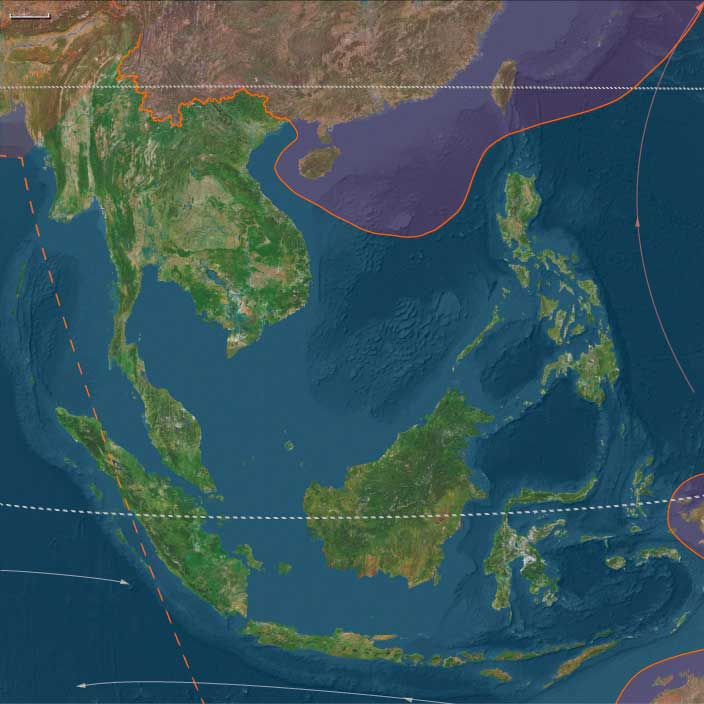
US efforts to contain the spread of Communism in Asia involve forging alliances with tribes and warlords inhabiting the areas of the “Golden Triangle”, an expanse covering Laos, Thailand and Burma, thus providing accessibility and protection along the southeast border of China.
In order to maintain their relationship with the warlords while continuing to fund the struggle against communism, the US and France supply the drug warlords and their armies with ammunition, arms and air transport for the production and sale of opium.
This results in an explosion in the availability and illegal flow of heroin into the United States and into the hands of drug dealers and addicts.
Locations
Groups
- United States of America (US, USA) (Washington DC)
- France (French republic); the Fourth Republic
- CIA (Central Intelligence Agency of the U.S.A.)
- Burma, Union of
- Thailand, Kingdom of
- Laos, Kingdom of
Topics
- Chinese Civil War
- Chinese Civil War of 1945-49
- Indochina War, First, or French Indochina War of 1946-54
- Cold War
Commodoties
Subjects
Regions
Related Events
Filter results
Showing 10 events out of 4916 total
Another seven to eight million people had been internally deported to remote areas of the Soviet Union (including entire nationalities or ethnicities in several cases).
The size, scope, and scale of the Gulag slave-labour camps remain subjects of much research and debate.
Many Gulag camps operate in extremely remote areas of northeastern Siberia.
The best-known clusters include Sevvostlag (the North-Eastern Corrective Labor Camps) along the Kolyma and Norillag near Norilsk, where sixty-nine thousand prisoners live in 1952.
Major industrial cities of Northern Siberia, such as Norilsk and Magadan, will develop from camps built by prisoners and run by former prisoners.
North Polynesia (1948–1959 CE)
Postwar Prosperity and Economic Diversification
Between 1948 and 1959, North Polynesia—particularly the Territory of Hawaii—experienced significant economic growth and diversification following World War II. The reduction in military expenditures necessitated a transition toward a more diversified economy, emphasizing tourism, construction, and revitalized agricultural sectors beyond traditional sugar and pineapple industries. Federal programs and investments, such as the G.I. Bill, greatly contributed to the islands' economic stability and growth, promoting higher education, homeownership, and business development among residents.
Boom in Tourism and Infrastructure Development
Tourism emerged as a central pillar of North Polynesia's postwar economy, with the Hawaiian Islands gaining prominence as an international travel destination. Investments in hotel construction, airport expansion, and infrastructure enhancements facilitated rapid growth in tourist arrivals, creating substantial employment opportunities and stimulating related sectors, including retail, entertainment, and transportation.
Agricultural Shifts and Labor Dynamics
Agriculture underwent notable transformation during this period. While sugar and pineapple remained significant, diversification included new cash crops such as coffee, macadamia nuts, and tropical fruits. Mechanization and modernization improved productivity but also altered labor dynamics, leading to reduced employment opportunities in traditional plantation sectors and necessitating shifts toward service industries and construction.
Social Transformations and Civil Rights Advances
Postwar North Polynesia witnessed important social changes and progress in civil rights. Labor movements became increasingly influential, successfully advocating for better wages, working conditions, and social benefits. The International Longshore and Warehouse Union (ILWU) notably played a crucial role, representing diverse ethnic communities and helping dismantle historical labor inequalities.
Cultural Renaissance and Identity
This period saw a burgeoning cultural renaissance marked by increased recognition and celebration of Hawaiian heritage. Initiatives in education and media encouraged preservation and revitalization of traditional cultural practices, language, music, and dance. The cultural resurgence became a source of pride and identity for the indigenous and local populations amidst rapid modernization and Americanization.
Military Presence and Strategic Importance
Despite the end of wartime conditions, the strategic importance of North Polynesia persisted. The Korean War (1950–1953) reinforced Hawaii's position as a critical U.S. military hub in the Pacific, ensuring continued federal investment in military facilities and maintaining a significant military presence. This contributed to regional economic stability but also raised ongoing concerns about land use, environmental impact, and community relations.
Political Mobilization and Statehood Movement
Political activism intensified, driven by a collective desire for greater autonomy, representation, and statehood. Local leaders and organizations worked diligently to build consensus and lobby for admission to the United States as a state. In 1959, after sustained advocacy, a referendum was overwhelmingly approved by local residents, paving the way for formal statehood.
Hawaii's Admission as the 50th State
On August 21, 1959, Hawaii officially became the 50th state of the United States, marking a historic milestone for North Polynesia. This achievement represented the culmination of decades-long political efforts and signified recognition of the islands' strategic importance, economic contributions, and diverse cultural heritage within the broader American context.
Educational Expansion and Public Health Advances
Educational infrastructure expanded significantly during this period, supported by federal and state investments. The University of Hawaii system grew substantially, offering broader access to higher education for residents. Simultaneously, public health initiatives, building upon wartime medical advancements, significantly improved healthcare access, infrastructure, and overall population health.
Conclusion of the Era
Between 1948 and 1959, North Polynesia navigated substantial postwar adjustments, experiencing economic prosperity, social transformation, and significant political developments. The culmination of these changes was the historic admission of Hawaii as a U.S. state, setting the stage for future growth and cementing the region's critical role in American and Pacific affairs.
The United States makes states of the territories of Alaska (January 3, 1959) and
Wartime intelligence operative John Robert Kerr’s work for Australia’s Directorate of Research and Civil Affairs will later gave rise to many conspiracy theories.
Kerr was born in Balmain, a working-class suburb of Sydney, where his father was a boilermaker.
After graduating the Fort Street High School (formerly Fort Street Boys' High School), he won scholarships to the University of Sydney and graduated in law with first class honors and the University Medal, being called to the New South Wales bar in 1938.
At Fort Street, he met Dr H.V.
Evatt, who would later became a judge of the High Court of Australia, and became a protégé of his for many years.
In 1938, Kerr had married Alison Worstead, generally known as Peggy, with whom he had had three children.
In 1946, he had become principal of the Australian School of Pacific Administration and the first Secretary-General of the South Pacific Commission.
Returning to the bar in 1948, he becomes a prominent lawyer representing trade union clients and a member of the Australian Labor Party.
Intending to seek Labor endorsement for a parliamentary seat at the 1951 election, he withdraws in favor of another candidate.
After the Labor split of 1955, however, he becomes disillusioned with party politics.
He dislikes what he sees as the leftward trend of the Australian Labor Party under Evatt's leadership, but is not attracted to the breakaway group, the Democratic Labor Party.
During the decade of the 1950s, he joins the anticommunist advocacy group established by the United States' CIA, the Association for Cultural Freedom, joining its Executive Board in 1957.
Kerr becomes a regular contributor to the ASCF’s house organ, Quadrant.
Maritime East Asia (1948–1959 CE): Cold War Divisions, Revolutionary Transformations, and Economic Foundations
Between 1948 and 1959 CE, Maritime East Asia—encompassing lower Primorsky Krai, the Korean Peninsula, the Japanese Archipelago south of northern Hokkaido, Taiwan, and southern, central, and northeastern China—experiences profound transformations driven by Cold War divisions, revolutionary upheaval, ideological consolidation, and rapid economic rebuilding. The period decisively shapes regional identities, creating geopolitical alignments and lasting legacies.
China: Communist Victory and Maoist Reconstruction
In 1949, after years of civil war, Communist forces under Mao Zedong decisively defeat the Nationalist government, establishing the People’s Republic of China (PRC) on October 1. The defeated Nationalist government, led by Chiang Kai-shek, retreats to Taiwan, maintaining a rival government as the Republic of China (ROC).
The PRC initiates radical restructuring under Maoist ideology, including sweeping land reform, collectivization, and centralized economic planning. Campaigns like the Great Leap Forward (1958–1961) aim to rapidly industrialize and collectivize agriculture but result in severe famine and human suffering. Despite these setbacks, the period fundamentally reshapes China’s social, economic, and political landscape.
Korea: Division, Devastating War, and Entrenched Partition
The division of Korea at the 38th parallel solidifies in 1948, with rival states emerging: the Soviet-supported Democratic People’s Republic of Korea (North Korea) under Kim Il-sung, and the U.S.-backed Republic of Korea (South Korea) led by Syngman Rhee. Tensions erupt into open conflict with the outbreak of the Korean War (1950–1953), as North Korea invades the South aiming for reunification by force.
The war devastates the peninsula, involving Chinese intervention on behalf of North Korea and extensive United Nations support for South Korea. A ceasefire in 1953 establishes the heavily fortified Demilitarized Zone (DMZ), leaving the peninsula divided, scarred by immense human and economic costs, and firmly entrenched in Cold War geopolitics.
Japan: Postwar Reconstruction and Economic Miracle Foundations
Under continued American occupation until 1952, Japan undergoes extensive political, economic, and social reforms, including democratization, land redistribution, educational reform, and economic restructuring. The San Francisco Peace Treaty (1951) formally ends the occupation, restoring Japanese sovereignty but maintaining a robust U.S. security presence.
Japan’s recovery accelerates rapidly, driven by industrial innovation, technological advancement, and government-led economic policies focused on export-oriented growth. By the late 1950s, the foundations of Japan’s future economic miracle are firmly laid, positioning the country as a rising global economic power and essential U.S. ally in the region.
Taiwan: Nationalist Refuge and Economic Reorientation
Taiwan becomes the refuge for Chiang Kai-shek’s Nationalist government following its defeat on the mainland in 1949. Initially imposing authoritarian rule and martial law (1949–1987), the ROC government embarks on economic reforms, agricultural modernization, industrialization, and infrastructure expansion.
Taiwan’s economy experiences robust growth, aided by American economic and military support. Rapid industrialization, land reform, and improved education significantly raise living standards, transforming Taiwan into a thriving economic entity. Nevertheless, political tensions and identity debates persist, influenced by complex interactions between mainland refugees and indigenous Taiwanese populations.
Legacy of the Era: New Regional Realities and Lasting Impacts
The years 1948 to 1959 CE decisively reshape Maritime East Asia, embedding Cold War geopolitical realities into the region’s core identity. China embarks on revolutionary transformations with far-reaching consequences. The Korean Peninsula is entrenched in division, its ongoing tensions emblematic of broader ideological conflict. Japan rebuilds, laying the foundations for future economic prosperity and geopolitical significance. Taiwan consolidates economically under authoritarian rule, establishing a distinct identity amid regional complexities. Collectively, these dramatic developments profoundly influence subsequent regional dynamics, with lasting impacts on East Asian and global affairs.
Malayans wage a terrorist campaign against British imperialism.
East Europe (1948–1959 CE): Cold War Intensification and Stalinist Consolidation
Political and Military Developments
Formation and Consolidation of the Eastern Bloc
During this era, the Soviet Union firmly consolidated control over Eastern Europe, formalizing communist regimes across countries such as Poland, East Germany (German Democratic Republic), Czechoslovakia, Hungary, Romania, and Bulgaria. These nations collectively formed the Eastern Bloc, solidifying the geopolitical division between East and West.
NATO and Warsaw Pact Formation
In response to the Western alliance (NATO, 1949), the Soviet Union and its Eastern European allies formed the Warsaw Pact in 1955, significantly shaping Cold War geopolitics. The Pact institutionalized military cooperation and strategic alignment within the Eastern Bloc.
Soviet Military Expansion and Nuclear Arms Race
Military capabilities significantly expanded, with extensive modernization of conventional forces and intensified development of nuclear weapons. This period marked the onset of the nuclear arms race with Western powers, heightening global Cold War tensions.
Economic and Technological Developments
Centralized Economic Planning and Industrial Growth
Economic policies were dominated by centralized planning, emphasizing heavy industry, infrastructure development, and resource extraction. Industrial production expanded rapidly, supporting both domestic reconstruction and military requirements.
Technological Advancements
Technological advancements accelerated, particularly in nuclear technology, aerospace, and military-industrial sectors. The launch of Sputnik 1 in 1957 marked a significant Soviet achievement, igniting the global Space Race.
Cultural and Artistic Developments
Continued Cultural Control and Socialist Realism
The Soviet regime maintained tight cultural control, promoting Socialist Realism as the exclusive artistic standard. Artistic and literary works were strictly regulated to align with ideological objectives, emphasizing socialist achievements and collective goals.
Educational Expansion and Scientific Development
Educational institutions expanded significantly, emphasizing scientific and technical fields to meet industrial and military needs. The period saw notable advancements in science education and research, solidifying Soviet technological capabilities.
Settlement Patterns and Urban Development
Accelerated Urbanization and Housing Development
Eastern European cities rapidly expanded to accommodate growing populations and industrial activity. Urban planning emphasized mass housing projects, improved infrastructure, and efficient transportation networks to support industrial productivity.
Fortified Borders and Military Infrastructure
Strategic infrastructure, including fortified borders and extensive military installations, was significantly developed, reflecting ongoing geopolitical tensions and preparedness for potential Cold War conflicts.
Social and Religious Developments
Intensified Social Control and Repression
Social policies during this period were characterized by intensified state control, surveillance, and political repression. Dissent was systematically suppressed, maintaining a rigidly controlled social order aligned with Stalinist policies.
Continued Anti-Religious Measures
Anti-religious policies remained vigorous, with religious practices severely restricted, clergy persecuted, and religious institutions dismantled or heavily controlled. The state continued promoting atheism as the ideological standard.
Long-Term Consequences and Historical Significance
The period from 1948 to 1959 CE was pivotal for Eastern Europe, marked by intense Cold War divisions, extensive Soviet consolidation, and accelerated technological and economic development. The establishment of the Warsaw Pact and significant military and technological achievements solidified Eastern Europe's strategic importance, shaping global political dynamics profoundly in subsequent decades.
The Soviet Union, having become the world's second nuclear power, establishes the Warsaw Pact alliance, and enters into a struggle for global dominance, known as the Cold War, with the rivaling United States and NATO.
After Stalin's death in 1953 and a short period of collective rule, the new leader Nikita Khrushchev denounces Stalin and launches the policy of de-Stalinization, releasing many political prisoners from the Gulag labor camps.
The general easement of repressive policies will become known later as the Khrushchev Thaw.
In 1957, the Soviet Union launches the world's first artificial satellite, Sputnik 1, thus starting the Space Age.
Northeast Europe (1948–1959 CE): Cold War Division, Reconstruction, and Paths to Welfare and Stability
Between 1948 and 1959 CE, Northeast Europe entered the Cold War era profoundly divided. Finland navigated cautious neutrality under Soviet oversight; Estonia, Latvia, and Lithuania endured harsh Soviet occupation and forced integration into the USSR; and Denmark, Sweden, and Norway experienced robust democratic stability, economic recovery, and welfare-state development under a Western orientation. This era solidified the ideological, political, and economic divisions across the region, shaping its trajectory deeply into the latter half of the twentieth century.
Finland: Neutrality, Reconstruction, and the "Paasikivi–Kekkonen" Doctrine
Finland, though maintaining independence, occupied a precarious geopolitical position adjacent to the Soviet Union. The Finnish government carefully navigated its sovereignty through the influential Paasikivi–Kekkonen Doctrine, formulated by presidents Juho Kusti Paasikivi (1946–1956) and his successor Urho Kekkonen (1956–1982). This doctrine prioritized neutrality, cooperation, and pragmatic accommodation of Soviet interests to preserve national independence.
In 1948, Finland signed the Treaty of Friendship, Cooperation, and Mutual Assistance with the Soviet Union, institutionalizing Finnish neutrality and limiting its foreign policy autonomy. Despite restrictions, Finland engaged in extensive postwar reconstruction and economic recovery. Finnish industries—particularly forestry, paper, metal, and shipbuilding—rebounded impressively, bolstered by extensive trade with the Soviet Union, Western Europe, and the United States. Finnish society also began laying foundations for what would become its highly admired welfare state.
Baltic States: Soviet Occupation, Resistance, and Russification
Estonia, Latvia, and Lithuania endured continued Soviet occupation as forcibly integrated republics within the Soviet Union. The late 1940s and 1950s saw intensified Sovietization policies: mass deportations, imprisonment, collectivization of agriculture, and suppression of national cultures and languages. These actions aimed at erasing national identities and enforcing Soviet conformity.
Yet, resistance persisted. Forest Brothers, Baltic partisans fighting Soviet rule, maintained guerrilla warfare into the early 1950s, symbolizing Baltic resilience. Secret educational networks, underground literature, and clandestine cultural activities sustained national identities despite oppressive Soviet rule. Nevertheless, economic hardship, demographic changes due to Russian immigration, and harsh Russification policies defined Baltic experiences throughout this era.
Denmark: Democratic Stability, NATO Membership, and Welfare State Development
Denmark, experiencing rapid recovery from wartime occupation, fully embraced Western integration. In 1949, Denmark became a founding member of NATO, significantly shaping its security and diplomatic orientation during the Cold War.
Denmark enjoyed stable democratic governance under successive Social Democratic governments led prominently by Prime Minister Hans Hedtoft (1947–1950, 1953–1955) and subsequently H.C. Hansen (1955–1960). Economic recovery was rapid, driven by agriculture modernization, industrial expansion, and extensive public infrastructure projects. Denmark implemented progressive social reforms, greatly expanding its welfare state, improving healthcare, education, housing, and social security, setting a high standard of living and economic equality.
Norway: Postwar Reconstruction, NATO Membership, and Social Welfare Expansion
Norway’s postwar recovery under Prime Minister Einar Gerhardsen (1945–1951, 1955–1965) was similarly robust. Norway also joined NATO in 1949, aligning its security interests with Western democracies against potential Soviet threats.
Economic recovery and modernization in Norway were supported by the U.S.-led Marshall Plan and domestic investments in industry, infrastructure, and education. Norway’s welfare state expanded substantially, focusing on comprehensive healthcare, education, social services, and workers' rights. Politically stable and socially cohesive, Norway solidified its democratic traditions and emerged as a prosperous, welfare-oriented society.
Sweden: Neutrality, Prosperity, and Welfare State Excellence
Sweden, maintaining its policy of armed neutrality established during World War II, became a model of economic prosperity and social welfare. Swedish neutrality facilitated extensive international diplomatic influence, promoting human rights, peace initiatives, and global cooperation through the United Nations.
Under the long tenure of Prime Minister Tage Erlander (1946–1969), Sweden enjoyed remarkable economic expansion, technological innovation, and comprehensive welfare state development. Major reforms provided universal healthcare, improved pensions, expanded educational opportunities, and advanced labor rights, creating one of the world's most admired welfare systems. Sweden’s prosperous economy, bolstered by manufacturing and technology sectors, positioned the nation as an exemplar of stable democracy and social equity.
Economic Divergence: Prosperity vs. Stagnation
The economic divide between the Nordic states (Denmark, Norway, and Sweden) and the Baltic region under Soviet rule became pronounced during this period. Nordic economies rapidly industrialized, modernized, and expanded their welfare programs, greatly improving citizens' quality of life. In contrast, Estonia, Latvia, and Lithuania, burdened by forced collectivization and inefficient Soviet central planning, faced economic stagnation, shortages, and hardship.
Finland occupied a unique economic middle ground. Though politically constrained by Soviet influence, Finland effectively balanced Eastern trade with Western economic engagement, fostering steady growth and robust industrial expansion, setting the foundation for future prosperity.
Cultural Development and Identity Preservation
Despite political division, all nations preserved and enhanced their cultural identities. Finland, under neutrality and careful diplomacy, cultivated thriving national literature, education, and arts, exemplified by cultural icons like composer Jean Sibelius, whose legacy continued into this era.
In the Baltic states, culture became a means of resistance against Soviet suppression. Secret cultural societies, clandestine publication of banned literature, and preservation of languages sustained national identities despite harsh Sovietization attempts.
Scandinavian cultural life flourished openly. Denmark, Sweden, and Norway invested heavily in arts, education, and media, fostering vibrant cultural scenes with notable contributions in literature, film, and design. Cultural openness, innovation, and educational excellence became hallmarks of the Nordic region.
Diplomatic Alignment and Regional Cooperation
This period solidified the geopolitical division of Northeast Europe. Finland’s neutrality policy was meticulously balanced between Soviet pressures and Western opportunities. Estonia, Latvia, and Lithuania remained isolated behind the Iron Curtain, under Soviet control and integrated within the Eastern Bloc.
Denmark and Norway’s NATO membership and Sweden’s active neutrality and international diplomacy strengthened their collective Western orientation. Increasingly, Nordic cooperation—culturally, economically, and diplomatically—became significant, laying groundwork for deeper regional integration in subsequent decades.
Technological and Educational Progress
Throughout the region, educational and technological advancements progressed significantly. Finland, Denmark, Norway, and Sweden achieved major strides in science, industry, engineering, and education, producing highly educated populations and innovative economies. These nations rapidly embraced technological innovations, improved infrastructure, transportation, and communications, facilitating economic growth and societal improvements.
In contrast, Soviet-controlled Baltic states suffered from isolation and restrictive policies, limiting genuine educational advancement and innovation despite high literacy rates.
Legacy of the Era
The period 1948–1959 CE defined Northeast Europe's historical path through pronounced Cold War divisions. Finland preserved its independence through strategic neutrality and prudent diplomacy. Estonia, Latvia, and Lithuania endured severe hardships under Soviet occupation, yet maintained resilient national identities. Denmark, Sweden, and Norway achieved political stability, democratic vitality, economic prosperity, and social welfare excellence, becoming models of democratic governance.
These formative Cold War years profoundly influenced regional identities, societal structures, geopolitical alignments, and cultural trajectories, setting the stage for evolving political developments, eventual liberation movements, and deeper regional cooperation in subsequent decades.
East Central Europe (1948–1959 CE): Communist Consolidation, Stalinist Repression, and Early Cold War Realities
Between 1948 and 1959 CE, East Central Europe—encompassing modern-day Poland, Czechia, Slovakia, Hungary, and those portions of eastern Germany and Austria east of 10°E and north of the line running from roughly 48.2°N at 10°E southeastward to the Austro-Slovenian border near 46.7°N, 15.4°E—was firmly integrated into the Soviet sphere of influence, marking the early stages of the Cold War. This era was defined by the entrenchment of communist rule, widespread Stalinist political repression, forced economic collectivization, and sporadic resistance efforts culminating in dramatic uprisings.
Political and Military Developments
Soviet Satellite States and Stalinization (1948–1953)
By 1948, Soviet-backed communist parties firmly controlled Poland, Hungary, and Czechoslovakia, imposing Stalinist regimes characterized by centralized economic planning, secret police terror, show trials, and suppression of political opposition.
-
In February 1948, the Czechoslovak Communist Party, led by Klement Gottwald, seized total power in the so-called Prague Coup, ending Czechoslovak democracy and establishing a Soviet-style dictatorship.
-
Poland and Hungary similarly experienced intense Stalinist consolidation, with leaders like Bolesław Bierut in Poland and Mátyás Rákosi in Hungary imposing severe repression.
East Germany and the Formation of the GDR (1949)
In October 1949, the Soviet-occupied zone of Germany officially became the German Democratic Republic (GDR), governed by the Socialist Unity Party (SED). Under leader Walter Ulbricht, the GDR aligned firmly with Soviet policies, initiating harsh political repression and strict border controls.
Austrian Neutrality (1955)
In 1955, Austria secured independence and neutrality with the signing of the Austrian State Treaty, resulting in the withdrawal of occupying Allied and Soviet forces. Austria thereby emerged as a neutral buffer state between East and West.
Uprisings and Resistance (1953–1956)
Growing dissatisfaction with Soviet-imposed regimes triggered significant popular resistance:
-
The East German Uprising (June 1953) erupted with mass protests against harsh working conditions and political oppression, violently suppressed by Soviet tanks.
-
The Hungarian Revolution (October–November 1956) represented the most significant rebellion, briefly toppling communist rule and installing reformist leader Imre Nagy, before being crushed by Soviet military intervention, resulting in thousands of casualties and mass emigration.
Economic and Technological Developments
-
Soviet-style central planning imposed extensive industrialization, heavy industry growth, and agricultural collectivization.
-
Economic policies caused severe disruptions, shortages, declining living standards, and widespread dissatisfaction, exacerbating social tensions.
Cultural and Social Developments
-
Communist authorities enforced strict censorship, promoting Soviet-style socialist realism in arts and education.
-
Religious institutions, notably the Catholic Church in Poland and Hungary, became focal points of passive resistance, despite severe restrictions and persecutions.
Settlement and Urban Development
-
Large-scale industrial projects transformed urban landscapes, creating industrial towns and emphasizing socialist-style housing and architecture.
Long-Term Consequences and Historical Significance
This era, defined by Stalinist repression, mass political trials, popular uprisings, and the hardening of Cold War divisions, decisively shaped the trajectory of East Central Europe. It entrenched Soviet control and ideological conformity, but also highlighted the region’s persistent resistance and aspiration for greater political and cultural autonomy, foreshadowing future conflicts and reforms.
Years: 1948 - 1959
Locations
Groups
- United States of America (US, USA) (Washington DC)
- France (French republic); the Fourth Republic
- CIA (Central Intelligence Agency of the U.S.A.)
- Burma, Union of
- Thailand, Kingdom of
- Laos, Kingdom of
Topics
- Chinese Civil War
- Chinese Civil War of 1945-49
- Indochina War, First, or French Indochina War of 1946-54
- Cold War
Commodoties
Subjects
Regions