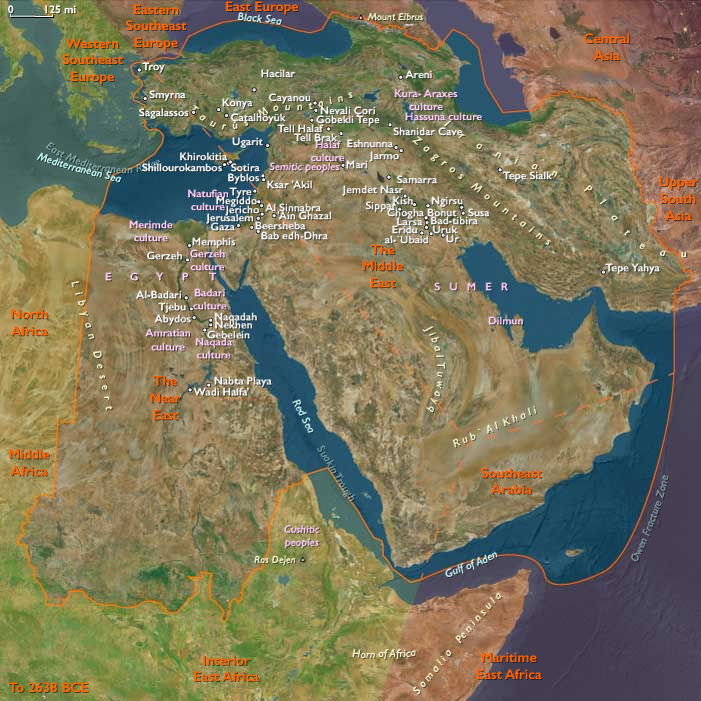
Uruk, situated east of the present bed …
Years: 3933BCE - 3790BCE
Uruk, situated east of the present bed of the Euphrates river, on the ancient dry former channel of the Euphrates River, some thirty kilometers east of modern As-Samawah, Al-Muthann, Iraq, is eponymous of the Uruk period, which is the protohistoric Chalcolithic to Early Bronze Age period in the history of Mesopotamia spanning from around 4000 BCE to about 3100 BCE.
It is succeeded by the Jemdet Nasr period of Sumer proper.
In myth, Uruk was founded by Enmerkar, who brought the official kingship with him, according to the Sumerian king list.
He also, in the epic Enmerkar and the Lord of Aratta, constructs the Eanna (Sumerian: E2-ana, 'House-of-Heavens') temple for the goddess Inanna in the Eanna District of Uruk.
Uruk plays a leading role in the early urbanization of Sumer in the mid-fourth millennium BCE.
Starting from the Early Uruk period, Uruk exercises hegemony over nearby settlements.
At this time (about 3800 BCE), there are two centers of twenty hectares, Uruk in the south and Nippur in the north, surrounded by much smaller ten-hectare settlements.
Locations
Groups
Topics
Subjects
Regions
Subregions
Related Events
Filter results
Showing 10 events out of 68811 total
The Rise of Sheep Husbandry and the Introduction of Wool Textiles in the Linear Pottery Culture
As sheep became more common among the Linear Pottery culture (LBK) peoples, their economic role expanded beyond meat and milk production to include the use of wool as a fiber source for textiles. This development marked a significant technological and cultural shift in early Neolithic Europe.
Sheep and the Emergence of Wool Production
- Early domesticated sheep were primarily raised for meat, hides, and possibly milk, but over time, selection for woolly fleece led to the development of wool-producing breeds.
- Wool provided an alternative to plant fibers, such as flax, which had been the dominant textile material in Neolithic Europe.
- The increase in sheep husbandry suggests a growing reliance on livestock-based economies, complementing crop cultivation.
Impact on Textile Production and Society
- Textile production diversified, with woven woolen fabrics eventually becoming widespread in later Neolithic and Chalcolithic cultures.
- Wool had advantages over flax and other plant fibers:
- Warmer and more insulating, suitable for colder climates.
- Easier to dye and process, allowing for greater textile variety.
- Durable and flexible, making it ideal for clothing, blankets, and trade goods.
- The shift toward sheep-based wool production reflects broader economic and technological advances, including loom weaving and improved textile tools.
Legacy of Wool in Early European Societies
- By the Late Neolithic and Chalcolithic periods, wool textiles had become more prominent in Europe, as evidenced by loom weights, spindle whorls, and textile impressions in pottery.
- The increasing role of sheep husbandry set the foundation for later Bronze Age economies, where textile production and trade became highly specialized.
The adoption of wool-producing sheep among the Linear Pottery peoples represents a key step in the evolution of textile technology, contributing to the expansion of more complex agrarian societies in prehistoric Europe.
The Domestication and Spread of Cattle in South Asia, the Middle East, and Europe (4th Millennium BCE)
By the 4th millennium BCE, domesticated cattle had become an integral part of agrarian societies in South Asia, the Middle East, and Europe, marking a major advancement in agriculture, animal husbandry, and economic development.
Early Domestication of Cattle
- South Asia – The humped zebu (Bos indicus), believed to have originated in India, was domesticated and adapted to hot, arid climates.
- The Middle East and Europe – Taurine cattle (Bos taurus), domesticated in the Fertile Crescent, spread into Anatolia, the Balkans, and Western Europe.
- Early domesticated cattle were used for:
- Milk and meat production
- Plowing and traction (later developments)
- Ritual and religious significance in early cultures
Spread of Zebu Cattle to the Middle East and Africa
- The humped zebu eventually spread westward into the Middle East and Africa, where it was favored for its:
- Heat resistance and drought tolerance, making it well-suited for arid environments.
- Resistance to disease, particularly in tropical and subtropical regions.
- In Africa, zebu cattle influenced local breeds, such as the Sanga cattle, which emerged from hybridization between zebu and indigenous African cattle.
Impact of Cattle Domestication
- Transformed early agricultural economies, providing a stable food source and labor for farming.
- Enabled larger settlements and permanent communities, as cattle herding supported food surpluses.
- Contributed to social and trade networks, with cattle becoming valuable commodities in exchange and tribute systems.
The domestication and spread of cattle was a defining event in early agricultural societies, shaping the development of pastoralism, trade, and human settlement patterns across Eurasia and Africa.
The Domestication of Pigs: A Parallel to Cattle Domestication
Pigs were domesticated around the same time as cattle, in the 4th millennium BCE, though some genetic studies suggest a much earlier domestication event. They likely originated from only two wild species, reflecting a relatively limited genetic lineage compared to other domesticated animals.
Origins of Domesticated Pigs
- Near East and Europe – The Eurasian wild boar (Sus scrofa scrofa) was domesticated in the Fertile Crescent, later spreading into Anatolia and Europe.
- East Asia – The Asian wild boar (Sus scrofa vittatus) was independently domesticated in China and Southeast Asia, leading to genetically distinct pig breeds.
Evidence for Earlier Domestication
- A 1994 study suggested that pigs may have been domesticated much earlier than previously believed, with evidence pointing to pre-Neolithic interactions between humans and wild boars.
- Recent genetic analyses suggest that pig domestication may have begun as early as 9000 BCE in some regions, coinciding with the earliest Neolithic farming cultures.
Impact of Pig Domestication
- Pigs became a crucial livestock species, providing:
- Meat as a high-calorie food source
- Skins and bones for tools and materials
- Unlike cattle and sheep, pigs were more suited to settled agricultural life, thriving on human food waste and requiring less grazing land.
- Over time, domesticated pigs spread through trade and migration, leading to the emergence of regional pig breeds adapted to different environments.
The domestication of pigs and cattle marked a fundamental shift in early agricultural societies, supporting food surpluses, permanent settlements, and economic specialization in Neolithic cultures across Eurasia.
The 5.9 kiloyear event probably initiates the most recent desiccation of the Sahara desert around 3900 BCE, ending the Neolithic Subpluvial.
One of the most intense aridification events during the Holocene, it also triggers worldwide migration to river valleys, e.g., from central North Africa to the Nile Valley, what will lead eventually to the emergence of the first complex, highly organized, state-level societies in the fourth millennium BCE.
It is associated with the last round of the Sahara pump theory.
A model by Claussen et al. (1999) suggested rapid desertification associated with vegetation atmosphere interactions following a cooling event (Bond event 4).
Bond, et al., (1997) identified a North Atlantic cooling episode fifty-nine hundred years ago from ice-rafted debris, as well as other such now called Bond events that indicate the existence of a quasiperiodic cycle of Atlantic cooling events, which occur approximately every fifteen hundred years.
For some reason, all of the earlier of these arid events (including the 8.2 kiloyear event) were followed by recovery, as attested by the wealth of evidence of humid conditions in the Sahara between 10,000 and 6,000 BP.
However, it appears that only a partial recovery, at best, followed the 5.9 kiloyear event, with accelerated desiccation in the millennium that followed.
For example, Cremaschi (1998) describes evidence of rapid aridification in Tadrart Acacus of southwestern Libya, in the form of increased aeolian erosion, sand incursions and the collapse of the roofs of rock shelters.
The 5.9 kiloyear event is also recorded as a cold event in the Erhai Lake (China) sediments.
In the Middle East, the 5.9 kiloyear event leads to the abrupt end of the Ubaid period.
The Funnelbeaker culture marks the appearance of megalithic tombs at the coasts of the Baltic and of the North sea, an example of which are the Sieben Steinhäuser, a group of five dolmens on the Lüneburg Heath in the NATO training area of Bergen-Hohne, in the state of Lower Saxony in northern Germany.
The megalithic structures of Ireland, France, and Portugal are somewhat older and have been connected to earlier archaeological cultures of those areas.
The Middle East (3933–3790 BCE): Urbanization, Metallurgy, and Cultural Transitions
Susa and the Uruk Period
Between 3933 and 3790 BCE, the site of Susa in southwestern Iran became an important urban center during the Uruk period, specifically in its Susa I phase (4000–3700 BCE). Monumental architecture emerged during this era, exemplified by the construction of the "High Terrace," which would later expand substantially during the Susa II phase (3700–3100 BCE) to approximately sixty by forty-five meters. The remarkable artifacts discovered at Susa provide crucial insights into the administrative origins and early writing systems of the Uruk period.
Early Bronze Production
During this era, the earliest known bronze artifacts appeared on the Iranian plateau, notably at Tepe Yahya around 3800 BCE. This early bronze, likely resulting from accidental mixtures of copper with arsenic or antimony, represented a significant technological advancement. Known as "arsenical bronze," such alloys demonstrated superior properties compared to pure copper. While arsenic contamination was common in copper ores, the deliberate creation of arsenical bronze remains a subject of debate, although its presence clearly indicates the technological progression during this period.
Early Settlement at Ur
The city of Ur, at the time located near the mouth of the Euphrates on the Persian Gulf, provides evidence of early occupation dating back to the Ubaid period around 3800 BCE. Early excavations in the 1920s uncovered deep archaeological layers initially interpreted as evidence of the biblical Great Flood. Modern understanding, however, attributes these layers to regular flooding from the Euphrates and Tigris rivers, along with substantial erosion by water and wind. Ur would later flourish as an urban center during the third millennium BCE.
Uruk and Urban Hegemony
The city of Uruk, located east of the modern Euphrates riverbed near As-Samawah, Iraq, became the focal point of the Uruk period, a protohistoric era spanning from about 4000 to 3100 BCE. According to Sumerian mythology, Uruk was founded by Enmerkar, who established kingship and constructed the celebrated Eanna temple dedicated to the goddess Inanna. Around 3800 BCE, Uruk, along with Nippur, emerged as dominant urban centers of approximately twenty hectares each, asserting regional hegemony over surrounding smaller settlements.
Ubaid Art and Social Structure
The Mesopotamian sculpture of the late Ubaid period featured terra cotta statuettes of gods, men, and women. The culture, originating from southern Mesopotamia, maintained clear connections to earlier regional traditions. The Ubaid period notably saw the development of distinct social divisions between agricultural peasants, nomadic pastoralists, and hunter-fisher communities living in reed huts along the Arabian littoral.
Climatic Shifts and Cultural Decline in Arabia
The Arabian Peninsula experienced a significant climatic shift around 3800 BCE, marking the abrupt end of the Arabian Bifacial/Ubaid period in eastern Arabia and the Oman peninsula. The increased aridity, likely linked to the 5.9 kiloyear event at the end of the Older Peron, led to the cessation of semi-desert nomadism and the disappearance of human occupation for nearly a millennium, a period known as the "Dark Millennium."
Areni-1 Cave Discoveries in Armenia
Meanwhile, the cave site Areni-1 in Armenia revealed groundbreaking insights into Bronze Age civilization, showcasing an advanced winemaking enterprise, diverse pottery styles, and numerous Copper Age artifacts dating back approximately six thousand years. These discoveries, including the world’s oldest known winery and leather shoe, reflect sophisticated domestic and agricultural practices, highlighting the broad cultural advancements across the region during this period.
This epoch marks significant developments in urbanization, metallurgy, and sociocultural organization, profoundly shaping subsequent historical trajectories in the ancient Middle East.

Susa I sees the beginning of monumental architecture on the site, with the construction of a 'High Terrace', which is increased during Susa II to measure roughly sixty by forty-five meters.
The most interesting aspect of this site is the objects discovered here, which are the most important evidence available to us for the art of the Uruk period and the beginning of administration and writing.
Defended Neolithic Settlements and Strategic Adaptations (c. 3800 BCE)
By 3800 BCE, Neolithic settlers strategically established their communities in easily defensible locations, such as riverbanks, plateaus, and swamps. This period saw a growing emphasis on security and communal defense, as evidenced by the construction of fortifications and specialized dwellings.
Fortified Settlements and Defensive Structures
-
Many Neolithic villages were reinforced with:
- Wooden palisades, serving as protective barriers.
- Earth embankments and ditches, adding layers of defense.
- Elevated or isolated locations, reducing vulnerability to raids.
-
These fortifications suggest an increasing concern for security, possibly due to inter-group conflicts, competition for resources, or population pressures.
Pile Dwellings in Shallow Lakes (Switzerland and Beyond)
- Evidence of pile dwellings from this period has been found in shallow lake areas across present-day Switzerland, southern Germany, and northern Italy.
- These stilt houses, constructed above water, indicate early adaptations to aquatic environments, providing:
- Natural protection from potential threats.
- Access to fishing and wetland resources.
- Stability in flood-prone landscapes.
The Emergence of Defended Villages in Western Europe
- Around the same time, fortified villages began to appear across Western Europe, reflecting an increasing need for security.
- Defensive settlements were found in regions such as:
- France (e.g., Causewayed enclosures).
- Britain (e.g., Early hilltop enclosures).
- Central and Eastern Europe (e.g., Lengyel culture enclosures).
These developments highlight a significant shift in Neolithic social organization, where permanent settlements, resource management, and defensive strategies became essential for survival and community stability. The rise of fortified settlements marks a key step toward the more complex societies of the later Neolithic and early Bronze Age.
The increased violence noticed historically in both Egypt and throughout the Near and Middle East, leading eventually to the Early Dynastic Period in both the First Dynasty of Egypt and Sumer, is associated with the period of the 5.9 kiloyear event.
James DeMeo and Steve Taylor suggest that this period is associated with the rise of patriarchy, institutionalized warfare, social stratification, abuse of children, the development of the human ego, separation from the body, the rise of anthropomorphic gods and the concept of linear historic time.
The earliest known bronze is produced on the Iranian plateau.