
Urban development in Canaan again began culminating …
Years: 2349BCE - 2206BCE
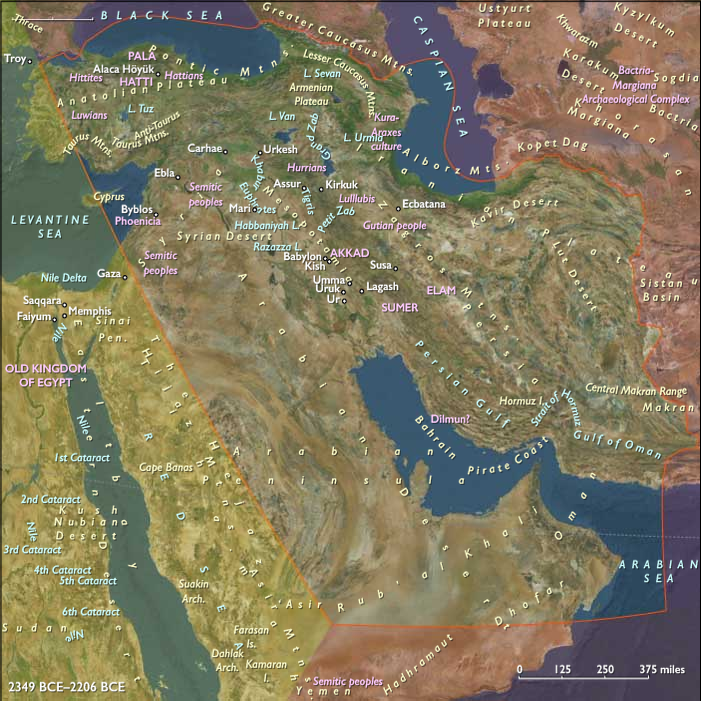
Urban development in Canaan again began culminating in the Early Bronze Age development of sites like Ebla in present northern Syria.
Continuously occupied from before 3000 BCE, its first apogee is between about 2400 and 2240 BCE, having gradually built its empire through trade with the cities of Sumer and Akkad, as well as with peoples to the northwest.
Its name, which means “White Rock” and refers to the limestone outcrop on which the city is built, is mentioned in texts from Akkad from around 2300 BCE.
Scholars believe the language of Ebla to be among the oldest known written Semitic languages.
Most of the Ebla palace tablets, which date from this period, are about economic matters; they provide a good look into the everyday life of the inhabitants, as well as many important insights into the cultural, economic, and political life in northern Mesopotamia around the middle of the third millennium BCE.
The texts are accounts of the state revenues, but they also include royal letters, Sumerian-Eblaite dictionaries, school texts, and diplomatic documents, like treaties between Ebla and other towns of the region.
Ebla's most powerful king is listed as Ebrium, or Ibrium, who concludes the so-called "Treaty with Ashur", which offers king Tudia of Assyria, at this time a minor Akkadian kingdom that evolves in the twenty-third to twenty-first centuries BCE, the use of a trading post officially controlled by Ebla.
The form of government is not well known, but the city appears to have been ruled by a merchant aristocracy who elected a king and entrusted the city's defense to paid soldiers.
The fifth and last king of Ebla during this period is Ebrium's son, Ibbi-Sipish, the first to succeed in a dynastic line, thus breaking with the established Eblaite custom of electing its ruler for a fixed term of office, lasting seven years.
This absolutism may have contributed to the unrest that would ultimately be instrumental in the city's decline.
Meantime, however, the reign of Ibbi-Sipish is considered a time of inordinate prosperity, in part because the king is given to frequent travel abroad.
It was recorded both in Ebla and Aleppo that he concluded specific treaties with neighboring Armi, as Aleppo is called at the time.
Locations
People
Groups
- Mesopotamia
- Sumer
- Mari, City-State of
- Canaanite culture, archaic
- Kish, City-state of
- Lagash, 1st Dynasty of
- Egypt (Ancient), Old Kingdom of
- Hurrians
- Assur, or Ashur, city-state of
- Ebla, Kingdom of
- Akkadian Empire
Topics
Subjects
Regions
Subregions
Related Events
Showing 10 events out of 17 total
Years: 2349BCE - 2206BCE
Locations
People
Groups
- Mesopotamia
- Sumer
- Mari, City-State of
- Canaanite culture, archaic
- Kish, City-state of
- Lagash, 1st Dynasty of
- Egypt (Ancient), Old Kingdom of
- Hurrians
- Assur, or Ashur, city-state of
- Ebla, Kingdom of
- Akkadian Empire
Topics
Subjects
Regions
Subregions