
South Asia (2637 – 910 BCE): Bronze …
Years: 2637BCE - 910BCE
South Asia (2637 – 910 BCE): Bronze and Iron Age Transformations — Cities, Rice, and the First Ocean Routes
Regional Overview
Between the mountains and monsoons, South Asia in the Bronze and early Iron Ages became a cradle of urban complexity, metallurgy, and interoceanic exchange.
Across the Indus Basin and the Deccan Plateau, in Sri Lanka’s dry-zone plains and along the coasts of the Arabian Sea and Bay of Bengal, societies combined irrigation, metallurgy, and seafaring into the foundations of later Indian civilization.
This epoch witnessed both the Indus Civilization’s rise and dispersal and the spread of iron-working and wet-rice agriculture eastward, transforming the subcontinent from riverine cities to agrarian and maritime networks.
Geography and Environment
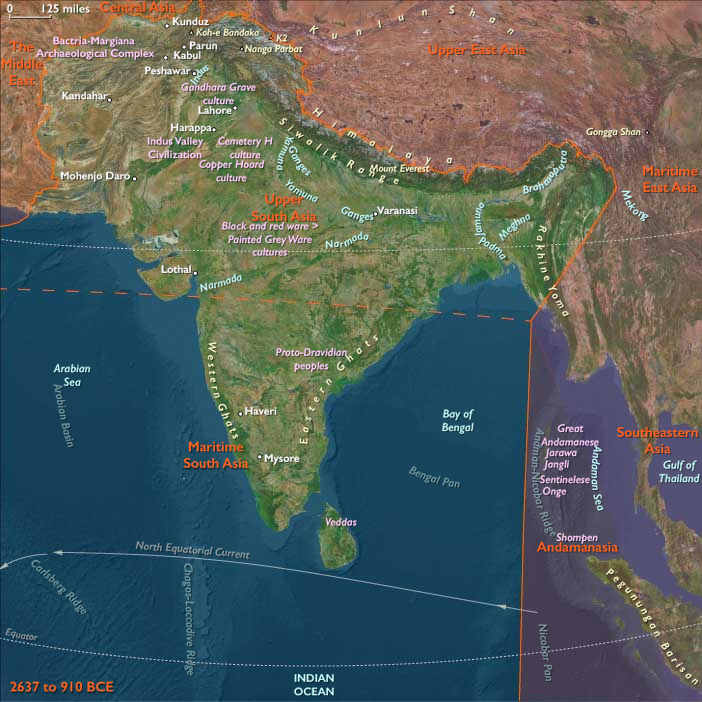
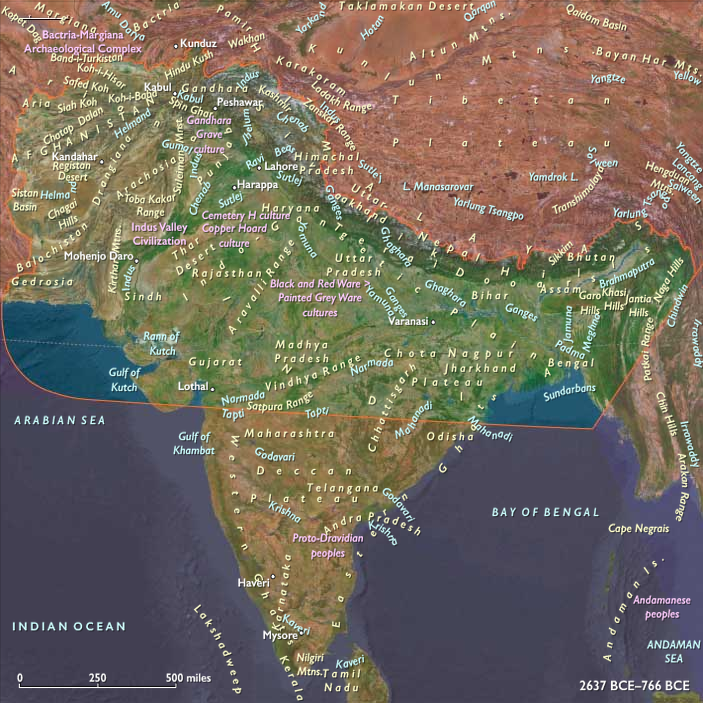
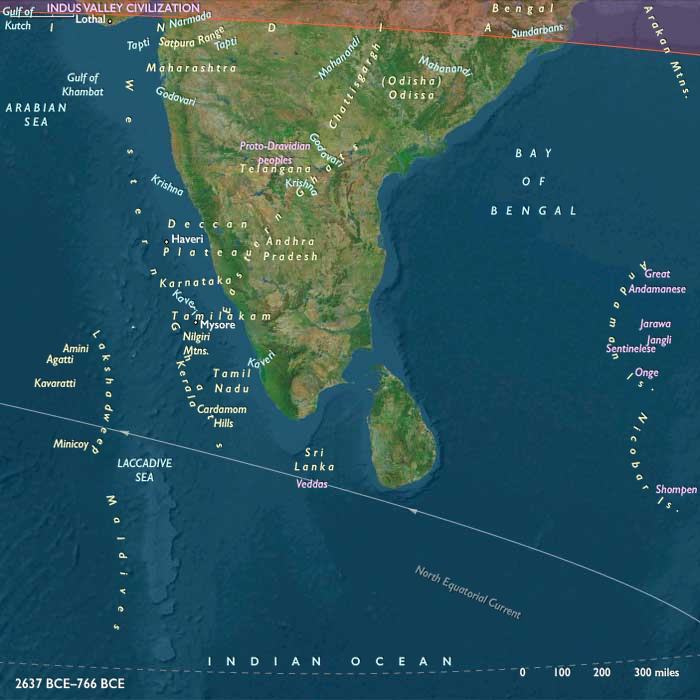
South Asia’s landscapes ranged from the Hindu Kush passes to the Ganga and Brahmaputra deltas, from Deccan basalt uplands to Sri Lanka’s reservoirs and Maldivian atolls.
Monsoon rainfall and snowmelt from the Himalayas nourished dense settlement, while drier western tracts relied on irrigation canals and seasonal rivers.
Aridification after 2000 BCE rebalanced habitation eastward toward the rain-fed Ganga system, while southern peninsulas and islands developed independent agro-maritime economies.
Climate and Environmental Shifts
Holocene climatic moderation gave way to greater monsoon fluctuation.
The Ghaggar–Hakra system desiccated, pushing Indus populations east and south.
In the Deccan and Sri Lanka, alternating wet–dry cycles fostered tank irrigation and multi-crop farming.
Overall, adaptive resilience—diversifying between rice and millet, river and rain—ensured continuity despite shifting rainfall.
Societies and Political Developments
-
Indus Civilization (c. 2600–1900 BCE): Planned cities such as Mohenjo-Daro and Harappa displayed baked-brick architecture, standardized weights, and extensive craft specialization. Their decline after 1900 BCE led to dispersed regional cultures.
-
Post-Harappan and Early Vedic Era: Successor villages in the Punjab and Doab cultivated new crops and livestock under shifting polities; by 1200–600 BCE, the Painted Grey Ware horizon spread across the Ganga plain, foreshadowing later Mahājanapadas.
-
Southern and Island Polities: In the Deccan and Tamilakam, iron-age communities erected megaliths, developed iron ploughs, and organized redistributive chiefdoms; protohistoric Anuradhapura arose in Sri Lanka.
-
Across the northwestern gateways—Gandhara and Bactria—trade and cultural exchange tied South Asia to Iran and Central Asia.
Economy and Technology
Agriculture diversified: wheat and barley in the Indus west, rice and millet in the Ganga east, pulses and cottonthroughout.
Metallurgy spanned copper–bronze tool traditions to early iron in the first millennium BCE.
Long-distance trade linked Lothal’s docks with the Persian Gulf and Oman, while Deccan and Sri Lankan ports prepared the routes that would later connect to Rome and China.
Craft industries produced beads, textiles, and fine ceramics such as Black-and-Red Ware and Rouletted Ware (the latter emerging late).
Movement and Interaction Corridors
Mountain passes—the Khyber, Bolan, and Himalayan valleys—channeled metal, horses, and cultural influences.
Rivers like the Indus, Ganga, and Godavari served as internal arteries.
Maritime circuits around the Arabian Sea, Gulf of Mannar, and Bay of Bengal began to cohere, with early traffic between Gujarat, Sri Lanka, and Southeast Asia’s coasts.
These routes laid the groundwork for the Indian Ocean world of later antiquity.
Belief and Symbolism
Religious expression evolved from Indus civic ritual—fire altars, animal emblems, and proto-Yogic motifs—to Vedic sacrificial traditions in the Indo-Gangetic plains.
In the south, megalithic ancestor cults and hero-stone memorials signified community identity and territorial continuity.
Across the region, sacred water, fertility, and lineage defined the moral geography that would underlie Hindu, Buddhist, and Jain cosmologies.
Environmental Adaptation and Resilience
Hydraulic ingenuity—canals, tanks, and wells—sustained urban and agrarian systems.
As aridity spread westward, populations re-centered on the wetter east and south, developing rice-paddy regimes and tank irrigation that stabilized yields.
Combined grain–livestock economies and trade redundancy buffered climatic shocks, while maritime expansion diversified resource access.
Regional Synthesis and Long-Term Significance
By 910 BCE, South Asia had traversed the arc from Bronze Age urbanism to Iron Age agrarian and maritime complexity.
The Indus world’s legacy of planning and craft merged with Vedic ritual and iron agronomy in the Ganga plain, while the Deccan and Sri Lanka evolved distinctive megalithic and hydraulic traditions.
This period forged the technological, agricultural, and cultural scaffolding for the classical civilizations of the next millennium—worlds of empire, commerce, and faith radiating from the subcontinent across Asia and the seas.
Groups
- Mehrgarh
- Harrapan civilization, Mature (Indus Valley Civilization)
- Vedic period
- Hinduism
- Painted Grey Ware culture
- India, Iron Age
Topics
Commodoties
- Weapons
- Gem materials
- Colorants
- Domestic animals
- Grains and produce
- Fibers
- Textiles
- Strategic metals
Subjects
Regions
Subregions
Related Events
Showing 10 events out of 68553 total
Years: 2637BCE - 910BCE
Groups
- Mehrgarh
- Harrapan civilization, Mature (Indus Valley Civilization)
- Vedic period
- Hinduism
- Painted Grey Ware culture
- India, Iron Age
Topics
Commodoties
- Weapons
- Gem materials
- Colorants
- Domestic animals
- Grains and produce
- Fibers
- Textiles
- Strategic metals
Subjects
Regions
Subregions