
East Asia (6,093 – 4,366 BCE): Middle …
Years: 6093BCE - 4366BCE
East Asia (6,093 – 4,366 BCE): Middle Holocene — Rivers, Herds, and the First Corridors of Exchange
Geographic & Environmental Context
During the Middle Holocene, East Asia—from the Huang He (Yellow River) and Yangtze valleys to the Qinghai–Tibetan Plateau and Gobi steppe margins—was a vast mosaic of fertile basins, upland grasslands, and coastal plains.
Two worlds coexisted:
-
The agrarian heartlands of the eastern lowlands, where agriculture, pottery, and village life flourished.
-
The highland and steppe frontiers of Upper East Asia, where herding and transhumance were just beginning to take form.
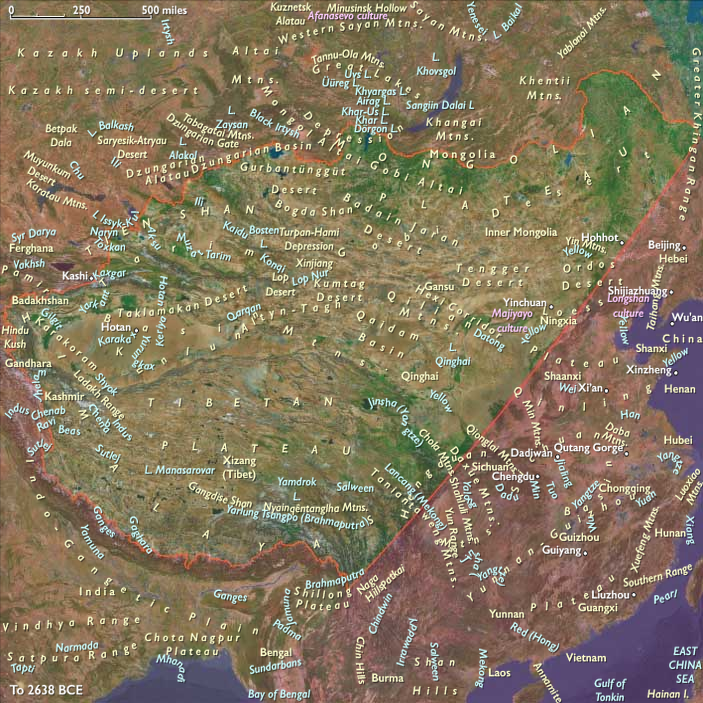
Between them ran the Hexi Corridor, the first great artery of exchange linking Central Asia’s oases with northern China’s river civilizations. Across this enormous range, diverse ecologies—monsoon plains, loess plateaus, and alpine meadows—were brought into a loose but growing web of contact.
Climate & Environmental Shifts
The epoch coincided with the Holocene Climatic Optimum, when warmth and rainfall peaked across most of East Asia.
-
Monsoons strengthened, spreading moisture deep into the Loess Plateau and northern plains.
-
Glaciers retreated from Tibetan and Altai valleys, leaving open alpine pastures.
-
Rivers swelled and deposited thick alluvium, enriching floodplains that became cradles of early agriculture.
This combination of humidity and stability fostered the dual emergence of wet-rice cultivation in the south and millet farming and proto-herding in the north and west—two complementary subsistence systems that would shape East Asia’s future.
Subsistence & Settlement
A fundamental transformation unfolded as cultivation, foraging, and herding converged.
-
Lowland East (Maritime sphere, Lower Yangtze and Yellow River basins):
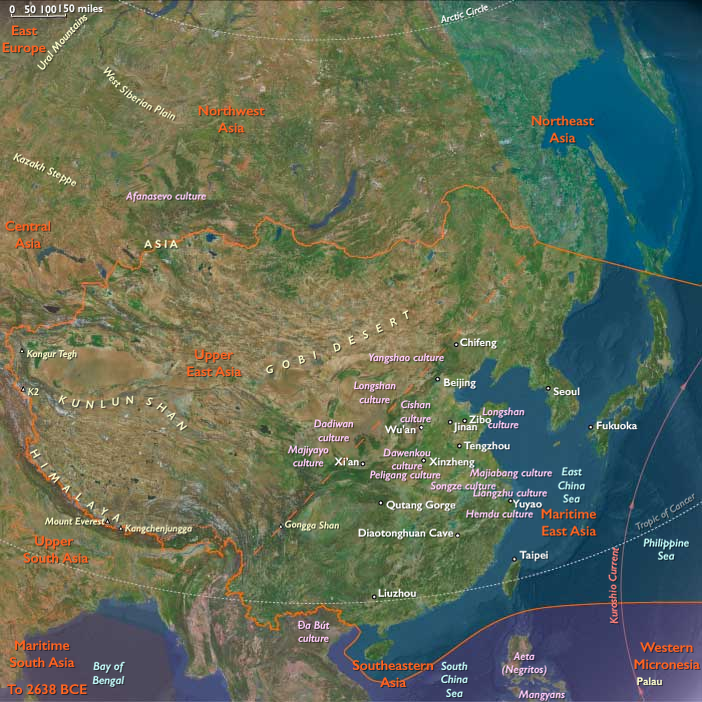
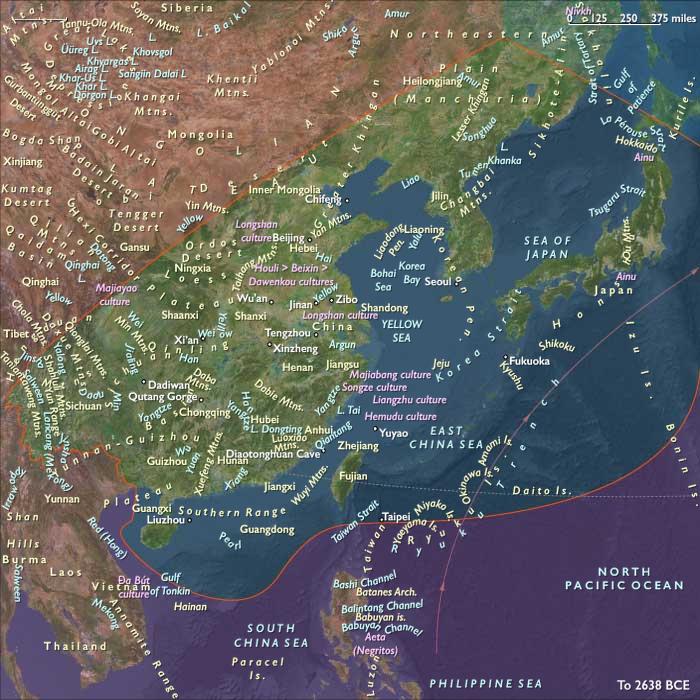
Early farmers of the Hemudu and Majiabang traditions cultivated rice, kept pigs and dogs, and fished in lakes and rivers. Settlements with pile houses, granaries, and pottery workshops dotted floodplains and deltas. -
Northern plains and Loess Plateau:
Communities of the Peiligang, Cishan, and Yangshao cultures grew millet and raised small stock, forming the first permanent inland villages of northern China. -
Upper East Asia (Tibet, Mongolia, Xinjiang, Qinghai):
Here, the proto-domestication of sheep and goats occurred along the Gobi and Tarim margins. Lakeside and steppe hamlets practiced mixed economies—hunting, fishing, herding, and wild plant collection—transitioning toward mobile pastoralism.
Together these zones formed a continent-wide continuum of subsistence, from sedentary rice farmers on the coast to semi-nomadic proto-herders on the steppe.
Technology & Material Culture
Material innovation advanced rapidly:
-
Pottery diversified into corded, burnished, and painted styles; fine red and gray wares became markers of cultural identity.
-
Ground-stone adzes, sickles, and grinding slabs proliferated, supporting intensified plant cultivation.
-
Bone needles and early loom weaving appeared in both lowland and steppe contexts.
-
Composite bows, polished stone points, and net weights reflected versatile hunting and fishing economies.
-
In Upper East Asia, ritual cattle and standing stones appeared—precursors to the monumental expressions of later pastoral cultures.
Technological convergence across the region—ceramics, polished tools, animal management—signaled growing contact and shared innovation.
Movement & Interaction Corridors
The Middle Holocene saw the emergence of the first trans-Eurasian corridors.
-
The Hexi Corridor became a vital link between the Chinese interior and Central Asia, channeling obsidian, pottery styles, and herd animals.
-
Altai and Ordos passes connected pastoral and agricultural zones, forming early prototypes of the Silk Road.
-
Along the eastern seaboard, riverine and maritime exchange carried jade, shells, and decorative ceramics between Shandong, Jiangsu, and the Yangtze Delta.
-
Across maritime East Asia, inter-island voyaging between Taiwan, Fujian, and the Ryukyus may already have occurred, prefiguring the later Austronesian expansions.
These routes fostered a dynamic cultural frontier—a fluid meeting ground between farmers, herders, and coastal navigators.
Cultural & Symbolic Expressions
Spiritual and artistic life grew in complexity:
-
Burials with pottery, jade, and painted vessels suggest emerging status distinctions and ancestor veneration.
-
Ritual pits and house-shrines in Yangshao villages indicate the intertwining of domestic and sacred life.
-
In the highlands, standing stones, cairns, and cattle effigies signified early sky-ancestor beliefs and territorial marking.
-
Painted ceramics, often in spiral and solar motifs, reflected cosmological symbolism tied to fertility and cycles of nature.
A shared conceptual world—of earth, ancestor, and sky—was taking root across both agrarian and pastoral settings.
Environmental Adaptation & Resilience
East Asian communities adapted through diversification and integration.
-
Wet-field rice buffered lowlands against drought.
-
Millet and dry-field crops provided insurance in arid zones.
-
Mixed herding and foraging sustained upland populations through variable rainfall.
-
Seasonal mobility—between floodplain and terrace, valley and high pasture—ensured both food security and ecological balance.
The result was a system of reciprocal adaptation: societies learned to bridge environments rather than specialize narrowly within them.
Long-Term Significance
By 4,366 BCE, East Asia had become a continent of converging traditions.
Rice agriculture, millet farming, and animal herding coexisted in complementary zones connected by trade and migration. The Hexi Corridor emerged as a cultural artery linking the Chinese world to the Inner Asian steppe; maritime exchange began to weave the coastal arc from the Yellow Sea to the Pacific islands.
The epoch set the foundations for East Asia’s later Bronze Age civilizations—the agrarian polities of the Central Plains, the pastoral networks of the steppe, and the seafaring communities of the littoral.
This Middle Holocene equilibrium—warm, fertile, and networked—was the first great flowering of the East Asian world: a continent learning to live between river and steppe, field and sea.
Topics
Commodoties
Subjects
Regions
Subregions
Years: 6093BCE - 4366BCE
Topics
Commodoties
Subjects
Regions
Subregions