Carloman dies on December 4, 771, at …
Years: 771 - 771
December
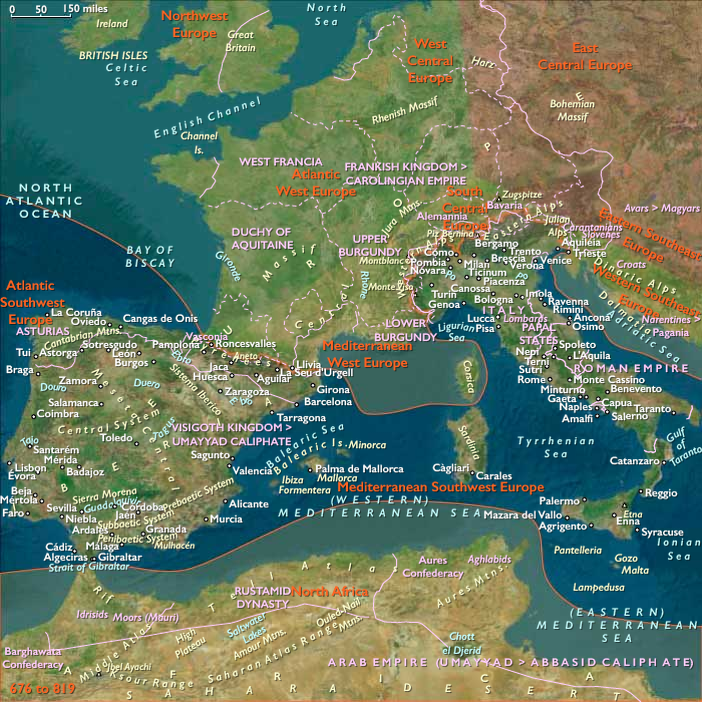
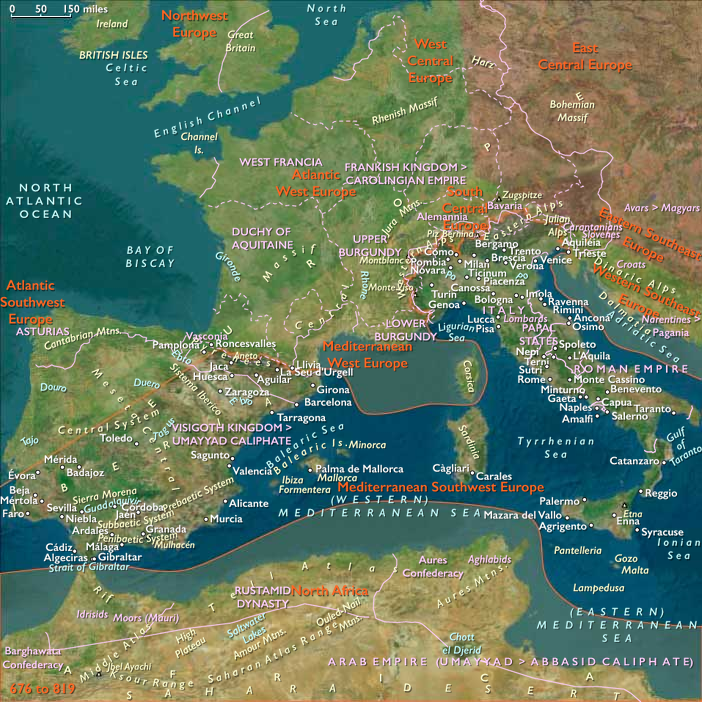
Carloman dies on December 4, 771, at the villa of Samoussy, and Charles seizes his late brother’s territories.
Carloman’s heirs, including his widow, Gerberga, his widow, take refuge among the Lombards, sheltered by Desiderius, who then asserts independence for Lombardy, currently a vassal of both the papacy and the Frankish kingdom.
An angered Charles divorces his Lombard queen and consolidates control of the territories wrested from his late brother’s family.
She has no known children and her ultimate fate is unknown.
Locations
People
Groups
- Franks
- Lombards (West Germanic tribe)
- Christianity, Chalcedonian
- Rome, Duchy of
- Lombards (Italy), Kingdom of the
- Roman Empire, Eastern: Isaurian dynasty
- Francia (Carolingians)
- Papal States (Republic of St. Peter)
Topics
Commodoties
Subjects
Regions
Subregions
Related Events
Filter results
Showing 10 events out of 55102 total
The Moorish occupation of Narbonne had ended in 759 after four decades, during which time the Jewish population had greatly increased.
Jews play a pivotal role in the formal occupation of the city by Charlemagne, who grants them a third of the town under their own ruler (nasi).
Pope Stephen III complains to the Bishops of Narbonne and Septimania about the Frankish kings allowing Jews to own land.
Stephen had continued throughout 769 and 770 to rely on the support and advice of Christophorus and Sergius who had placed him on the papal throne.
Their antipathy towards the Lombards and general pro-Frankish stance causes King Desiderius to engineer their downfall.
He bribed the Papal Chamberlain, Paulus Afiarta, and other members of the papal court to spread rumors about them to the pope.
When Desiderius attempts to enter Rome in 771 with an army, claiming to be on a pilgrimage to pray at the shrine of St. Peter, Christophorus and Sergius shut the gates of the city against them.
Arriving at the gates and seeing armed troops manning the walls, the Lombard king asks to speak to the Pope, who comes out to him.
During Stephen’s absence, Afiarta and his supporters seek to stir up a mob to overthrow Christophorus and Sergius, but the Primicerius and his son gain the upper hand, and force Afiarta and his colleagues to flee to the Lateran Palace.
Stephen had by this stage returned to the Lateran, and he is confronted in the Basilica of St. Theodore by the fleeing Afiarta and his co-conspirators being chased by Christophorus and his supporters.
Apparently at this point, a suspicious Christophorus, believing that Stephen had entered into some agreement with Desiderius, forces Stephen into taking an oath that he will not turn Christophorus or his son over to the Lombards.
After this, a furious Stephen berates Christophorus, demands he stop harassing Afiarta, and orders him and his followers to withdraw, to which Christophorus complies.
Stephen flees the next day to St. Peter’s Basilica to seek the protection of Desiderius.
The Lombard king, shutting Stephen up in his suites in the Basilica, makes it clear to the Pope that the price for his help is to be the handing over of Christophorus and Sergius.
The Pope sends two bishops to negotiate with Christophorus and Sergius, telling them that they must either retire to a monastery or come out to him at St. Peter’s.
A message is sent at the same time from Desiderius to the people of the city, declaring that Pope Stephen has bid them to expel Christophorus from the city and save themselves from harm.
This message from the Lombard king has the desired effect; Christophorus and Sergius begin to suspect their associates, who in turn rapidly abandon them.
Both are reluctant to leave the city, but eventually both make their way to the Pope during the night.
The next day, Stephen is allowed to return to the city, while Christophorus and Sergius are left in Lombard hands.
Negotiations to secure their release are unsuccessful, and before the day was out, Afiarta arrives with his partisans.
After discussing the situation with Desiderius, they have both men blinded.
Christophorus dies after three days, while Sergius is kept in a cell in the Lateran.
Desiderius, in an attempt to forestall the potential intervention of Charlemagne has Stephen write a letter to the Frankish king, wherein he declares that Christophorus and Sergius had been involved in a plot with an envoy of Charlemagne’s brother, Carloman, to kill the Pope.
Further, that Stephen had fled to Desiderius for protection, and that eventually Christophorus and Sergius were brought out against their will.
While Stephen managed to save their lives, later a group of men had them blinded, but not on Stephen’s orders.
He then concludes that if it wasn’t for “his most excellent son Desiderius”, he would have been in fatal danger, and that Desiderius had reached an agreement with him to restore to the Church all the lands which she had claims on that were still in Lombard hands.
That such a letter was a fiction is demonstrated very soon after; when Stephen asks Desiderius to fulfill the promises he had made over the body of Saint Peter, the Lombard king responds:
”Be content that I removed Christophorus and Sergius, who were ruling you, out of your way, and ask not for rights. Besides, if I do not continue to help you, great trouble will befall you. For Carloman, king of the Franks, is the friend of Christophorus and Sergius, and will be wishful to come to Rome and seize you.”
Desiderius continues to stir trouble in Italy; in 771, he manages to persuade the bishops of Istria to reject the authority of the Patriarch of Grado, and to have them place themselves under the Patriarch of Aquileia, which is directly under Lombard control.
Stephen writes to the rebellious bishops, suspending them and ordering them to place themselves once again under the authority of Grado, or face excommunication.

The people of the area around modern-day Hastings have, from the sixth century until 771, identified the territory as that of the Haestingas tribe and a kingdom separate from the surrounding kingdoms of Suth Saxe ("South Saxons", i.e., Sussex) and Kent.
It will work to retain its separate cultural identity until the eleventh century.
The kingdom is probably a subkingdom, the object of a disputed overlordship by the two powerful neighboring kingdoms: when King Wihtred of Kent settled a dispute with King Ine of Sussex and Wessex in 694, it is probable that he seceded the overlordship of Haestingas to Ine as part of the treaty.
King Offa of Mercia invades southern England in 771, and over the next decade will gradually seize control of Sussex and Kent.
Symeon of Durham records a battle fought at an unidentified location near Hastings in 771, at which Offa defeats the Haestingas tribe, effectively ending its existence as a separate kingdom.
A 1.2% growth of carbon-14 concentration recorded in tree rings suggests that a very strong radiation burst may have hit the earth in either 774 or 775.
East Central Europe (772–783 CE): Carolingian Expansion, Saxon Resistance, and Slavic State Consolidation
Between 772 and 783 CE, East Central Europe—encompassing Poland, Czechia, Slovakia, Hungary, and those portions of Germany and Austria lying east of 10°E and north of a line stretching from roughly 48.2°N at 10°E southeastward to the Austro-Slovenian border near 46.7°N, 15.4°E—entered a pivotal period marked by the rise of Carolingian influence under Charlemagne, intensified Saxon resistance to Frankish expansion, and continued political maturation of Slavic principalities. The Avar Khaganate remained internally stable yet increasingly wary of Carolingian power, while Thuringia maintained its practical autonomy, though increasingly under pressure from the west.
Political and Military Developments
Carolingian Conquests and Saxon Resistance
-
Beginning in 772 CE, Charlemagne initiated campaigns to subdue the Saxons east of the Rhine and Elbe rivers, triggering fierce resistance and ongoing military conflicts that dramatically reshaped regional political dynamics in eastern Germany and western Poland.
Continued Bavarian Influence over Slavic Territories
-
Bavaria maintained its established protectorate over Carantania, continuing to wield significant political influence and integrating the region economically and culturally, despite the increasing pressures of Carolingian expansion.
Consolidation of Slavic States
-
Slavic principalities, particularly in Bohemia and Moravia, further solidified governance structures, clearly defining territorial boundaries and developing effective defensive strategies against external threats, preparing for future encounters with Frankish and Carolingian influence.
Thuringian Autonomy under Carolingian Pressure
-
Thuringian rulers preserved autonomy yet faced increasing diplomatic and military pressure from the expanding Carolingian Empire, signaling an imminent change in their independent status.
Avar Diplomatic Caution
-
The Avar Khaganate maintained internal stability but increasingly adopted cautious diplomatic relations, recognizing the rising Carolingian threat and potential regional instability resulting from Frankish–Saxon conflicts.
Economic and Technological Developments
Economic Prosperity Amid Conflict
-
Despite military conflicts, regional economic networks remained active, sustaining trade exchanges among Saxon, Slavic, Bavarian, Thuringian, Avar, and Frankish communities, including agricultural goods, iron, precious metals, textiles, and luxury items.
Expansion of Fortifications and Military Infrastructure
-
Ongoing conflicts prompted significant investment in defensive fortifications and military infrastructure by Saxon, Slavic, Bavarian, and Avar communities, enhancing regional security and technological sophistication.
Cultural and Artistic Developments
Increased Frankish–Germanic Influence
-
Carolingian and Saxon military interactions introduced new Germanic cultural influences across eastern Germany, Poland, and western Slavic territories, reflected archaeologically through evolving burial customs, weaponry, and metalworking styles.
Slavic Cultural Distinction
-
Bohemian and Moravian Slavic communities reinforced their distinct cultural identities, evident through differentiated archaeological finds, artistic styles, ceramics, jewelry, and settlement patterns.
Avar Artistic Continuity
-
The Avars maintained their distinct cultural traditions, prominently influencing regional decorative arts, jewelry, metalworking techniques, and equestrian equipment.
Settlement and Urban Development
Urban Expansion under Saxon and Frankish Influence
-
Saxon settlements, despite ongoing conflicts, continued their growth, reinforcing existing fortified towns and forming the basis of later medieval urban centers within eastern Germany and adjacent areas.
Slavic Administrative and Urban Growth
-
Bohemian and Moravian urban centers expanded in response to growing political stability and economic activity, laying important groundwork for the medieval era.
Stability in Bavarian and Thuringian Settlements
-
Bavarian-influenced Carantania and autonomous Thuringian territories continued enjoying relative economic stability, though increasingly influenced by Carolingian expansion and Saxon–Frankish conflicts.
Social and Religious Developments
Heightened Military Aristocracies
-
Ongoing Saxon–Carolingian conflicts emphasized the role of warrior aristocracies among Saxon, Bavarian, and Frankish societies, reinforcing hierarchical social structures and military prowess.
Strengthened Slavic Leadership
-
Slavic principalities in Bohemia and Moravia continued centralizing leadership, improving governance, administrative efficiency, and defensive capabilities amid growing external pressures.
Continued Stability of Avar Society
-
The Avars retained stable societal structures, maintaining internal cohesion through effective elite governance and careful diplomacy.
Long-Term Consequences and Historical Significance
The era 772–783 CE marked a transformative phase for East Central Europe, characterized by Charlemagne's aggressive eastward expansion, persistent Saxon resistance, and reinforced Slavic state formation. These events significantly reshaped regional power dynamics, preparing the ground for subsequent Carolingian dominion and dramatically influencing the medieval political, cultural, and economic trajectory of the region.
The Saxon Wars are the campaigns and insurrections of the more than thirty years from 772, when Charlemagne first enters Saxony with the intent to conquer, to 804, when the last rebellion of disaffected tribesmen is crushed.
Emperor Constantine V, whose military achievements make him enormously popular despite his persecution of monks who oppose his iconoclastic position, consolidates imperial power. (In later centuries, the folk of Constantinople will stand by his tomb, seeking his aid against whatever enemy imperils the city's defenses.)
Eastern Southeast Europe (772–783 CE): Imperial Consolidation and Cultural Legacy
Settlement and Migration Patterns
Continued Stability and Consolidation
From 772 to 783 CE, Eastern Southeast Europe experienced continued stability and demographic consolidation. The region benefited from maintained peace and the strengthened settlement of diverse communities, enhancing regional cohesion and security.
Political and Military Developments
Emperor Constantine V’s Consolidation of Power
Emperor Constantine V achieved considerable success in consolidating imperial authority, largely due to his military accomplishments. Despite his harsh persecution of monks who opposed his iconoclastic policies, his popularity among the broader population remained notably high, demonstrating his effective governance and military prowess.
Legacy and Cultural Impact
Constantine V's military successes significantly reinforced imperial security and strengthened Constantinople’s defenses. His lasting popularity became legendary, with future generations seeking spiritual aid at his tomb during times of crisis, reflecting his enduring impact on Byzantine cultural memory and identity.
Economic and Technological Developments
Economic Prosperity
The continued peace and effective imperial administration promoted sustained economic prosperity, supporting growth in trade and agricultural productivity. Secure trade routes further enhanced regional economic resilience and stability.
Advancements in Defense Infrastructure
Strategic investments in defensive infrastructure, especially in Constantinople and frontier regions, remained a priority. These enhancements ensured the empire’s preparedness against potential threats and further solidified imperial stability.
Cultural and Artistic Developments
Flourishing Cultural Activities
Cultural and artistic endeavors thrived, benefiting from the stability and imperial support of Constantine V’s reign. The era witnessed continued investment in religious and cultural institutions, significantly enriching regional artistic expression and identity.
Intellectual and Educational Resilience
Educational institutions and scholarly communities continued actively preserving and developing classical and theological knowledge. The peaceful conditions facilitated intellectual growth, reinforcing cultural resilience and continuity.
Social and Religious Developments
Dominance of Eastern Orthodoxy
Eastern Orthodox Christianity continued strengthening its influence in societal structures, providing spiritual guidance and reinforcing communal cohesion despite ongoing religious controversies. The religious institutions’ central role contributed significantly to regional stability.
Continued Iconoclast Controversy
Despite Constantine V’s broad popularity, his iconoclast stance persisted as a source of significant religious and social tension. The persecution of monks and the ongoing theological debate shaped social dynamics and religious discourse profoundly during this period.
Long-Term Consequences and Historical Significance
The period from 772 to 783 CE was marked by Emperor Constantine V’s robust consolidation of power, military success, and complex religious legacy. His reign’s impact on imperial stability, cultural identity, and religious tensions profoundly influenced Eastern Southeast Europe's historical trajectory and enduring cultural memory.
The Middle East: 772–783 CE
Baghdad: Center of the Abbasid World
Ascendance of Baghdad
During this era, Baghdad, the thriving capital of the Abbasid Caliphate, reaches unprecedented prominence, becoming the largest city in the world. Overtaking Chang'an, the capital of Tang China, Baghdad stands as the undisputed heart of a vast empire stretching from North Africa to Central Asia. Its remarkable growth symbolizes the Abbasids' flourishing intellectual, cultural, and economic dominance, positioning it as the leading metropolis of its age.
Baghdad, capital of the Abbasid Empire, becomes the largest city of the world, taking the lead from Chang'an, capital of China.
Years: 771 - 771
December
Locations
People
Groups
- Franks
- Lombards (West Germanic tribe)
- Christianity, Chalcedonian
- Rome, Duchy of
- Lombards (Italy), Kingdom of the
- Roman Empire, Eastern: Isaurian dynasty
- Francia (Carolingians)
- Papal States (Republic of St. Peter)