
The Ottomans, upon finally suppressing the Serbs …
Years: 1814 - 1814
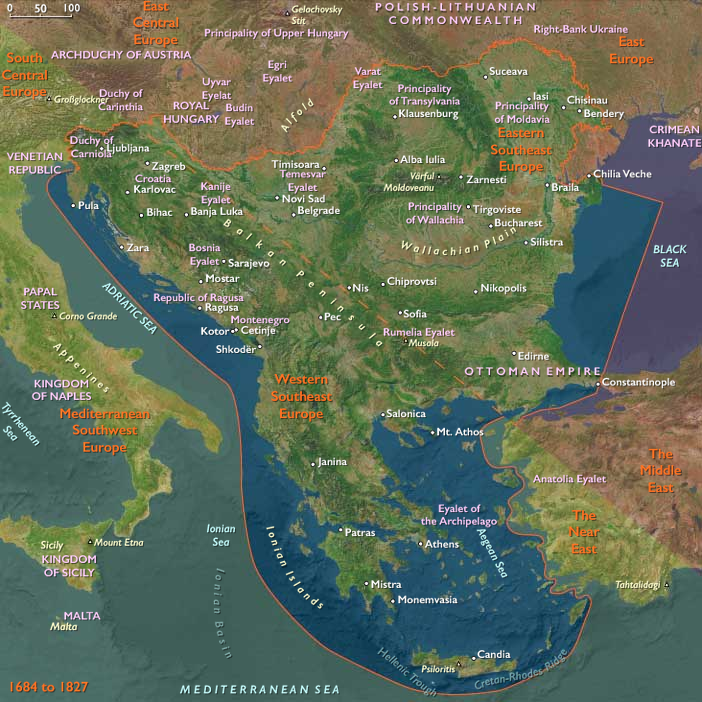
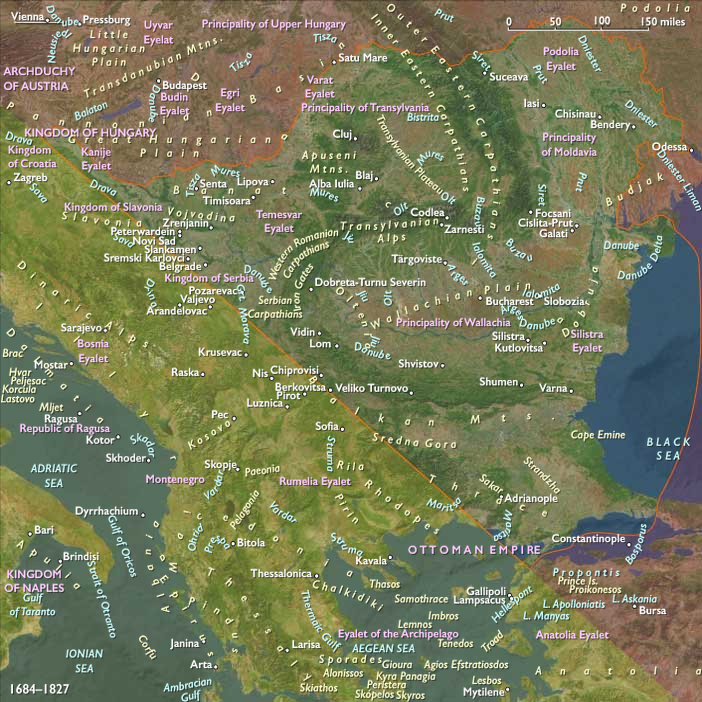
The Ottomans, upon finally suppressing the Serbs in 1814, grant them autonomy within the Empire.
Locations
Groups
Subjects
Regions
Subregions
Related Events
Filter results
Showing 10 events out of 21089 total
In 1813, a force of Blood warriors had set off for a raid on the Crows in the Bighorn area.
In the next year, Crows near the Little Bighorn River kill Blackfoot Top Knot.
New Zealand's indigenous Māori had quickly recognized the great advantages in trading with European and American strangers, whom they call tauiwi, whose ships had begun visiting New Zealand in the early 1800s.
The Bay of Islands offers a safe anchorage and has a high Māori population.
Māori had begun to supply food and timber to attract ships.
What Māori want are respect, plus firearms, alcohol, and other goods of European manufacture.
Kororareka (present Russell) had developed as a result of this trade but had soon earned a very bad reputation, a community without laws and full of prostitution, and has become known as the "Hell Hole of the Pacific", despite the translation of its name being "How sweet is the penguin", (korora meaning blue penguin and reka meaning sweet).
European law has no influence and Māori law is seldom enforced within the town's area.
The Ngāpuhi control the Bay of Islands, the first point of contact for most Europeans visiting New Zealand in the early nineteenth century.
Hongi Hika has protected early missionaries and European seamen and settlers, arguing the benefits of trade.
He has befriended Thomas Kendall—one of three lay preachers sent by the Church Missionary Society to establish a Christian toehold in New Zealand.
In 1814 Hongi Hika and his uncle Ruatara, the then-leader of the Ngāpuhi, had visited Sydney, Australia, with Kendall and met the local head of the Church Missionary Society, Samuel Marsden.
Ruatara and Hongi Hika invited Marsden to establish the first Anglican mission to New Zealand in Ngapuhi territory.
Marsden had remained based in New South Wales.
By the early nineteenth century there had been increasing contact between Māoris and Europeans, mainly by the many whalers and sealers around the coast of New Zealand and especially in the Bay of Islands.
A small community of Europeans has formed in the Bay of Islands made up of explorers, flax traders, timber merchants, seamen, ex-convicts who had served their sentence, and some escaped convicts.
Marsden, concerned that they are corrupting the Māori way of life, had become determined to find a mission station in New Zealand.
Marsden had lobbied the Church Missionary Society successfully to send a mission to New Zealand.
Lay missionaries John King, William Hall and Thomas Kendall had been chosen in 1809, but it is not until March 14, 1814, that Marsden had taken his schooner, the Active (captained by Thomas Hansen), on an exploratory journey to the Bay of Islands with Kendall and Hall, during which time he claims to have conducted the first Christian service on New Zealand soil.
He had met Māori Rangatira, or chiefs from the iwi or tribe Ngapuhi, who control the region around the Bay of Islands, including the chief of the Ngapuhi, Ruatara, and a junior war leader, Hongi Hika, who had helped pioneer the introduction of the musket to Māori warfare in the previous decade.
Hongi Hika had returned with them to Australia on August 22.
At the end of the year Kendall, Hall and King return to start a mission to the Ngapuhi under Ruatara's (and, later, Hongi Hika's) protection in the Bay of Islands.
Hongi Hika returns with them, bringing a large number of firearms from Australia for his warriors.
The British East India Company's adamant refusal to raise Bengal's opium exports beyond the quota of four thousand chests per annum leaves a vast unmet demand for drugs among China's swelling population of opium smokers.
The Company's monopoly on Bengal opium faces strong competition from Turkey and west India as demand has driven the price per chest upward from four hundred and fifteen rupees in 1799 to two thousand four hundred and twenty-eight rupees just fifteen years later.
The Filiki Etaireia (Greek: Friendly Society), founded by merchants in Odessa in 1814, is the most important of many clandestine revolutionary groups that have arisen to overthrow Ottoman rule in southeastern Europe and to establish an independent Greek state.
Unlike other such groups, it is able to attract a substantial membership while remaining undetected by Ottoman authorities.
The organization brings together men from many levels of society to provide an organizational base for the dissemination of revolutionary ideas and for coordinated action.
Jöns Jacob Berzelius suggests the use of letters as symbols for the chemical elements in 1814.
In order to aid his experiments, the Swedish chemist has developed a system of chemical notation in which the elements are given simple written labels—such as O for oxygen, or Fe for iron—with proportions noted by numbers.
This is the same basic system used today, the only difference being that instead of the subscript number used today (e.g., H2O), Berzelius uses a superscript (H2O).
Between 1796 and 1814, among the rest of Italian Jewry, the city's Jewish congregation is emancipated, under French influence.
From 1814 Alessandria is Savoyard territory once more, part of the Kingdom of Sardinia.
Marie-Henri Beyle, better known by his pen name Stendhal, born on January 1783 in Grenoble, Isère, had had an unhappy childhood in in what he found to be stifling provincial France, disliking his "unimaginative" father and mourning his mother, who had died when he was young.
His closest friend was his younger sister, Pauline, with whom he had maintained a steady correspondence throughout the first decade of the nineteenth century.
The military and theatrical worlds of the First French Empire were a revelation to Beyle, who had been named an auditor with the Conseil d'État on August 3, 1810, and had thereafter taken part in the French administration and in the Napoleonic wars in Italy.
Traveling extensively in Germany, he had had been part of Napoleon's army in the 1812 invasion of Russia.
Beyle had left for Italy after the 1814 Treaty of Fontainebleau, taking up the expatriate’s life in Milan and embarking full-time on a writing career under the pen name Stendahl (as well as one hundred others).
Scholars in general believe he borrowed this nom de plume from the German city of Stendal in homage to Johann Joachim Winckelmann.
Within the year, he completes his first work, The Lives of Haydn, Mozart and Metastasio, which, although largely plagiarized, reveal an originality.
Jean-Baptiste Biot had been aboard for the first scientific hot-air balloon ride in 1804 with Joseph-Louis Gay-Lussac (NNDB 2009, O’Connor and Robertson 1997).
They had reached a height of seven thousand and sixteen meters meters (twenty-three thousand feet), quite dangerous without on-board oxygen.
In 1812, Biot had turned his attention to the study of optics, particularly the polarization of light.
Prior to the nineteenth century, light was believed to consist of discrete packets called corpuscles.
During the early nineteenth century, many scientists have begun to disregard the corpuscular theory in favor of the wave theory of light.
Biot begins his work on polarization to show that the results he is obtaining could appear only if light were made of corpuscles.
His work in chromatic polarization and rotary polarization greatly advances the field of optics, although it was later shown that his findings could also be obtained using the wave theory of light (Frankel, Eugene. "Corpuscular Optics and the Wave Theory of Light: The Science and Politics of Revolution in Physics." Social Studies of Science vol. 6, no 2.May 1976. Sage Publications, Ltd. 15 June 2009).
Biot's work on the polarization of light has led to many breakthroughs in the field of optics.
Liquid crystal displays (LCDs), such as television and computer screens, use light that is polarized by a filter as it enters the liquid crystal, to allow the liquid crystal to modulate the intensity of the transmitted light.
This happens as the liquid crystal's polarization varies in response to an electric control signal applied across it.
Polarizing filters are used extensively in photography to cut out unwanted reflections or to enhance reflection.
Biot is also a member of the Legion of Honor; he is elected chevalier in 1814.
Robert Peel, as Chief Secretary in Dublin in 1813, had proposed the setting up of a specialist police force, later called "Peelers".
The Royal Irish Constabulary is founded under Peel in 1814.
Born in Bury, Lancashire, England, to the industrialist and Member of Parliament Sir Robert Peel, 1st Baronet, one of the richest textile manufacturers of the early Industrial Revolution, young Robert had been educated first at Hipperholme Grammar School, then at Harrow School and finally Christ Church, Oxford, where he had taken took a double first in classics and mathematics.
He is also believed to have attended Bury Grammar School.
While living in Tamworth, he is credited with the development of the Tamworth Pig by breeding Irish stock with some local Tamworth pigs.
Groomed for statesmanship by his father, Peel had entered politics in 1809 at the young age of twenty-one as a Tory MP for the Irish rotten borough of Cashel, Tipperary.
With a scant twenty-four electors on the rolls, he had won election unopposed.
His sponsor for the election (besides his father) had been the Chief Secretary for Ireland, Sir Arthur Wellesley, the future Duke of Wellington, with whom Peel's political career is to be entwined for the next twenty-five years.
Peel had made his maiden speech at the start of the 1810 session, when he was chosen by the Prime Minister, Spencer Perceval, to second the reply to the king's speech.
His speech was a sensation, famously described by the Speaker, Charles Abbot, as "the best first speech since that of William Pitt." (Gash, Norman (1961). Mr. Secretary Peel: The Life of Sir Robert Peel to 1830. New York: Longmans.)
James Mill writes a number of articles, containing an exposition of utilitarianism, for the supplement to the fifth edition of the Encyclopædia Britannica in 1814, the most important being those on "Jurisprudence," "Prisons" and "Government."
Mill was born at Northwater Bridge, in the parish of Logie Pert, Angus, Scotland, the son of James Mill, a shoemaker.
His mother, Isabel Fenton, of a family that had suffered from connection with the Stuart rising, had resolved that he should receive a first-rate education, and sent him first to the parish school and then to the Montrose Academy, where he remained until the unusual age of seventeen and a half.
He then entered the University of Edinburgh, where he had distinguished himself as a Greek scholar.
In October 1798, he was ordained as a minister of the Church of Scotland, but met with little success.
From 1790 to 1802, in addition to holding various tutorships, he occupied himself with historical and philosophical studies.
Finding little prospect of a career in Scotland, in 1802 he went to London, in company with Sir John Stuart, then member of parliament for Kincardineshire, and had devoted himself to literary work.
From 1803 to 1806, he edited an ambitious periodical called the Literary Journal, which professed to give a summary view of all the leading departments of human knowledge.
During this time he also edited the St. James's Chronicle, belonging to the same proprietor.
In 1804, he wrote a pamphlet on the corn trade, arguing against a bounty on the exportation of grain.
In 1805, he published a translation (with notes and quotations) of An Essay on the Spirit and Influence of the Reformation of Luther, a C.F.
Villers's work on the Reformation, an attack on the alleged vices of the papal system.
About the end of this year, he began his The History of British India, which he will take twelve years to complete, instead of three or four, as had been expected.
In that year he had also married Harriet Burrow, whose mother, a widow, kept what was then known as an establishment for lunatics in Hoxton.
He then took a house in Pentonville, where his eldest son, John Stuart Mill, was born in 1806.
In 1808, he had become acquainted with Jeremy Bentham, and will for many years be his chief companion and ally.
He has adopted Bentham's principles in their entirety, and has determined to devote all his energies to bringing them before the world.
Between 1806 and 1818, he writes for the Anti-Jacobin Review, the British Review and The Eclectic Review; but there is no means of tracing his contributions.
In 1808, he had begun to write for the Edinburgh Review, to which he had contributed steadily until 1813, his first known article being "Money and Exchange."
He also wrote on Spanish America, China, Francisco de Miranda, the East India Company, and the Liberty of the Press.
In the Annual Review for 1808, two articles of his are traced—a "Review of Fox's History," and an article on "Bentham's Law Reforms," probably his first published notice of Bentham.
In 1811, he had cooperated with William Allen (1770–1843), a Quaker and chemist, in a periodical called the Philanthropist.
He contributed largely to every issue—his principal topics being Education, Freedom of the Press, and Prison Discipline (under which he expounded Bentham's Panopticon).
He has made powerful onslaughts on the Church in connection with the Bell vs. Lancasterian school system debate, and has taken a part in the discussions that will lead to the foundation of the University of London in 1825.
Years: 1814 - 1814
Locations
Groups
Subjects
Regions
Subregions