
Unrest soon spreads to other areas of …
Years: 1875 - 1875
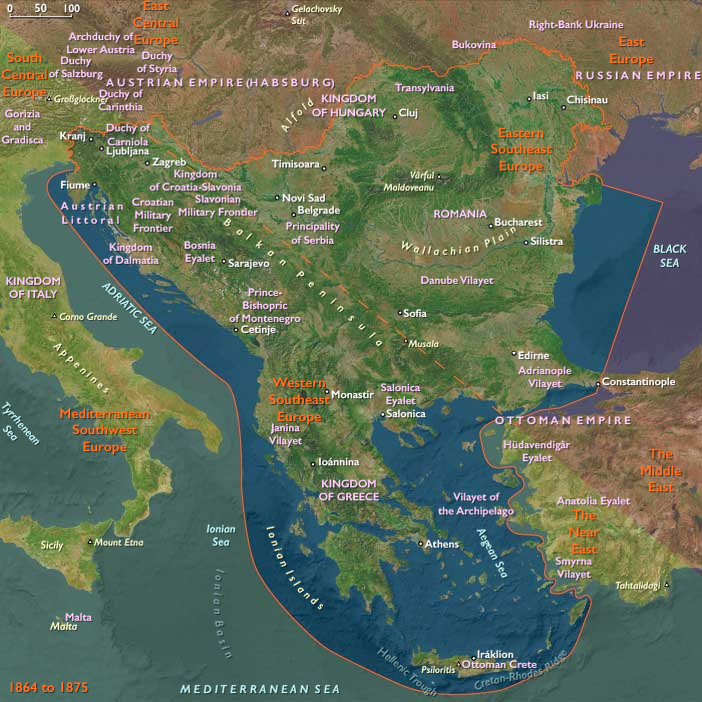
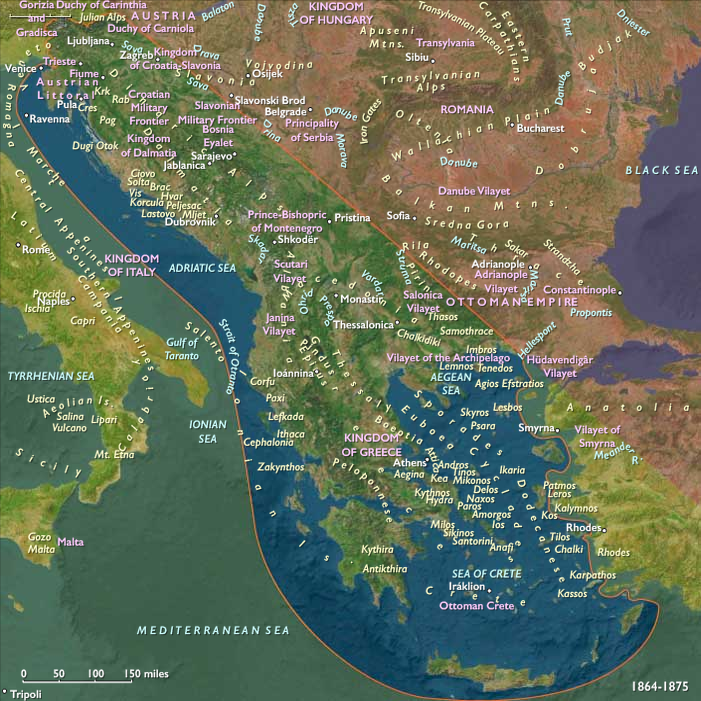
Unrest soon spreads to other areas of Bosnia, and repressive force is applied both by the new Bosnian governor and by local landowners using their own irregular troops.
Locations
Groups
Topics
Subjects
Regions
Subregions
Related Events
Filter results
Showing 10 events out of 12415 total
Hawaii and the United States reach an agreement and a treaty is signed on January 30, 1875.
The treaty allows certain Hawaiian goods, mainly sugar and rice, to be admitted into the United States tax-free.
During the early part of Kalākaua's reign, the king will make full use of his power to appoint and dismiss cabinets.
King Kalākaua believes in the hereditary right of the aliʻi to rule.
Kalākaua will continually dismiss cabinets and appoint new ones.
This draws criticism from people of the "Missionary Party", who want to reform Hawaiian government based on the model of the United Kingdom's constitutional monarchy where the monarch has very little real power over the government but has a position of great dignity and is the head of state.
The party believes the legislature should control the cabinet ministers rather than the king.
This struggle will continue throughout Kalākaua's reign.
Civil war had erupted in Tonga in the fifteenth century and again in the seventeenth.
It was in this context that the first Europeans had arrived, beginning with Dutch explorers Willem Schouten and Jacob Le Maire.
Between April 21 to 23, 1616, they had moored at the Northern Tongan islands "Cocos Island" (Tafahi) and "Traitors Island" (Niuatoputapu), respectively.
The kings of both of these islands had boarded the ships and Le Maire had drawn up a list of words in Niuatoputapu (a language now extinct).
On April 24, 1616 they had tried to moor at the "Island of Good Hope" (Niuafo'ou), but a less welcoming reception there made them decide to sail on.
On January 21, 1643, the Dutch explorer Abel Tasman had become the first European to visit the main island (Tongatapu) and Haʻapai after rounding Australia and New Zealand.
The most significant impact had been the visits of Captain Cook in 1773, 1774, and 1777, followed by the first London missionaries in 1797, and the Wesleyan Methodist Walter Lawry in 1822.
Around that time, most Tongans had converted en masse to the Wesleyan (Methodist) or Catholic faiths.
The murder, in 1799, of Tonga’s fourteenth ruler of the Tuʻi Kanokupolu dynasty had sent Tonga into a civil war for fifty years; the islands had finally been united into a Polynesian kingdom in 1845 by the ambitious young warrior, strategist, and orator Tāufaʻāhau.
Sir Hercules Robinson, Fiji's first governor, is replaced in June 1875 by Sir Arthur Gordon, who is named the first High Commissioner for the Western Pacific.
Rather than establish direct rule in all spheres, Gordon grants autonomy over local affairs to Fiji's chiefs, though they are now forbidden to engage in tribal warfare.
The colony is divided into four regions, each under the control of a Roko; these regions are further subdivided into twelve districts, each ruled by a traditional chief.
An outbreak of measles that begins in Fiji in 1875 will kill forty thousand Fijians, a third of the population.
...Wanganui, ...
...New Plymouth and ...
...Nelson.
Pioneer pastoralists, often men with experience as squatters in Australia, lease lands from the New Zealand government at the annual rate of £5 plus £1 for each thousand sheep above the first five thousand.
The leases are renewed automatically, which give the wealthy pastoralists a strong landed interest and make them a powerful political force.
In all, between 1856 and 1876, eight million one hundred thousand acres are sold for £7.6 million, and Two million two hundred thousand acres are given free to soldiers, sailors and settlers.
New Zealand’s first European settlers had been self-sufficient farmers because of the vast distances involved.
By the 1840s, however, large scale sheep ranches were exporting large quantities of wool to the textile mills of England.
Most of the first settlers had been brought over by a program operated by the New Zealand Company (inspired by Edward Gibbon Wakefield) and were located in the central region on either side of Cook Strait, and at Wellington, ...
Mindon makes trade and territorial concessions to stave off further British encroachments, including ceding the Karenni States to the British in 1875.
On August 15, 1873, he had also enacted the Seventeen Articles, one of Southeast Asia's first indigenous laws protecting freedom of the press.
In October of this same year, Sultan Abdul Samad sends a letter to Andrew Clarke requesting for Selangor to be placed under the British protectorate.
In November 1873, a ship from Penang had been attacked by pirates near Kuala Langat, Selangor.
After a number of subsequent piracy attacks in Selangor, Clarke had assigned Frank Swettenham as a live-in advisor to Sultan Abdul Samad in August 1874.
Swettenham is highly influential in shaping British policy and the structure of British administration in the Malay Peninsula.
Swettenham had been first sent to Singapore in 1871 as a cadet in the civil service of the Straits Settlements (Singapore, Malacca, and Penang Island).
Learning the Malay language, he plays a major role as British-Malay intermediary in the events surrounding British intervention in the peninsular Malay states in the 1870s.
He is a member of the Commission for the Pacification of Larut set up following the signing of the Pangkor Treaty of 1874 and he serves alongside Chief Commissioner John Frederick Adolphus McNair, and Chinese Kapitan Chung Keng Quee and Chin Seng Yam.
The Commission is successful in freeing many women taken as captives during the Larut Wars (1862–73), getting stockades dismantled and getting the tin mining business going again.
