
Juan de Oñate, the founder of New …
Years: 1601 - 1601
Juan de Oñate, the founder of New Mexico, visits Etzanoa, the Wichita city, sixty years after Coronado's expedition.
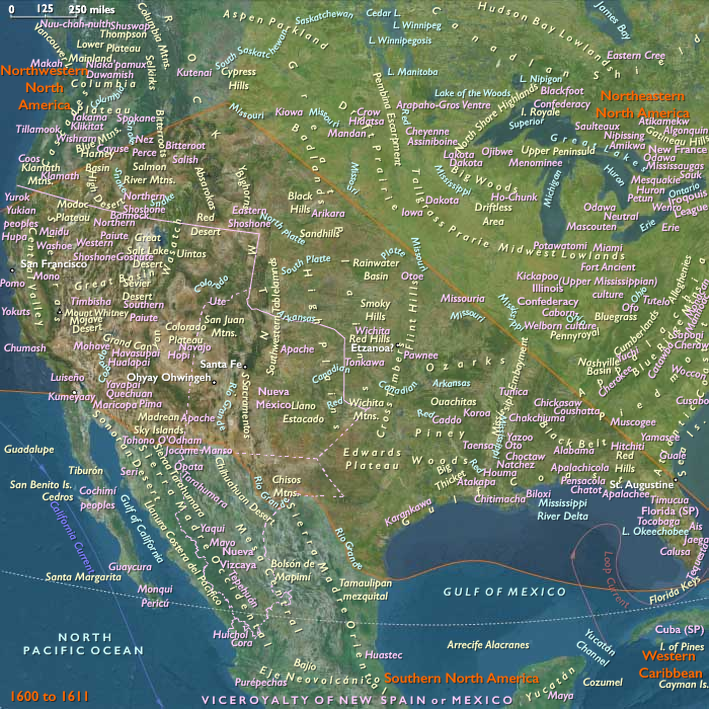
Oñate had journeyed east from New Mexico, crossing the Great Plains and encountering two large settlements of people he called Rayados, most certainly Wichita, and Escanjaques, who may be identical with the Aguacane who live along the tributaries of the Red River in western Oklahoma.
If so, they are probably related to the people later known as the Wichita.
The Escanjaques try to persuade Oñate to plunder and destroy "Quiviran" villages.
The Rayado city is probably on the Walnut River near Arkansas City, Kansas.
Oñate describes the city as containing "more than twelve hundred houses" which would indicate a population of about twelve thousand.
His description of the Etzanoa is similar to that of Coronado's description of Quivira.
The homesteads are dispersed; the houses round, thatched with grass and surrounded by large granaries to store the corn, beans, and squash they grow in their fields.
Oñate's Rayados are probably the Wichita sub-tribe later known as the Guichitas.
What the Coronado and Oñate expeditions show is that the Wichita people of the sixteenth century are numerous and widespread.
They are not, however, a single tribe at this time but rather a group of several related tribes speaking a common language.
The dispersed nature of their villages probably indicates that they are not seriously threatened by attack by enemies, although that will change as they will soon be squeezed between the Apache on the West and the powerful Osage on the East.
European diseases will also probably be responsible for a large decline in the Wichita population in the seventeenth century.
Oñate had journeyed east from New Mexico, crossing the Great Plains and encountering two large settlements of people he called Rayados, most certainly Wichita, and Escanjaques, who may be identical with the Aguacane who live along the tributaries of the Red River in western Oklahoma.
If so, they are probably related to the people later known as the Wichita.
The Escanjaques try to persuade Oñate to plunder and destroy "Quiviran" villages.
The Rayado city is probably on the Walnut River near Arkansas City, Kansas.
Oñate describes the city as containing "more than twelve hundred houses" which would indicate a population of about twelve thousand.
His description of the Etzanoa is similar to that of Coronado's description of Quivira.
The homesteads are dispersed; the houses round, thatched with grass and surrounded by large granaries to store the corn, beans, and squash they grow in their fields.
Oñate's Rayados are probably the Wichita sub-tribe later known as the Guichitas.
What the Coronado and Oñate expeditions show is that the Wichita people of the sixteenth century are numerous and widespread.
They are not, however, a single tribe at this time but rather a group of several related tribes speaking a common language.
The dispersed nature of their villages probably indicates that they are not seriously threatened by attack by enemies, although that will change as they will soon be squeezed between the Apache on the West and the powerful Osage on the East.
European diseases will also probably be responsible for a large decline in the Wichita population in the seventeenth century.
Locations
People
Groups
- Wichita, or Kitikitish (Amerind tribe)
- Osage Nation (Amerind tribe)
- Apache (Na-Dené tribe)
- Pawnee (Amerind tribe)
- New Spain, Viceroyalty of
- Spain, Habsburg Kingdom of
- Santa Fe de Nuevo México (Spanish Colony)
Topics
Commodoties
Subjects
Regions
Subregions
Related Events
Showing 10 events out of 33897 total
Years: 1601 - 1601
Locations
People
Groups
- Wichita, or Kitikitish (Amerind tribe)
- Osage Nation (Amerind tribe)
- Apache (Na-Dené tribe)
- Pawnee (Amerind tribe)
- New Spain, Viceroyalty of
- Spain, Habsburg Kingdom of
- Santa Fe de Nuevo México (Spanish Colony)
Topics
Commodoties
Subjects
Regions
Subregions