
France has not completely defeated Austria, but …
Years: 1809 - 1809
October
France has not completely defeated Austria, but the Treaty of Schönbrunn, signed on October 14, 1809, nevertheless imposes a heavy political toll on the Austrians.
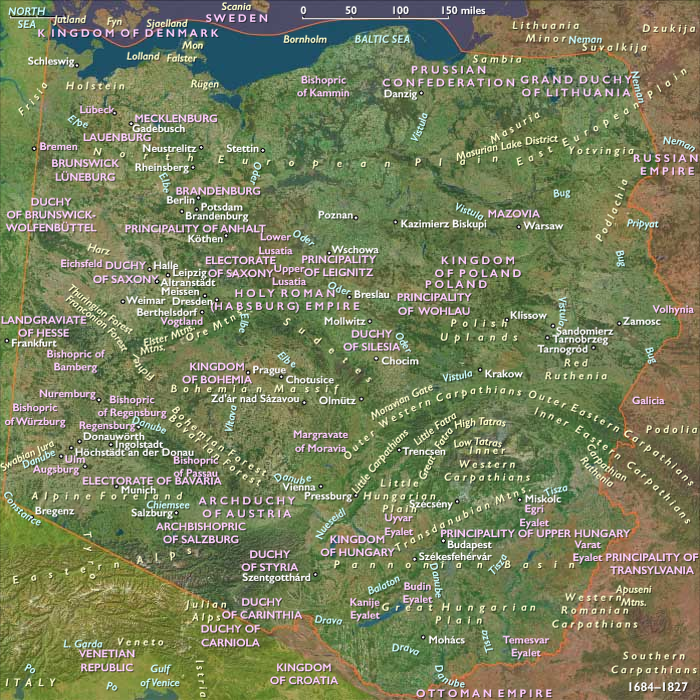
As a result of the treaty, France receives Carinthia, Carniola, and the Adriatic ports, while Galicia is given to the Poles, the Salzburg area of the Tyrol goes to the Bavarians, and Russia is ceded the district of Tarnopol.
Austria loses over three million subjects, about twenty percent of her total population.
Emperor Francis also agrees to pay an indemnity equivalent to almost eighty-five million francs, gives recognition to Napoleon's brother Joseph as the King of Spain, and reaffirms the exclusion of British trade from his remaining dominions
The Austrian defeat paves the way for the marriage of Napoleon to the daughter of Emperor Francis, Marie Louise.
Dangerously, Napoleon assumes that his marriage to Marie Louise will eliminate Austria as a future threat, but the Habsburgs were not as driven by familial ties as Napoleon thought.
The impact of the conflict is not all positive from the French perspective.
The revolts in Tyrol and the Kingdom of Westphalia during the conflict had been an indication that there is much discontent over French rule among the German population.
Just a few days before the conclusion of the Treaty of Schönbrunn, an eighteen-year-old German named Friedrich Staps had approached Napoleon during an army review and attempted to stab the emperor, but he had been intercepted in the nick of time by General Rapp.
The emerging forces of German nationalism are too strongly rooted by this time, and the War of the Fifth Coalition plays an important role in nurturing their development.
By 1813, when the Sixth Coalition will be fighting the French for control of Central Europe, the German population will be fiercely opposed to French rule and will largely support the Allies.
The war has also undermined French military superiority and the Napoleonic image.
The Battle of Aspern-Essling had been the first major defeat in Napoleon's career and had been warmly greeted by much of Europe.
The Austrians had also shown that strategic insight and tactical ability are no longer a French monopoly.
The French themselves are actually suffering from tactical shortcomings; the decline in tactical skill of the French infantry had led to increasingly heavy columns of foot soldiers eschewing all maneuver and relying on sheer weight of numbers to break through, a development best emphasized by MacDonald's attack at Wagram.
The Grande Armée has lost its qualitative edge partly because raw conscripts have replaced many of the veterans of Austerlitz and Jena, eroding tactical flexibility.
Additionally, Napoleon's armies are more and more composed of non-French contingents, undermining morale.
Although Napoleon had maneuvered with customary brilliance, as evidenced by overturning the awful initial French position, the growing size of his armies had stretched even his impressive mental faculties.
The scale of warfare has grown too large for even Napoleon to fully cope with, a lesson that will be brutally repeated during the invasion of Russia in 1812.
Locations
People
Groups
- Tyrol, County of
- Russian Empire
- Britain (United Kingdom of Great Britain and Ireland)
- France, (first) Empire of
- Austrian Empire
- Bavaria, Kingdom of
- Warsaw, Duchy of
- Westphalia, Kingdom of
Topics
Commodoties
Subjects
Regions

Subregions
Related Events
Showing 10 events out of 21748 total
Years: 1809 - 1809
October
Locations
People
Groups
- Tyrol, County of
- Russian Empire
- Britain (United Kingdom of Great Britain and Ireland)
- France, (first) Empire of
- Austrian Empire
- Bavaria, Kingdom of
- Warsaw, Duchy of
- Westphalia, Kingdom of
Topics
Commodoties
Subjects
Regions
Subregions