
The Succession Crisis of 1328 and the …
Years: 1324 - 1335
The Succession Crisis of 1328 and the Rise of the House of Valois
The Salic Law, which governed the French succession, strictly prohibited the crown from passing to a woman or through the female line. This principle became decisive in 1328, when King Charles IV the Fair died without a male heir, ending the direct Capetian line.
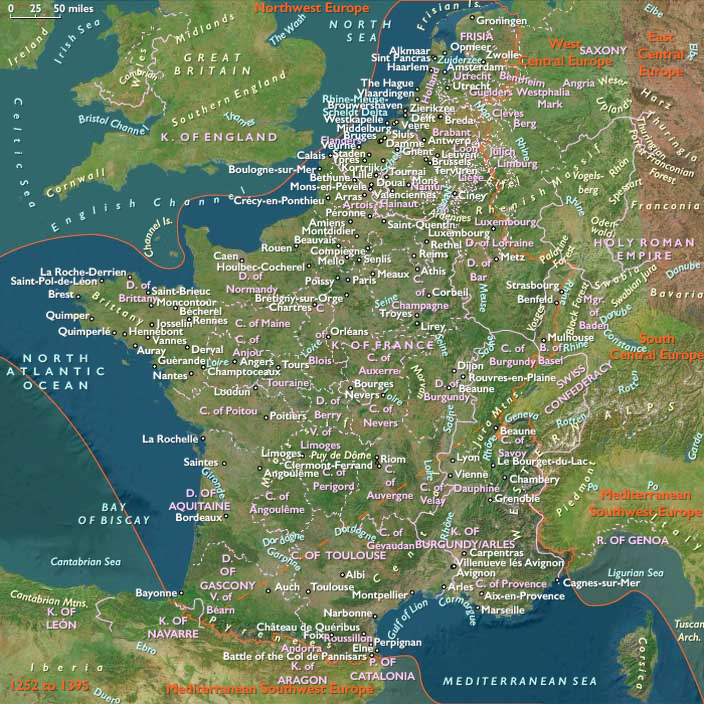
With no direct male descendant, the question of succession arose. The closest male claimant by blood was Edward III of England, the son of Isabella of France, Charles IV’s sister. However, the French nobility, adhering to Salic tradition, rejected Edward’s claim on the basis that kingship could not be transmitted through a woman. Instead, the crown passed to Philip of Valois, Charles IV’s cousin, who ascended the throne as Philip VI.
The Peak of Medieval French Monarchy
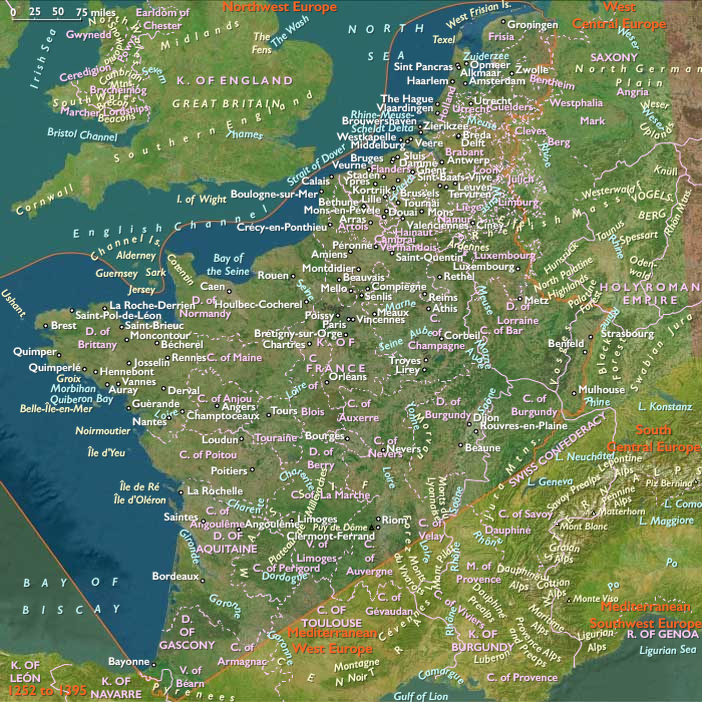
Philip VI’s reign (1328–1350) marked the height of medieval French power, as he inherited a kingdom that had been strengthened by his Capetian predecessors. France was the largest, wealthiest, and most populous kingdom in Western Europe, with a strong centralized monarchy and a formidable military. However, Philip’s rule was soon challenged by Edward III, who, resentful of his exclusion, revived his claim to the French throne in 1337, thus initiating the Hundred Years’ War.
While Philip initially secured French dominance at sea and maintained control over Flanders and Gascony, the early stages of the war would ultimately test and weaken the monarchy. His reign, though significant in consolidating Valois rule, marked the beginning of a prolonged struggle between England and France, which would shape the political and military landscape of Europe for the next century.
People
Groups
- French people (Latins)
- France, (Capetian) Kingdom of
- English people
- England, (Plantagenet, Angevin) Kingdom of
- France, (Valois) Kingdom of
Subjects
Regions
Subregions
Related Events
Showing 10 events out of 44704 total
Years: 1324 - 1335
People
Groups
- French people (Latins)
- France, (Capetian) Kingdom of
- English people
- England, (Plantagenet, Angevin) Kingdom of
- France, (Valois) Kingdom of
Subjects
Regions
Subregions