…Ulleungdo, an island in the Sea of …
Years: 1019 - 1019
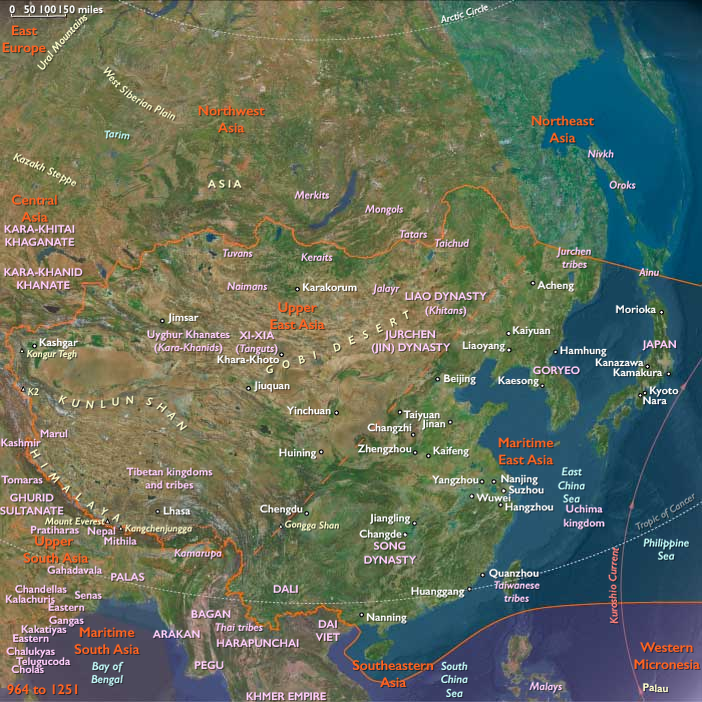
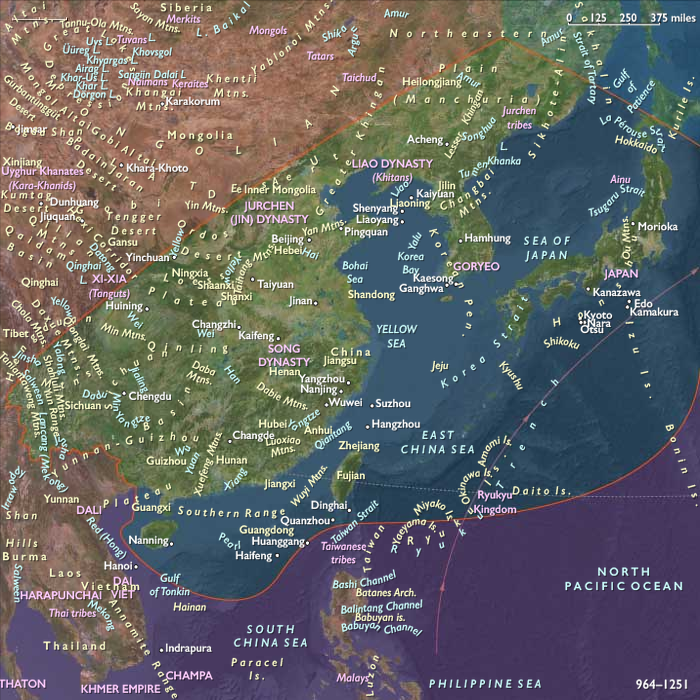
…Ulleungdo, an island in the Sea of Japan about one hundred and twenty kilometers (seventy-five miles) east of the Korean Peninsula and a recurrent security headache for the Goryeo, is abandoned because of the massive attacks of the Jurchen pirates.
The invasion in 1019 is one of those incidents.
Locations
Groups
Topics
Commodoties
Subjects
Regions
Subregions
Related Events
Filter results
Showing 10 events out of 51700 total
The Khitan troops invade Goryeo after crossing the Aprok River, but the Goryeo general Gang Gam-chan dams a stream and releases it as the Khitan troops are crossing.
Despite suffering significant casualties, some Khitan troops march to Gaegyeong, the capital of Goryeo.
During their campaign, general Gang Gam-chan cuts the supplies of the Khitan troops and harasses them relentlessly.
Exhausted, the Khitan troops decide to retreat hastily northward.
Monitoring the movement of their troops, general Gang Gam-chan attacks them in the vicinity of Guju, ending in a complete victory to the Goryeo Dynasty.
Barely a few thousand of the Liao troops survive after the bitter defeat by Goryeo at the Battle of Guju in 1019.
Many more are captured after surrendering along the river banks.
After the battle, peace negotiations follow and the Khitan will not invade Goryeo again.
Goryeo enters in a long and peaceful period with their foreign neighbors across the Aprok river.
The victory at the battle of Hong-Hwa-Jin is today called one of the three greatest military victories in Korean history (the others are the Battle of Salsu in 612 and the Battle of Hansando in 1592).
The Toi pirates, elements of the Jurchen, sail for Japan with about fifty ships from the direction of Goryeo, then assault Iki, …
…Tsushima and Hakata Bay.
For a week, using Noko Island in the bay as a base, they sack villages and kidnap Japanese people for use as slaves.
The Dazaifu, the administrative center of Kyūshū, then raises an army and successfully drives the pirates away.
Three enemies are captured by the Japanese army in Matsura, but they are identified as Koreans.
They say that they had guarded the borderland but had been captured by the Toi.
However, Japanese officers suspect them because there had been some Korean pirates in the former Silla period.
After Nakamine no Mochitaka's report, who had smuggled himself into Goryeo, this suspicion is resolved.
A few months later, the Goryeo delegate Jeong Jaryang reports that Goryeo forces had attacked the pirates off Wŏnsan and rescued about two hundred and sixty Japanese.
The Korean government then repatriates them to Japan.
There remain detailed reports by two captive women, Kura no Iwame and Tajihi no Akomi.
These Jurchen pirates, who live in what is today Hamgyŏngdo, North Korea, located in the northeast of the Korean peninsula, frequently attack the eastern coast.
In particular, …
Japanese regent and statesman Fujiwara no Michinaga was the fourth or fifth son of Fujiwara no Kaneie by his wife Tokihime, daughter of Fujiwara no Nakamasa.
There have been two regents and two imperial consorts among his brothers and sisters by the same mother.
As the youngest son of his father, his career at court, which he began at age fifteen, had been unremarkable until his two elder brothers Michitaka and Michikane died of disease in 995 during the reign of Emperor Ichijō.
Michinaga had struggled with Fujiwara no Korechika, the elder son of Michitaka, for political power.
With support of Senshi, his sister and mother of Ichijō, Michinaga had eventually succeeded in gaining power as well the support of majority of the court.
He had been appointed Nairan, the secretary of the emperor and the reviewer of all the documents sent to the emperor before the emperor himself read them.
During the initial years of Go-Ichijō's reign, Fujiwara no Michinaga had actually ruled from his position as sesshō (regent).
Although Michinaga has never formally taken on the title of kampaku regent, he exercises great power and influence, even after he formally retires from public life in 1019.
He will continue to direct the affairs of his son and successor, Fujiwara no Yorimichi, and will remain the de facto ruler of Japan until his death in 1028.
Yaroslav has during the past four years waged a complicated and bloody war for Kiev against his half-brother Sviatopolk, who is supported by his father-in-law, Duke Boleslaw I Chrobry of Poland.
During the course of this struggle, several other brothers (Boris, Gleb, and Sviatoslav) have been brutally murdered.
The Primary Chronicle accuses Sviatopolk of planning those murders, while the Saga of Eymund is often interpreted as recounting the story of Boris's assassination by the Varangians in the service of Yaroslav.
Yaroslav had defeated Sviatopolk in their first battle, in 1016, and Sviatopolk had fled to Poland.
Returning with Polish troops furnished by his father-in-law, Sviatopolk had seized Kiev and pushed Yaroslav back into Novgorod.
Boleslaw and his army remain in Rus' for several months, but later leave for Poland.
On his way to Poland, Boleslaw seizes some of the Cherven towns.
Meanwhile, the posadnik Konstantin Dobrynich and other citizens of Novgorod persuade Yaroslav to go to war against Kiev once again.
Sviatopolk is defeated and flees to the steppes.
Soon he returns with the Pecheneg army and attacks Yaroslav on the Alta River, but is once again defeated and flees to Poland, eventually dying on his way there.
Yaroslav now firmly establishes his rule over Kiev.
A new had war erupted between Norway and Sweden when Olaf II of Norway reestablished the Norwegian kingdom.
Many men in both Sweden and Norway try to reconcile the kings.
Olof's cousin, the earl of Västergötland, Ragnvald Ulfsson and the Norwegian king's emissaries Björn Stallare and Hjalti Skeggiason had arrived in 1018 at the thing of Uppsala in an attempt to sway the Swedish king to accept peace and as a warrant marry his daughter Ingegerd Olofsdotter to the king of Norway.
The Swedish king had been greatly angered and threatened to banish Ragnvald from his kingdom, but Ragnvald was supported by his foster-father Thorgny Lawspeaker.
Thorgny had delivered a powerful speech in which he reminded the king of the great Viking expeditions in the East that predecessors such as Erik Anundsson and Björn had undertaken, without having the hubris not to listen to their men's advice.
Thorgny himself had taken part in many successful pillaging expeditions with Olof's father Eric the Victorious and even Eric had listened to his men.
The present king wants nothing but Norway, which no Swedish king before him had desired.
This displeases the Swedish people, who are eager to follow the king on new ventures in the East to win back the kingdoms that paid tribute to his ancestors, but it is the wish of the people that the king make peace with the king of Norway and give him his daughter Ingegerd as queen.
Thorgny had finished his speech by saying: if you do not desire to do so, we shall assault you and kill you and not brook any more of your warmongering and obstinacy.
Our ancestors have done so, who at Mula thing threw five kings in a well, kings who were too arrogant as you are against us.
Olof, however, in 1019 instead marries his daughter Ingegerd-Irene to the powerful Yaroslav I the Wise .
An impending war is settled when Olof agrees to share his power with his son Anund Jacob.
Olof is also forced to accept a settlement with Olaf II of Norway at Kungahälla, who already had been married (unbeknownst to Olof) with Olof's daughter, Astrid, through the Geatish jarl Ragnvald Ulfsson.

Emperor Otto's ally Boleslaus I, the Premyslid ruler of Bohemia, had received Moravia. following the defeat of the Magyars by Otto in 955 at the Battle of Lechfeld,
Boleslaw I Chrobry of Poland, who had annexed Moravia in 999, rules it until 1019, when the Premyslid prince Bretislaus recaptures it.
Moravia will from this time forward share its history with Bohemia.
The Pechenegs (Patzinaks), a Turkic tribe, have long been known as the northern neighbors of the Bulgarians.
Constantine VII had thought them to be valuable allies against the Bulgars, Magyars, and Russians, but the Pechenegs begin to raid across the Danube into imperial territory after the conquest of Bulgaria in 1018.
Lahore appears as the capital of the Punjab for the first time under Anandapala—the Hindu Shahi king who is referred to as the ruler of (hakim i lahur)—after leaving the earlier capital of Waihind.
Few references to Lahore remain from before its capture by Sultan Mahmud of Ghazni in the eleventh century.
The sultan takes Lahore after a long siege and battle in which the city is torched and depopulated.