Tyre seems to have shifted the heart …
Years: 825BCE - 825BCE
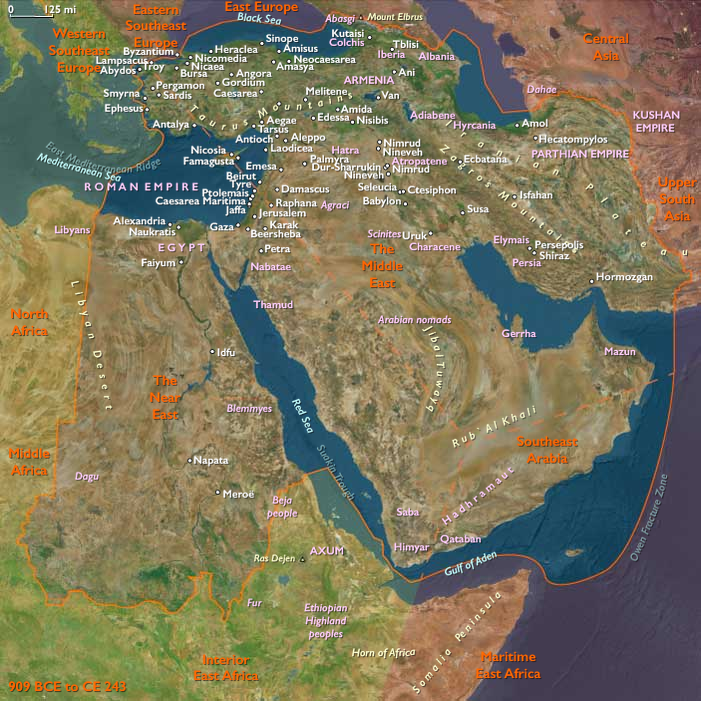
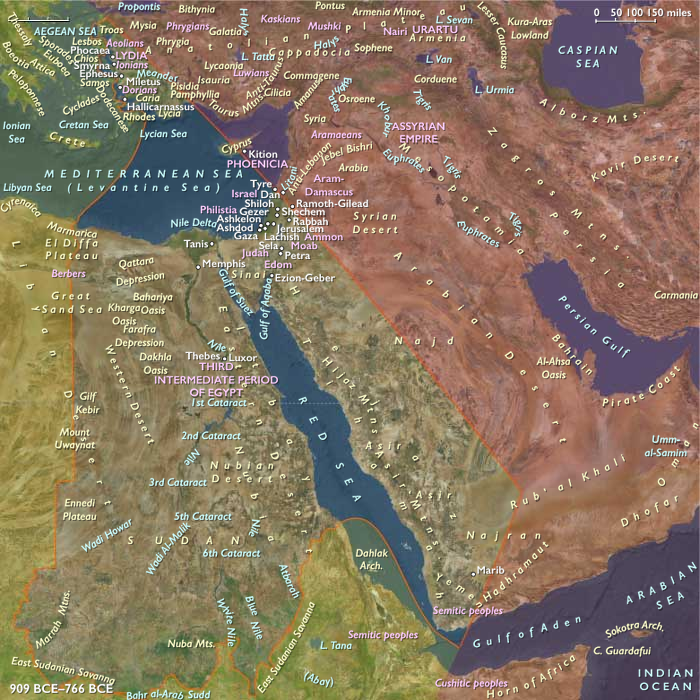
Tyre seems to have shifted the heart of its trading empire during Pygmalion's reign from the Middle East to the Mediterranean, as can be judged from the building of new colonies including Kition on Cyprus, Sardinia, and, according to tradition, Carthage.
Locations
People
Groups
Topics
Subjects
Regions
Subregions
Related Events
Filter results
Showing 10 events out of 66564 total
The Middle East, 825 to 814 BCE: The Reconsolidation Under Shamsi-Adad V
The era 825 to 814 BCE marks a significant phase of reconsolidation and expansion for the Assyrian Empire under the rule of Shamsi-Adad V, who ascends the throne in 824 BCE following a turbulent period of civil unrest. Shamsi-Adad V embarks on determined efforts to restore stability, unity, and imperial prestige that had been severely compromised during the preceding civil war between his father, Shalmaneser III, and his rebellious brother, Ashur-danin-pal.
Shamsi-Adad V proves to be a vigorous leader who strategically directs Assyrian resources towards reasserting imperial authority over previously contested territories. A pivotal achievement during this era is the successful integration of Chaldea into the Assyrian Empire, a region strategically situated at the southernmost part of Mesopotamia. This conquest not only solidifies Assyria’s dominance in the region but also significantly enhances its economic prosperity and geopolitical influence.
The integration of Chaldea underscores Assyria's revitalized military prowess and Shamsi-Adad V’s adeptness at overcoming internal political turmoil to pursue expansionist policies effectively. His decisive actions in Chaldea demonstrate the empire’s robust capability for recovery and adaptation, ensuring that Assyria remains a formidable force within the Middle East.
Culturally, Assyria during this period continues to be characterized by the elaborate attire and ceremonial traditions that had developed during earlier reigns. The fashion remains highly sophisticated, reflecting influences from neighboring Babylonian customs, with intricate embroidered garments and detailed grooming practices signifying social and political status.
Thus, the era from 825 to 814 BCE under Shamsi-Adad V represents an important chapter of restoration and renewed expansion for the Assyrian Empire. It is a testament to the empire's resilience, its enduring capacity for recovery, and its sustained ability to exert significant regional influence, shaping the historical trajectory of the Middle East.
Shamsi-Adad V, who rules Assyria from 824 BCE, adds Chaldea to his empire.
The Near East (825–814 BCE): Egyptian Division and Israelite Struggles
Egyptian Fragmentation Deepens
Between 825 and 814 BCE, Egypt's political fragmentation intensifies, particularly after the reign of Osorkon II. By approximately 818 BCE, control of Egypt is effectively divided, with Shoshenq III of the Twenty-second Dynasty ruling over Lower Egypt from Memphis and the Delta region, while Upper and Middle Egypt are governed by Takelot II and his son Osorkon, later known as Osorkon III. Following the death of Takelot II, rivalry erupts between his sons Osorkon and Shoshenq III, plunging Thebes into a civil conflict.
Adding to the political complexity, Pedubast I, a ruler of Libyan ancestry, had earlier declared himself Pharaoh, founding the Twenty-third Dynasty and reigning primarily over Thebes and Upper Egypt. His rule, lasting approximately twenty-five years, represents a further layer of political division. The competition between Pedubast I and the existing line of Takelot II/Osorkon III characterizes this turbulent era, underscoring the extent of Egypt's fragmentation during the Third Intermediate Period.
Jehoahaz and Israel’s Continuing Decline
In the northern kingdom of Israel, the death of King Jehu in 815 BCE marks the beginning of sole rulership for his son Jehoahaz. His reign unfolds against the backdrop of Israel’s diminished military and political power following catastrophic defeats by the Aramaean kingdom of Damascus under Hazael. Israel continues to suffer from the consequences of these military setbacks, facing severe territorial losses and reduced regional influence. Jehoahaz’s rule is characterized by efforts to stabilize a significantly weakened state, which struggles against ongoing external pressures and internal vulnerabilities.
Summary of the Era
The years 825–814 BCE witness profound political upheaval in the Near East, particularly marked by intensified fragmentation within Egypt. The rivalry among Egyptian rulers underscores the period's dynastic complexity and regional instability. Concurrently, Israel continues to endure significant political and military challenges under Jehoahaz, reflecting broader patterns of vulnerability and transition within the region. Collectively, these events highlight the ongoing reshaping of the Near Eastern political landscape, setting the stage for further developments in subsequent decades.
Egypt had effectively shattered in two states after the reign of Osorkon II, particularly, with Shoshenq III of the Twenty-Second Dynasty controlling Lower Egypt by 818 BCE while Takelot II and his son Osorkon (the future Osorkon III) rule Middle and Upper Egypt.
Osorkon and Shoshenq III, the two sons of Takelot II, sons battle for the throne after his death.
Thebes is engulfed in civil war between the forces of Pedubast I, who has proclaimed himself Pharaoh, versus the existing line of Takelot II/Osorkon B.
Jehohaz becomes sole ruler of Israel at the death of his father King Jehu in 815.
Kart-Hadasht (Carthage) is supposedly founded on the Tunisian coast of North Africa under Pygmalion of Tyre (820–774 BCE) as a way station and trading post for merchants in 814 BCE (the traditional date; archaeology confirms no date earlier than around 740 BCE.)
The Middle East, 813 to 802 BCE: The Regency of Sammuramat and Reign of Adad-nirari III
The era 813 to 802 BCE marks a remarkable and transformative period for the Assyrian Empire, primarily under the rule of Adad-nirari III, who ascends to the throne in 811 BCE following the death of his father, Shamsi-Adad V. Due to his youth, the early part of his reign sees significant influence from his mother, Queen Sammuramat, who serves as regent from 810 to 805 BCE.
Sammuramat's regency is notable for her exceptional authority and effective governance, a rarity for women in ancient Mesopotamian history. Her prominence gives rise to the legendary figure of Semiramis, a deified queen mythologized in later traditions as a powerful conqueror and founder of cities, notably Babylon. According to legend, Semiramis was nurtured by doves, symbolizing divine favor and protection. This mythological Semiramis reportedly led extensive military campaigns into regions including Persia, Egypt, Libya, and Ethiopia, further highlighting the lasting impression of Sammuramat's historical regency.
Upon assuming direct control after Sammuramat's regency, Adad-nirari III continues to consolidate and expand the Assyrian Empire. In 804 BCE, he achieves a major military and strategic success with the conquest of Damascus, an influential city-state in the Levant. This conquest significantly enhances Assyria's territorial reach and solidifies its dominance over vital trade routes and regional politics.
Under Adad-nirari III, Assyrian administrative and military structures remain robust and efficient, enabling sustained expansion and control. Culturally, the empire continues to reflect and expand upon the sophisticated ceremonial traditions and elaborate artistic expressions characteristic of the previous era. The intricate craftsmanship in palace reliefs, clothing, and ceremonial artifacts underscore the empire’s wealth and the imperial power vested in its rulers.
Thus, the era from 813 to 802 BCE represents a vital period in Assyrian history, marked by the influential regency of Sammuramat and the subsequent assertive and expansionist reign of Adad-nirari III. Their combined leadership ensures Assyria's continued prominence and stability, significantly shaping the geopolitical and cultural landscape of the Middle East during this era.

Adad-nirari III succeeds his father Shamshi-Adad V as king of Assyria in 811 BCE.
Queen Sammuramat serves as regent for her son Adad-Nirari III from 810 to 805.
(Sammuramat is evidently the basis for the Ishtar-like, deified mythological Queen Semiramis, wife of Ninus, founder of Nineveh. Semiramis was abandoned by her mother, the fish goddess Derceto, and nurtured by doves. After Ninus died, Semiramis ruled in the place of their son Ninyus for many years. According to the legend, she founded Babylon and led successful campaigns against Persia, Egypt, Libya, and Ethiopia. When her son plotted against her, she disappeared in the shape of a dove.)
Adad-nirari III conquers Damascus in 804 BCE.