Omar al-Bashir is deposed as President of …
Years: 2019 - 2019
April
Locations
People
Groups
Topics
Subjects
Regions
Subregions
Related Events
Filter results
Showing 10 events out of 16 total
The next day, Mahmoud Tawfik, the Interior Minister of Egypt, will state that the car contained explosives and was to be used in a terrorist operation.
The explosives-filled car had been on its way to commit an attack in another part of the capital.
Tawfik will accuse the Hasm Movement of carrying out the bombing, but the group will deny the allegations.
One crashes into the roof of the Hezbollah Media Center, about forty-five minutes before the second explodes in the air and damages the building.
It is the first such incident between Israel and Lebanon since the 2006 Lebanon War.
Substantial amendments to the Russian constitution proposed in January 2020 take effect in July following a national vote, allowing Putin to run for two more six-year presidential terms after his current term ends.
Russia launches a large-scale invasion of Ukraine on February 24, 2022.
The invasion is preceded by a Russian military buildup in occupied Crimea and around Ukraine, and by Russia's recognition of the breakaway separatist regions in eastern Ukraine.
The invasion is the largest conventional military attack in Europe since the Second World War.
At about 06:00 Moscow time, Putin announces a "special military operation" in eastern Ukraine; minutes later, cities of Ukraine are attacked by missiles.
Two hours later, Russian ground forces enter the country.
The invasion is met with widespread international condemnation, with further sanctions against Russia
Anti-war protests in Russia are met with mass arrests.
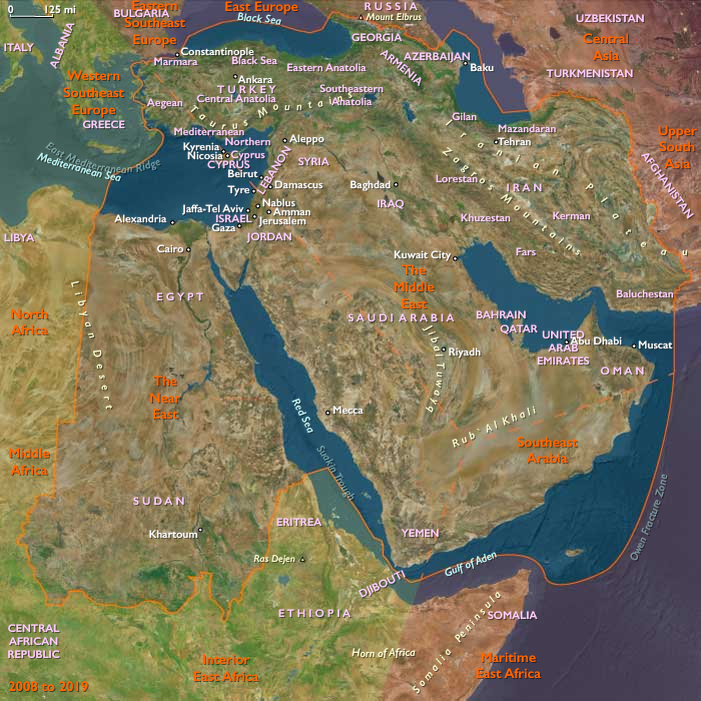
The Golan Heights, the hilly area overlooking the upper Jordan River valley on the west, is another area militarily occupied by Israel.
After the Arab-Israeli War of 1948/1949, Syria had fortified the western crest of the Golan Heights, which commands the Hula Valley, the Sea of Galilee, and the upper Jordan River valley, all in Israel.
In these sections, many Israeli civilians had been killed by Syrian artillery and sniper fire; agriculture and fishing were rendered difficult, and at times impossible.
The area had been part of extreme southwestern Syria until 1967, when it came under Israeli military occupation, and in December 1981, Israel unilaterally annexed the part of the Golan it held.
As long as Israel exists, it is unlikely to relinquish the Golan, because the Israelis have a deep-rooted fear—not without reason—of enemy guns firing down upon their cities and villages from these strategic heights.
The Golan's population in 1988 was estimated to be twenty-three thousand nine hundred, at least twenty thousand of whom were Jewish settlers.
More than ninety-five percent of Jordan's population are Sunnite Muslims; Christians constitute most of the rest, of whom two-thirds adhere to the Rum, or Greek Orthodox Church.
Other Christian groups include the Greek Catholics, also called the Melchites, or Catholics of the Byzantine rite, who recognize the supremacy of the Roman pope; the Roman Catholic community, headed by a pope-appointed patriarch; and the small Syrian Orthodox, or Jacobite, church, whose members use Syriac in their liturgy.
Most non-Arab Christians are Armenians, and the majority belong to the Gregorian, or Armenian, Orthodox church, while the rest attend the Armenian Catholic church.
There are several Protestant denominations representing communities whose converts came almost entirely from other Christian sects.
About half of Jordan's population is Palestinian.
The influx of Palestinian refugees not only altered Jordan's demographic map but has also affected its political, social, and economic life.
Jordan's population in the late 1940s was between two hundred thousand and two hundred and fifty thousand.
After the 1948/1949 Arab-Israeli War and the annexation of the West Bank, Jordanian citizenship was granted to some four hundred thousand Palestinians, who were residents of and remained in the West Bank, and to about half a million refugees from the new Israeli state.
Many of these refugees settled east of the Jordan River.
Between 1949 and 1967, Palestinians continued to move east in large numbers.
After the 1967 Arab-Israeli War, an estimated three hundred and ten thousand to three hundred and fifty thousand Palestinians, mostly from the West Bank, sought refuge in Jordan; thereafter immigration from the West Bank continued at a lower rate.
In 1988, Jordan renounced its claims to the West Bank, which had been under its rule from 1948 to 1967.
During the 1990/1991 Persian Gulf War, some three hundred thosusand additional Palestinians fled Kuwait (or were expelled) to Jordan.
Most Palestinians are employed and hold full Jordanian citizenship.
By the mid-1990s, approximately one million three hundred thousand Palestinians, representing about one-third of Jordan's population, were registered with the United Nations Relief and Works Agency for Palestine Refugees in the Near East (UNRWA), which provided education, medical care, relief assistance, and social services.
About one-sixth of these refugees live in camps in Jordan.
Jordan's Hashemite dynasty, whose ancestors were the hereditary emirs of Mecca until the Saudi-Wahhabis conquered the Hejaz in the mid-1920s, have the support of the Bedouin, but have often be at odds with the majority of the populace who, like many in the more secularly oriented Arab lands, would prefer a constitutional republic to a hereditary autocracy, however enlightened or benevolent.

“Occupied Palestine” includes the densely populated Gaza Strip, occupying one hundred and forty square miles (three hundred and sixtyy-three square kilometers) along the Mediterranean Sea just northeast of the Sinai Peninsula, unusual in being a densely settled area not recognized as a de jure part of any extant country.
The majority of its population, twelve hundred and three thousand in 2001, is Muslim Arab, among whom live scattered “outposts” of some seven thousand Jewish settlers, who have taken a large portion of the most desirable lands.
Living conditions in the Gaza Strip are typically poor, because of its dense and rapidly increasing population (the area's growth rate is one of the highest in the world); inadequate water, sewage, and electrical services; and high rates of unemployment.
Agriculture is the economic mainstay of the employed population, and nearly three-fourths of the land area is under cultivation.
Political tension and outbreaks of violence have often led Israeli authorities to close the border for extended periods, placing many Palestinians out of work.
The international airport in Gaza, which opened in November 1998, is closed, its runways torn up by Israeli bulldozers.
Gaza City and its surroundings continue to be greatly overpopulated by Arab refugees from Palestine.