
Two German religious orders, the Teutonic Knights …
Years: 1300 - 1300
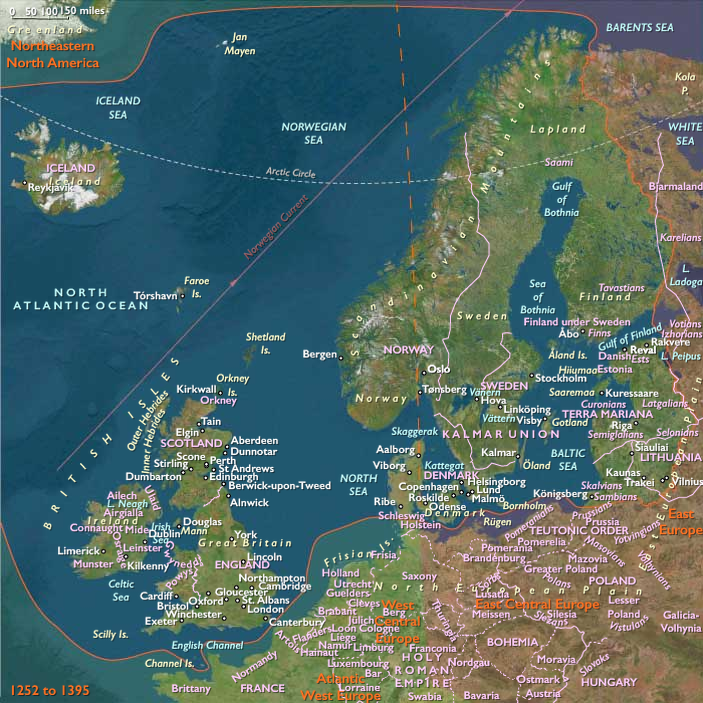
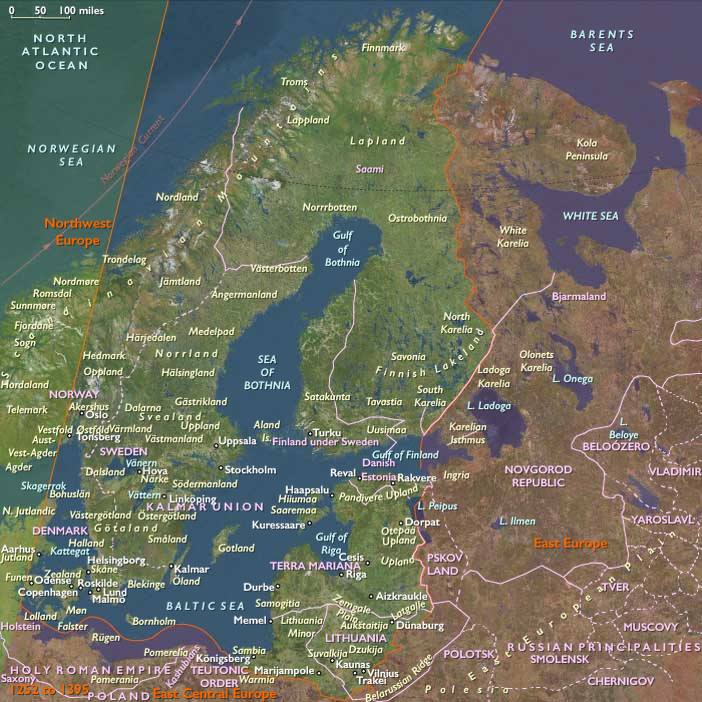
Two German religious orders, the Teutonic Knights and the Livonian Brothers of the Sword, had In the early thirteenth century conquered much of the area that is now Estonia and Latvia, in addition to parts of Lithuania.
A number of small Baltic tribal groups had responded by uniting under the rule of Mindaugas (Myndowe) and soundly defeating the Livonians at Šiauliai in the Battle of Saule in 1236.
Mindaugas had in 1250, signed an agreement with the Teutonic Order and in 1251 had been baptized in their presence by the bishop of Chełmno (in Chełmno Land.)
Mindaugas had been crowned on July 6, 1253, as Grand Duke of Lithuania but was murdered ten years later by his nephew Treniota, which had resulted in great unrest and a return to paganism.
Lithuania will remain a pagan empire for another one hundred and twenty years, fighting against the Teutonic and Livonian Orders during the Northern Crusades to Christianize the land.
The Grand Duchy of Lithuania had been ravaged in 1241, 1259 and 1275 by raids from the Golden Horde.
The duchy had entered times of relative instability after Mindaugas' death, as reflected by the fact that seven Grand Dukes had held the title over the course of the next thirty-two years.
Little is known about this period, but the Gediminid dynasty had been founded in about 1280.
Despite the instability, the Grand Duchy did not disintegrate.
Vytenis had assumed power in 1295, and during the next twenty years will lay solid foundations for the Duchy to expand and grow under the leadership of Gediminas and his son Algirdas.
Locations
People
Groups
- Blue Horde, Khanate of the
- Lithuania, Grand Duchy of
- Teutonic Knights of Venice (House of the Hospitalers of Saint Mary of the Teutons in Jerusalem)
Topics
Subjects
Regions
Subregions
Years: 1300 - 1300
Locations
People
Groups
- Blue Horde, Khanate of the
- Lithuania, Grand Duchy of
- Teutonic Knights of Venice (House of the Hospitalers of Saint Mary of the Teutons in Jerusalem)
Topics
Subjects
Regions
Subregions