
Two decades of Spanish conquest and slavery …
Years: 1517 - 1517
March
Two decades of Spanish conquest and slavery have depleted the indigenous population of the West Indies.
Cuban Governor Diego de Velázquez, hoping to establish a colony that might supply mineral riches and a replacement slave labor force, has sent a slave-hunting military expedition to the mainland under Francisco Hernandez de Córdoba.
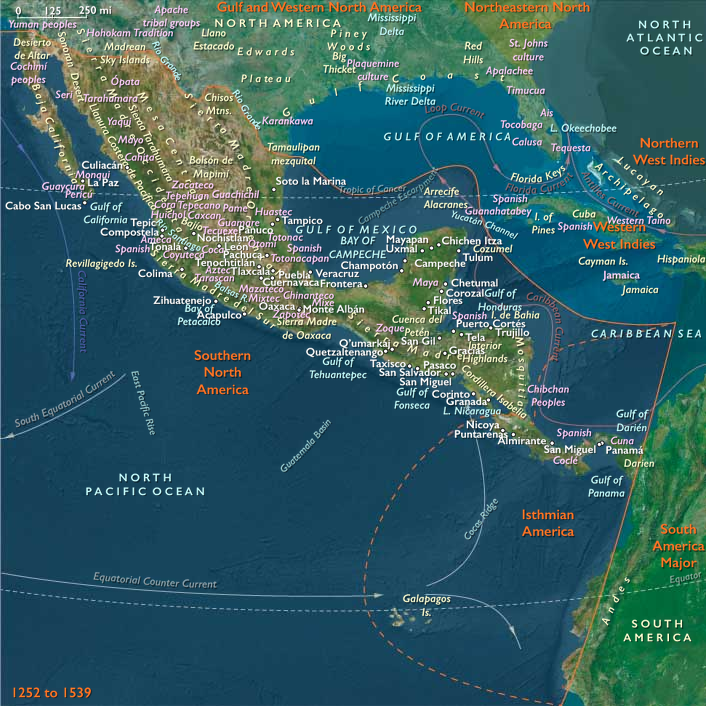
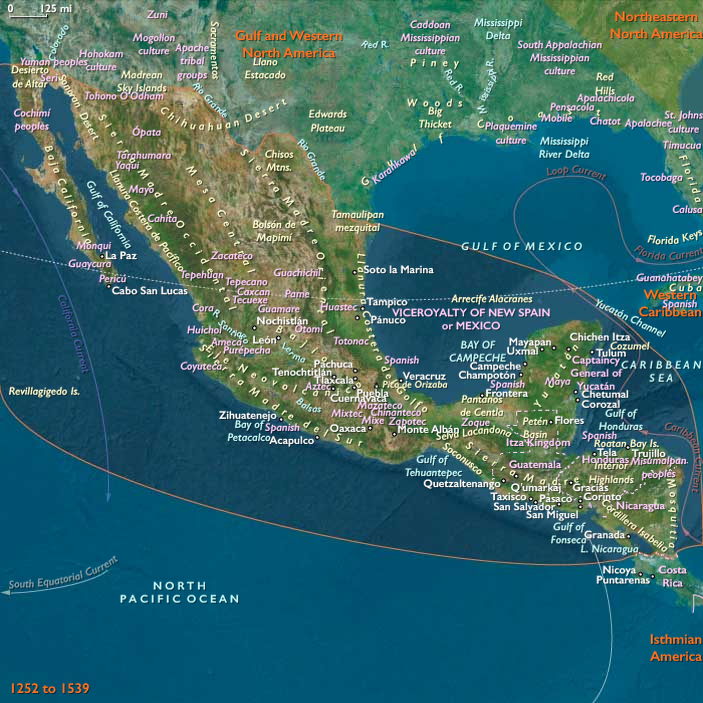
Escaping a two-day storm of Cuba’s western tip, the expedition had sailed through twenty-one days of fair weather and calm seas after, which they spot the Maya-occupied Yucatán coast and, some six miles from the the coast and visible from the ships, the first large populated center seen by Europeans in the Americas, with the first solidly built buildings: this is possibly near the site of present Chetumal.
The Spaniards, who evoke the Muslims in all that is developed but not Christian, speak of this first city they discover in America as El gran Cairo, as they later are to refer to pyramids or other religious buildings as mezquitas, "mosques".
It is reasonable to designate this moment as the discovery of Yucatán—even "of Mexico", if one uses "Mexico" in the sense of the borders of the modern nation state—but it should be noted that Hernández's expeditionaries are not the first Spaniards to tread on Yucatán.
In 1511 a boat of the fleet of Diego de Nicuesa, which was returning to Hispaniola, was wrecked near the coast of Yucatán, and some of its occupants had managed to save themselves.
At the moment in which the soldiers of Hernández see and name El gran Cairo, two of those shipwrecked sailors, Gerónimo de Aguilar and Gonzalo Guerrero, are living in the area of Campeche, speaking the Mayan dialect of the area, and Gonzalo Guerrero even seems to have been governing an indigenous community.
Nicuesa's shipwrecked sailors who had not been not sacrificed or worked to death by their Maya captors had ended up enslaved.
The two boats of shallower draft go on ahead to investigate whether they could anchor securely near land.
Expedition member Bernal Diaz dates March 4, 1517 as the first encounter with the Indians of Yucatán, who approach these boats in ten large canoes (called pirogues), using both sails and oars.
Making themselves understood by signs—the first interpreters, Julián and Melchior, sare obtained by precisely this expedition — the Indians, always with "smiling face and every appearance of friendliness", communicate to the Spaniards that the next day more pirogues will come to bring the recent arrivals to land.
This moment in which the Indians come up to the Spanish boats and accept strings of green beads and other trifles fashioned for this purpose is one of the few peaceful contacts that Hernández's group will have with the Indians, and even these gestures of peace are feigned on the part of the Indians.
Locations
People
- Bernal Díaz del Castillo
- Diego Velázquez de Cuéllar
- Francisco Hernández de Córdoba
- Gerónimo de Aguilar
- Gonzalo Guerrero
Groups
- Maya peoples
- Santo Domingo, Captaincy General of
- Tierra Firme, Province of
- Cuba, Governorate of
- Spain, Habsburg Kingdom of
Topics
Commodoties
Subjects
Regions
Subregions
Related Events
Showing 10 events out of 38928 total
Years: 1517 - 1517
March
Locations
People
- Bernal Díaz del Castillo
- Diego Velázquez de Cuéllar
- Francisco Hernández de Córdoba
- Gerónimo de Aguilar
- Gonzalo Guerrero
Groups
- Maya peoples
- Santo Domingo, Captaincy General of
- Tierra Firme, Province of
- Cuba, Governorate of
- Spain, Habsburg Kingdom of
Topics
Commodoties
Subjects
Regions
Subregions