Two councils of the Christian Church held …
Years: 247 - 247
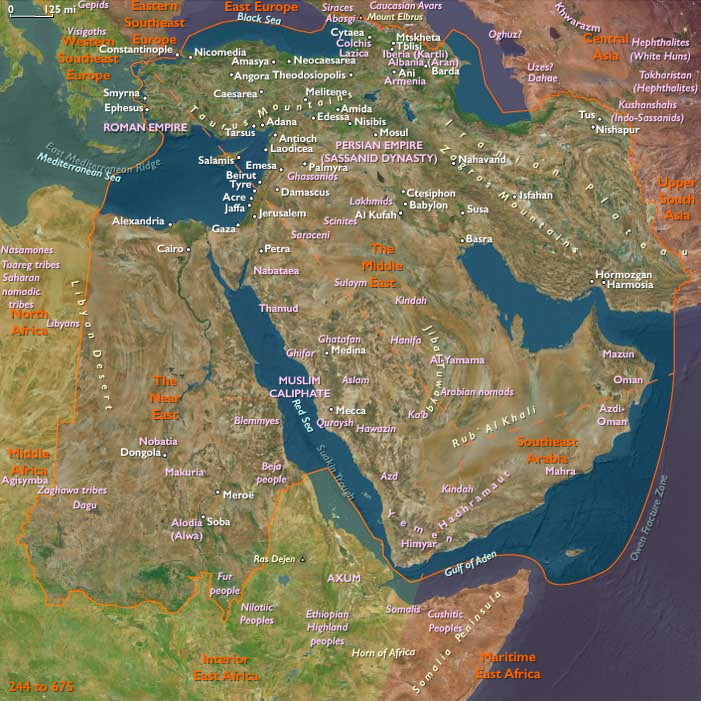
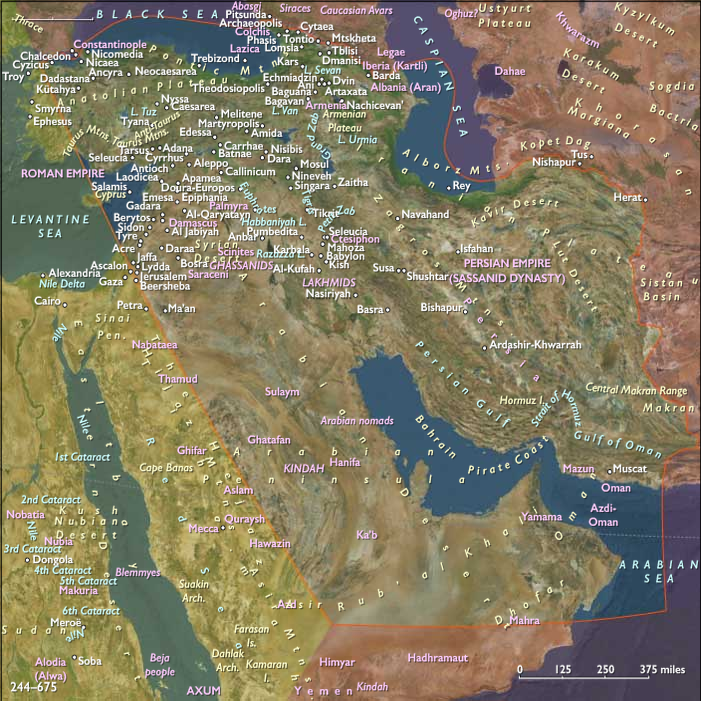
Two councils of the Christian Church held in Bostra, one in 246 and the other in 247, are known as the Councils of Arabia.
Both are held against Beryllus, the bishop of the local see, and his followers, who believe that the soul perishes upon the death of the body, but that it will one day rise with the body.
Origen, who is present at both councils, persuades them that their belief is heresy.
Locations
People
Groups
- Arabia Petraea
- Christians, Early
- Syria Palæstina, Roman province of (Judea, Samaria, and Idumea)
- Roman Empire (Rome): Non-dynastic
Topics
Commodoties
Subjects
Regions
Subregions
Related Events
Filter results
Showing 10 events out of 60405 total
Rav Huna succeeds in 247 as resh metivta, or director, of the Academy at Sura.
In addition to serving as the spiritual and intellectual ruler of Babylonian Jewry, he is also the Exilarch (Greek for 'Prince of Captivity)', or Resh Galuta (who usually can trace his lineage from Zerubbabel, the sixth-century BCE Davidic leader).
Received by the Persian Court, he is responsible as Chief Justice for criminal and civil matters, including the appointment of judges, police, and civil administrators.
Judah ben Ezekiel establishes a Babylonian Jewish academy at the Mesopotamian town of Pumbedita, where he focuses on the study of practical daily laws.
The area of present Vietnam had come under Chinese control in the late Han Dynasty in 43 and was ruled by Chinese governors.
Chinese control remained unchanged with the establishment of the Three Kingdoms, even with the fall of the Eastern Han Dynasty in 220,.
Trieu Thị Trinh, a Vietnamese female warrior, manages briefly in 248 to successfully resist the Kingdom of Wu during their occupation of Vietnam.
She is described as the “Vietnamese Joan of Arc”.
The Romans finally defeat the invading Goths in 248 after undertaking a series of campaigns against these and other tribes on the Danube, but the legions are not satisfied with the result, probably due to a low share of the plunder, if any.
Rebellion soon arises and Tiberius Claudius Pacatianus is proclaimed emperor by the troops.
He is known from coins, and from mentions in Zosimus and Zonaras, who say that he was an officer in one of the Danube legions.
According to Zosimus, the revolts of Pacatianus in Moesia (he probably controlled Viminacium) and Iotapianus in Syria prompted Philip to make an offer to the Roman Senate to step down, but the senator Gaius Messius Quintus Decius (who was sent by Philip to deal with the rebellion), correctly predicted that Pacatianus the Great would soon be killed by his own men before his own arrival.
After crushing the uprising, Philip nominates Decius as governor of the province, which future events will prove to be a mistake, at least where Philip is concerned.
Pacatianus's revolt had not been the only threat to Philip’s rule: in the East, Marcus Iotapianus had led another uprising in response to the oppressive rule of Priscus and the excessive taxation of the Eastern provinces.
Two other usurpers, Marcus Silbannacus and Sponsianus, are reported to have started rebellions without much success.
Philip returns to Rome in April 248 to celebrate the thousandth anniversary of the founding of the city, combining the anniversary with the celebration of Rome's alleged tenth saeculum.
According to contemporary accounts, the festivities are magnificent and include spectacular games, ludi saeculares, and theatrical presentations throughout the city.
In the coliseum, more than a thousand gladiators are killed along with hundreds of exotic animals including hippos, leopards, lions, giraffes, and one rhinoceros.
The events are also celebrated in literature, with several publications, including Asinius Quadratus's History of a Thousand Years, specially prepared for the anniversary.
Despite the festive atmosphere, discontent in the legions is growing.
The Korean polity of Baekje becomes a full-fledged kingdom during the reign of King Goi (234–286), as it continues its consolidation of the Mahan confederacy, a loose confederacy of chiefdoms that existed from around the first century BCE to the third century CE in the southern Korean peninsula in the Chungcheong Province.
Arising out of the confluence of Gojoseon migration and the Jin federation, Mahan was one of the Samhan (or "Three Hans") confederacies, along with Byeonhan and Jinhan.
Baekje had begun as a member statelet.
In 249, according to the Japanese chronicle Nihonshoki, Baekje's expansion reaches the Gaya confederacy to its east, around the Nakdong River valley.
Wang Bi, whose most important works are commentaries on Laozi's Tao Te Jing and the I Ching, serves as a minor bureaucrat in the Kingdom of Wei.
Married with a daughter, he dies of pestilence at the age of 24.
The text of the Tao Te Jing that appears with his commentary will widely be considered as the best copy of this work until the discovery in 1973 of the Mawangdui texts.
Sima Yi, a strategist, general, and politician of the Three Kingdoms era of China, is perhaps best known for defending Cao Wei from Zhuge Liang's Northern Expeditions.
Shu's Northern Expeditions after Zhuge Liang's death, had ceased for some years, and peace had returned to the Kingdom of Wei.
The emperor, Cao Rui is now an adult and, taking advantage of the peace, had turned to palace building, costing the state extravagant amounts of money and alienating his ministers and people.
In this environment, Gongsun Yuan, a powerful warlord, had rebelled.
After a campaign to suppress the rebellion was foiled by flooding, Sima Yi had been dispatched the next year, and although initially being set back by more flooding, he had defeated Gongsun Yuan and exterminated his family.
This campaign had brought him even greater prestige.
Cao Rui died not long afterward and the next emperor, again very young, Cao Fang, had ascended to the throne.
This time two regents had been appointed, Sima Yi and the son of Cao Zhen, Cao Shuang.
Cao Shuang was very jealous of Sima Yi's great power and prestige, and sought total control over the Kingdom of Wei.
At the advice of an advisor, he had persuaded the emperor to promote Sima Yi to personal instructor to the emperor.
Although among the highest of positions a person could be given, it is an honorary position only and Sima Yi had been left without any real political authority, although he has maintained his military command.
Zhu Ran of the Kingdom of Wu in 241 had Fancheng under siege.
Sima Yi had personally gone to lift the siege, and had succeeded in driving the attackers away.
He had then succeeded in the year 243 in defeating Zhuge Ke of Wu.
In contrast to this, Cao Shuang's attempts to attack the Kingdom of Shu had ended in failure, making the difference between his abilities and Sima Yi's all the more obvious.
Sensing danger, Sima Yi had retired from his position in 247, citing illness as the reason.
Suspicious, Cao Shuang had sent an advisor to visit Sima Yi, to check whether or not he was truly ill. Sima Yi, then advanced in age, had pretended to be senile.
As Cao Shuang's advisor completely believed the act, Cao Shuang finally felt safe that he had no challenge to his power.
Sima Yi has since bided his time and in 249 springs into action while Cao Fang and Cao Shuang are outside the capital on an official visit to Cao Rui's tomb.
He moves on the imperial palace with an army and persuades the emperor's mother to issue an order to arrest Cao Shuang in order to save the kingdom from its irresponsible government.
Cao Shuang and his allies, with an imperial order declaring them rebels, surrender, expecting to be spared.
Sima Yi instead executes them all.
With complete power over the Kingdom of Wei now in his hands, Sima Yi becomes chancellor.

Sima Yi, to deceive Cao Shuang into letting down his guard, had stopped all political activities in May 247 and later retired, and he goes further in pretending to be ill and senile.
In the winter of 248-249, Cao Shuang's protégé Li Sheng is named as the administrator of Jingzhou, and before he leaves for his position, Cao Shuang sends Li Sheng to check on Sima Yi.
Cao Shuang and his followers are overjoyed when Li reports that Sima Yi is indeed ill and dying, that he could not even hear clearly what Li Sheng had said.
Cao Shuang, sensing that Sima Yi no longer poses a threat to him, draws his attention away from Sima.
On January 6, 249, Cao Shuang and his brothers leave the capital to accompany the child emperor Cao Fang to pay respects to Cao Rui at his resting place at Gaoping Tomb, and they continue to stay out on a hunting expedition.
Sima Yi and his sons launch a coup d'état and seize control of the capital city by first closing all the city gates.
Sima then assigns his protégés to take over the positions held by Cao Shuang's brothers after taking the armory: Excellency over the Masses Gao Rou replaces Cao Shuang, and Imperial Herdsman Wang Guan replaces Cao Xi to command the imperial bodyguards.
Sima Yi goes to see the Empress Dowager, requesting her to give an order to arrest Cao Shuang and his brothers on charges of treason.
Huan Fan, an advisor of Cao Shuang, escapes with the seal signifying the power of Grand Commander and brings it to Cao Shuang.
Cao Shuang is in a dilemma, unsure whether to surrender his power or not.
Cao Shuang's family and loved ones are in Sima Yi's control, and Sima Yi promises that Cao Shuang will not be harmed, as Sima is only after Cao's power.
Eventually, Cao Shuang agrees to surrender and gives up his power.
On January 10, 249, Cao Shuang returns to Luoyang, the capital of Cao Wei, and his fate is sealed.
Once having gained power, Sima Yi has Cao Shuang and his brothers arrested on charges of treason, then has them executed.
Sima Yi refuses to take the position of Imperial Chancellor awarded to him, and remains as Grand Tutor.
Philip the Arab, since becoming the emperor of Rome in 244, has dedicated himself to building his native Syrian hamlet of Shahba' up to a metropolis.
The city has been renamed Philippopolis in dedication to the emperor, who is said to have wanted to turn the city into a replica of Rome itself.
Temples, triumphal arches, baths, a theater, and a great wall surrounding the city have all been built based on the plan of a typical Roman city.
The building of the city stops abruptly after the death of Philip in 249.
The initial success of Decius leads his army to proclaim him emperor, allegedly against his will, in the spring of 249.
He immediately marches on Rome, and Philip's army meets the usurper near modern Verona in the summer.
Decius wins the battle and Philip is killed, either in the fighting or assassinated by his own soldiers who are eager to please the new ruler.
When the news of Decius' success reaches Rome, Philip's eleven-year-old son and heir is murdered.
Years: 247 - 247
Locations
People
Groups
- Arabia Petraea
- Christians, Early
- Syria Palæstina, Roman province of (Judea, Samaria, and Idumea)
- Roman Empire (Rome): Non-dynastic