
Tweed's downfall comes in the wake of …
Years: 1871 - 1871
July
Tweed's downfall comes in the wake of the Orange riot of 1871, which occurs after Tammany Hall bans a parade of Irish Protestants celebrating an historical victory against Catholicism, because of a riot the year before in which eight people died when a crowd of Irish laborers attacked the paraders.
Under strong pressure from the newspapers and the Protestant elite of the city, Tammany had reversed course, and the march had been allowed to proceed, with protection from city policemen and state militia.
The result is an even larger riot in which over sixty people are killed and more than one hundred and fifty injured on July 12.
Although Tammany's electoral power base is largely centered in the Irish immigrant population, it also needs the city's elite to acquiesce in its rule, and this is conditional on the machine's ability to control the actions of their people, but the July riot shows that this capability is not nearly as strong as had been supposed.
Tweed had for months been under attack from the New York Times and Thomas Nast, the cartoonist from Harper's Weekly, but their campaign has had only limited success in gaining traction.
They had been able to force an examination of the city's books, but the blue-ribbon commission of six businessmen appointed by Mayor A. Oakey Hall, a Tammany man, which includes John Jacob Astor III, banker Moses Taylor and others who benefit from Tammany's actions, had found that the books had been "faithfully kept", letting the air out of the effort to dethrone Tweed.
The response to the Orange riot of 1871 changes everything, and only days afterwards the Times/Nast campaign begins to garner popular support.
More importantly, the Times has started to receive inside information from County Sheriff James O'Brien, whose support for Tweed has fluctuated during Tammany's reign.
O'Brien had tried to blackmail Tammany by threatening to expose the ring's embezzlement to the press, and when this had failed, he had provided the evidence he had collected to the Times.
Shortly afterward, county auditor Matthew J. O'Rourke had supplied additional details to the Times, which had reportedly been offered five million dollars to not publish the evidence.
The Times has also obtained the accounts of the recently deceased James Watson, who had been the Tweed Ring's bookkeeper, and these are published daily, culminating in a special four-page supplement on July 29 headlined "Gigantic Frauds of the Ring Exposed".
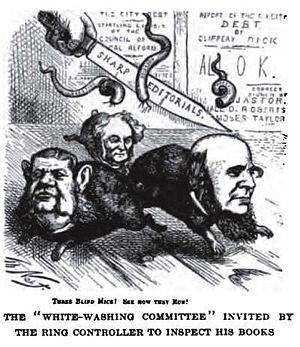
Thomas Nast cartoon of the "White-washing Committee" John Jacob Astor, Marshall O. Roberts, Moses Taylor
Locations
People
- George G. Barnard
- John Jacob Astor III
- Moses Taylor
- Peter B. Sweeny
- Richard B. Connolly
- Thomas Nast
- William M. Tweed
Groups
- Tammany Hall
- New York State (U.S.A.)
- United States of America (US, USA) (Washington DC)
- Erie Railway
Topics
- Party System, Third (United States)
- American Civil War & Reconstruction; 1864 through 1875
- Orange riots
Subjects
Regions
Subregions

Related Events
Showing 10 events out of 12734 total
Years: 1871 - 1871
July
Thomas Nast cartoon of the "White-washing Committee" John Jacob Astor, Marshall O. Roberts, Moses Taylor
Locations
People
- George G. Barnard
- John Jacob Astor III
- Moses Taylor
- Peter B. Sweeny
- Richard B. Connolly
- Thomas Nast
- William M. Tweed
Groups
- Tammany Hall
- New York State (U.S.A.)
- United States of America (US, USA) (Washington DC)
- Erie Railway
Topics
- Party System, Third (United States)
- American Civil War & Reconstruction; 1864 through 1875
- Orange riots
Subjects
Regions
Subregions