
Turkana Boy is the common name of …
Years: 1604493BCE - 1355662BCE
Turkana Boy is the common name of fossil KNM-WT 15000, a nearly complete skeleton of a hominid that died in the early Pleistocene.
This specimen is the most complete early human skeleton ever found.
It is one and a half million years old.
Turkana Boy is classified as either Homo erectus or Homo ergaster.
His age has been estimated from as old as fifteen years to as young as seven years six months.
The most recent scientific review suggests eight years of age.
It was initially suggested that he would have grown into 1.85 meters tall adult but the most recent analysis argues for the much shorter stature of 1.63 meters.
The reason for this shift has been research showing that his growth maturation differed from that of modern humans in that he would have had a shorter and smaller adolescent growth spurt.
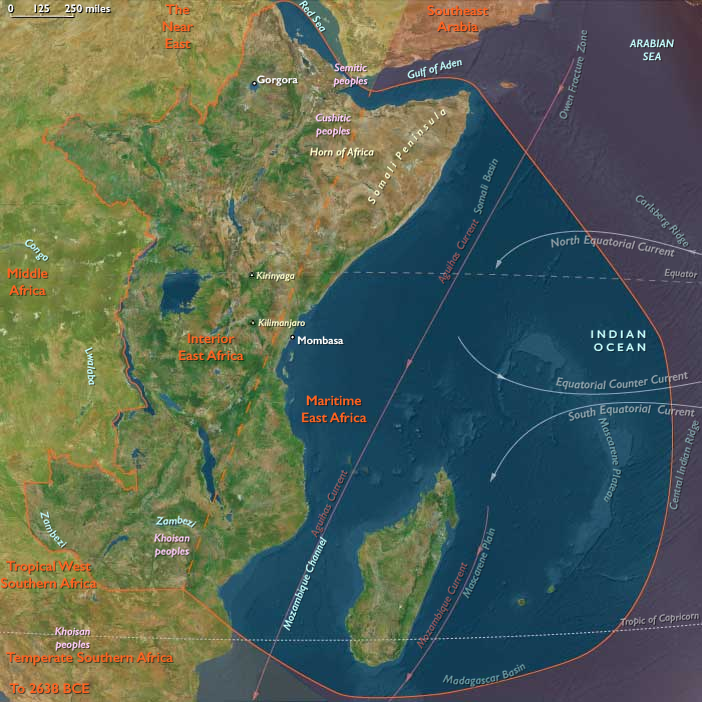
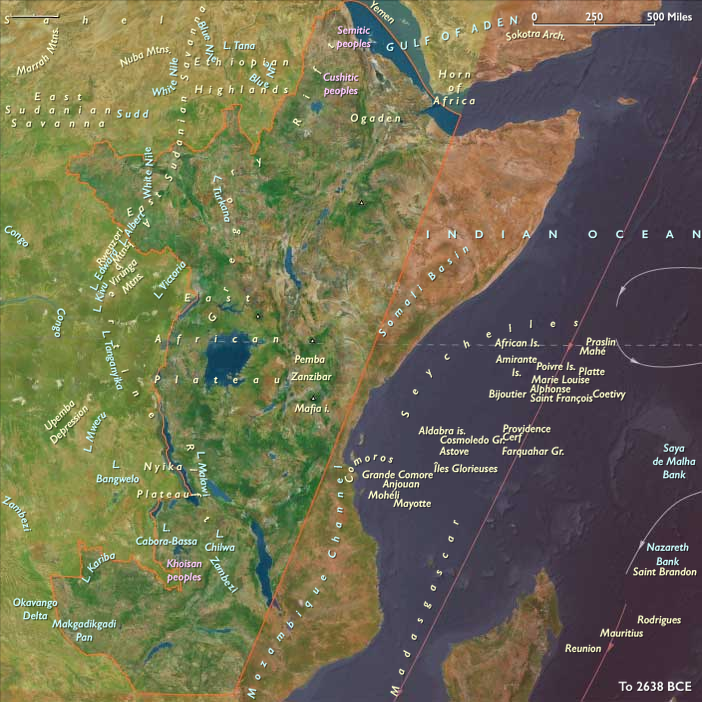
The skeleton was discovered in 1984 by Kamoya Kimeu, a member of a team led by Richard Leakey, at Nariokotome near Lake Turkana in Kenya.
The KNM-WT 15000 skeleton still had features (such as a low sloping forehead, strong brow ridges, and the absence of a chin) not seen in H. sapiens.
The arms were slightly longer.
Turkana Boy seems to have had a projecting nose rather than the open flat nose seen in apes.
His thoracic vertebrae are narrower than in Homo sapiens.
This would have allowed him less motor control over the thoracic muscles that are used in modern humans to modify respiration to enable the sequencing upon single out breaths of complex vocalizations.
Locations
Groups
Topics
Subjects
Regions
Subregions
Related Events
Showing 10 events out of 69781 total
Years: 1604493BCE - 1355662BCE
Locations
Groups
Topics
Subjects
Regions
Subregions