
Turan-Shah, following his success in Nubia, still …
Years: 1174 - 1174
Turan-Shah, following his success in Nubia, still seeks to establish a personal holding for himself while Saladin is facing an ever increasing amount of pressure from Nur al-Din, who seems to be attempting invading Egypt.
Baha ad-Din ibn Shaddad, Saladin's aide, suggests that there is a heretical leader in Yemen who is claiming to be the messiah, and that this is the principal reason that Saladin dispatches Turan-Shah to conquer the region.
While this is likely, it also appears 'Umara has considerable influence on Turan-Shah's desire to conquer Yemen and may have been the one who pushed him to gain Saladin's approval to use such a large part of the military forces in Egypt when the showdown with Nur al-Din seems to be so near.
Turanshah's departure from Egypt does not bode well for his adviser, 'Umara, however, as the poet finds himself caught up in an alleged conspiracy against Saladin and is executed.
Saladin, further mobilizing Muslim enthusiasm to create a united front against the Crusades, has made Egypt the most powerful Muslim state in the world at this time.
Although he had remained for a time theoretically a vassal of Nur ad-Din, this relationship ends in 1174 with the Syrian emir's death.
Saladin now sets out to conquer the Zengid kingdom in Syria as a preliminary to the Islamic holy war (jihad) against the Crusaders.
Locations
People
Groups
- Jews
- Islam
- Muslims, Sunni
- Muslims, Shi'a
- Christians, Roman Catholic
- Aleppo, Seljuq Emirate of
- Antioch, Principality of
- Jerusalem, Latin Kingdom of
- Tripoli, County of
- Jaffa and Ascalon, County of
- Damascus, Ayyubid Dynasty of
- Egypt, Ayyubid Sultanate of
Topics
Commodoties
Subjects
Regions
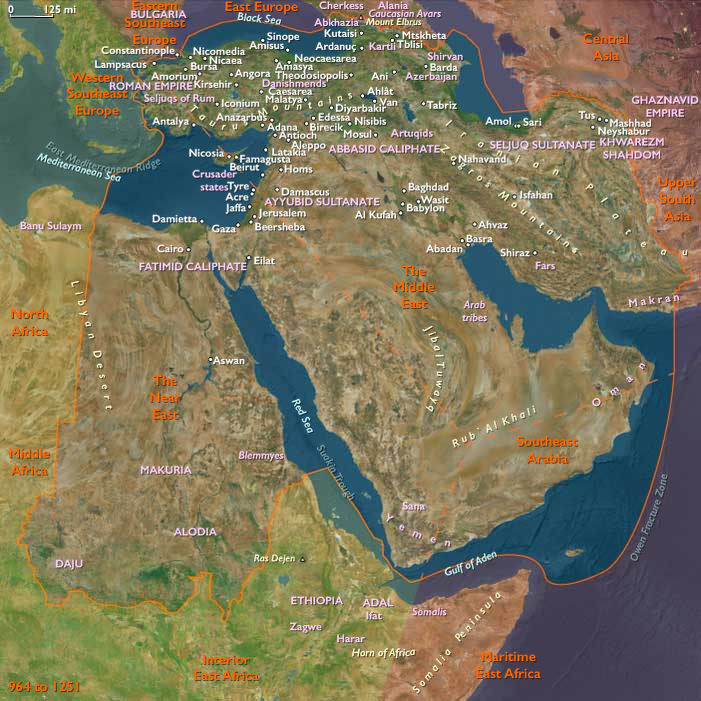
Subregions
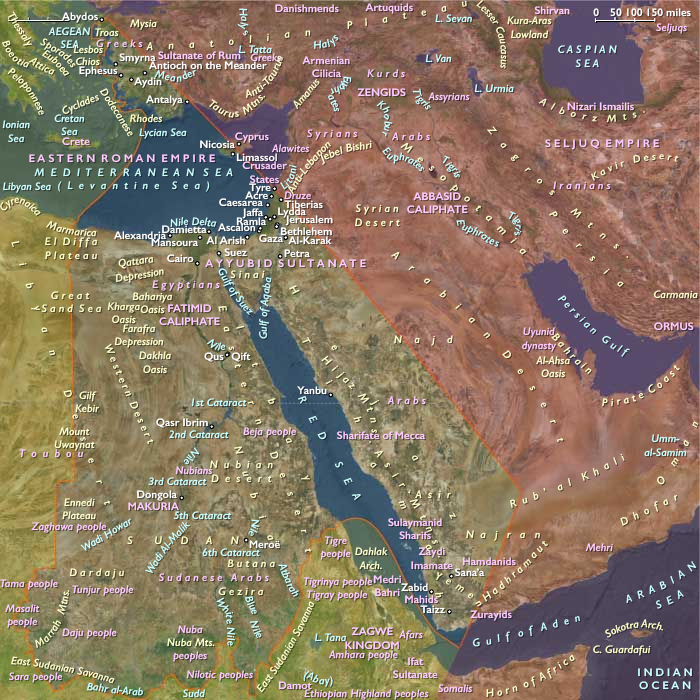
Related Events
Showing 10 events out of 48315 total
Years: 1174 - 1174
Locations
People
Groups
- Jews
- Islam
- Muslims, Sunni
- Muslims, Shi'a
- Christians, Roman Catholic
- Aleppo, Seljuq Emirate of
- Antioch, Principality of
- Jerusalem, Latin Kingdom of
- Tripoli, County of
- Jaffa and Ascalon, County of
- Damascus, Ayyubid Dynasty of
- Egypt, Ayyubid Sultanate of
Topics
Commodoties
Subjects
Regions
Subregions