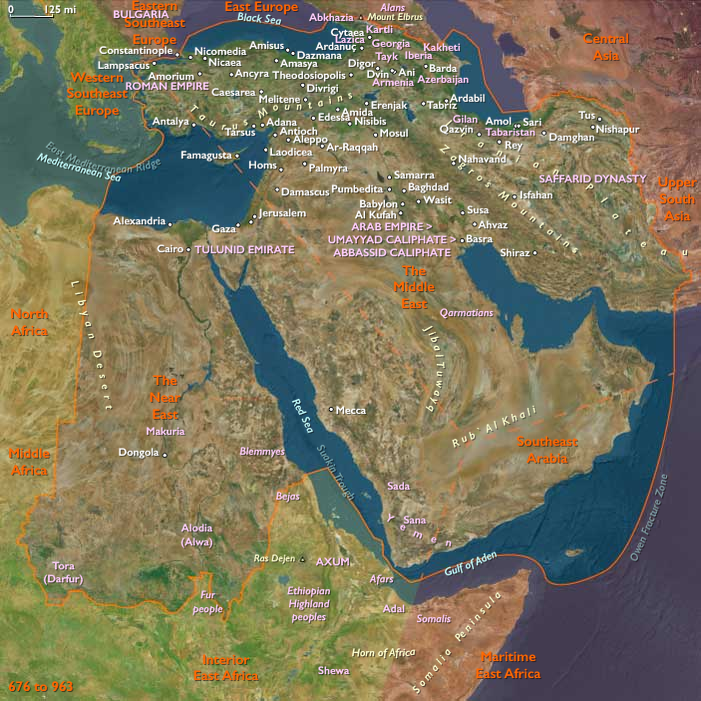
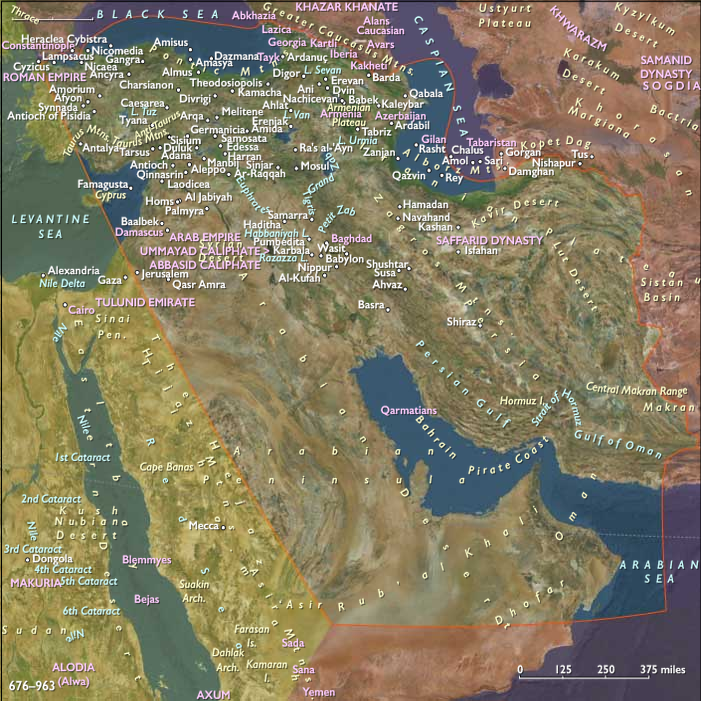
…Tudmur (Palmyra) in the plains, at which …
Years: 830 - 830
…Tudmur (Palmyra) in the plains, at which Muslim scholars can verify the astronomic knowledge handed down from antiquity.
These institutions foster the development of an Islamic school of astronomic sciences.
Locations
People
Groups
Topics
Subjects
- Commerce
- Symbols
- Writing
- Theory
- Government
- Scholarship
- Technology
- Cartography
- Mathematics
- Geology
- Astronomy
Regions
Subregions
Related Events
Filter results
Showing 10 events out of 54369 total
The proto-Magyars around the Don River are subordinates of the Khazar Khaganate.
Their neighbors are the archaeological Saltov Culture, i.e.
Bulgars (Proto-Bulgarians, descendants of the Onogurs) and the Alans, from whom they learned gardening, elements of cattle breeding and of agriculture.
The Bulgars and Magyars have shared a long-lasting relationship in Khazaria, either by alliance or rivalry.
The system of two rulers (later known as kende and gyula) is also thought to be a major inheritance from the Khazars.
Tradition holds that the Magyars are organized at this time in a confederacy of tribes called the Hét Magyar, whose tribes are Jenő, Kér, Keszi, Kürt-Gyarmat, Megyer (Magyar), Nyék, and Tarján.
The confederacy had been formed as a border defending allies of Khazaria, mainly during the reign of Khagan Bulan, the Khazar king who led the conversion of the Khazars to Judaism, and Ovadyah, with the Magyar tribe as ascendant.
A civil war breaks out in the Khazar khaganate around 830.
As a result, three dissident tribes of the Khazars, called Kabars, join the seven Magyar tribes and they move to ...
...what the Magyars call the Etelköz, i.e., the territory between the Carpathians and the Dnieper River (today's Ukraine).
The exact location of Etelköz is disputed.
"Etel", which means Volga in Old Turkic, could stand for the river Volga, or Etil.
According to Hungarian tradition, Etelköz was located between the river Volga and the lower Danube.
Modern historians, however, usually name slightly different locations, such as around the Dnieper, etc.
In any case, the Magyars appear around 830 on the west banks of the Don River.
Theophilos, an intelligent financier and administrator, dispatches architects and engineers to construct fortresses that will anchor the empire’s northern defenses against the Vikings and the Magyars.
Despite his interest in Islamic culture, he also bolsters his defenses, east and west, against the Muslims, with whom he will be compelled to war throughout his reign.
Baghdad, as the 'Abbasid capital, had became the center of scientific studies and trade after the Islamic conquest of Persia, and many merchants and scientists from as far as China and India travel to this city, as had Muslim mathematician Al-Khwārizmī.
Caliph al-Ma'mun, who encourages the translation of Greek philosophical and scientific work, founds an academy in Baghdad in 829 called the Bayt al-Hikmah, or House of Wisdom, to which the translators, most often Christians, are attached.
He also imports manuscripts of particularly important works that do not exist in the Islamic countries from Constantinople.
The contributions of Al-Khwārizmī', who works in the House of Wisdom, to mathematics, geography, astronomy, and cartography establish the basis for innovation in algebra and trigonometry.
His systematic approach to solving linear and quadratic equations leads to algebra, a word derived from the title of his 830 book on the subject, "The Compendious Book on Calculation by Completion and Balancing".
On the Calculation with Hindu Numerals, written about 825, is principally responsible for spreading the Indian system of numeration throughout the Middle East and Europe.
It will be translated into Latin as Algoritmi de numero Indorum.
Al-Khwārizmī, rendered as (Latin) Algoritmi, will lead to the term "algorithm".
Some of his work is based on Persian and Babylonian astronomy, Indian numbers, and Greek mathematics.
Al-Ma'mun, developing an interest in the sciences as well, establishes observatories at the Bayt al-Hikmah, and at …

Valentine succeeds Eugene II to the papacy in 827 but dies thirty or forty days after after taking office.
Gregory IV, chosen to succeed Valentine in December 827, had recognized the supremacy of the Frankish emperor in the most unequivocal manner, but papal dependence on the Roman Emperor has loosened through the quarrels of Louis and his sons.
In the sons' rebellion against their father, Gregory supports Lothair, hoping his intervention would promote peace, but in practice this action annoys the Frankish bishops.
Gregory's response is to insist upon the primacy of St. Peter's successor, the papacy being superior to the Emperor.
The Accusation Against Bernard of Septimania and the 830 Revolt
Bernard of Septimania, one of Louis the Pious’ closest advisors, finds himself at the center of court intrigue and dynastic conflict in the early 9th century.
According to Thegan of Trier’s Gesta Hludowici, Bernard is accused of having an illicit relationship with Empress Judith of Bavaria, Louis’ second wife. Thegan dismisses these claims as lies, but the rumors spread widely, intensifying political tensions at court.
The April 830 Riot at Rennes
By April 830, Louis the Pious' sons—Lothair, Pepin, and Louis the German—oppose their father’s rule, believing that Empress Judith and her allies (including Bernard) hold too much influence at court.
- While the Frankish army is gathered at Rennes to fight the Bretons, the rumors trigger unrest among the soldiers.
- A riot erupts, fueled by resentment toward Bernard and the Empress, reflecting the wider dynastic struggle between Louis and his rebellious sons.
- Facing serious threats to his life, Bernard flees the court, abandoning his position.
Bernard’s Fall from Power
- According to the Annales Bertiniani, Bernard returns to Barcelona, where he had previously served as Count of Barcelona and Margrave of Septimania.
- His brother, Eribert, who remained at court, is banished.
- Bernard is deprived of the County of Autun, a title he had held for some time.
The Aftermath: Dynastic Conflicts Continue
Bernard’s fall from favor marks a turning point in the struggles between Louis the Pious and his rebellious sons. Over the next decade, these dynastic conflicts will further destabilize the Carolingian Empire, leading to civil wars, shifting alliances, and the eventual fragmentation of the empire under the Treaty of Verdun (843).
The “Heliand,” an epic poem about the life of Christ written in the alliterative verse style of a Germanic saga, attempts to blend the old paganism with the new Christianity by presenting the Christian message in traditional heroic imagery, with the messiah as a Germanic duke.
The largest known work of written Old Saxon, the original manuscript would have been approximately six thousand lines, of which four incomplete fragments have been found that span most of the original.
Its preface indicates it was commissioned by Louis the Pious, which limits its origins to the years of Louis' reign, namely 814 to 840.
Cheshire, a plains area in northwest England between the Pennine uplands and the mountains of northern Wales, from 830 becomes a part of Mercia.
The Restoration of Louis the Pious at Nijmegen (October 830)
Following the April 830 revolt led by his three elder sons—Lothair I, Pepin of Aquitaine, and Louis the German—against their father, Emperor Louis the Pious, a brief civil war ensues. This rebellion, sparked by court tensions, allegations against Empress Judith, and resentment toward Bernard of Septimania, results in Louis’ temporary loss of power.
However, by October 830, Louis regains authority at an assembly in Nijmegen, marking a short-lived victory in his struggle to maintain control over the Carolingian Empire.
The Nijmegen Assembly and Louis’ Restoration
- Lothair I, who had previously attempted to assert imperial authority, is forced to submit to his father’s rule.
- The alliance between the rebellious sons weakens, allowing Louis to regain support among the Frankish nobility.
- Bernard of Septimania, accused of an affair with Empress Judith, remains in exile, while Judith herself is cleared of the allegations.
Aftermath and Continued Dynastic Struggles
Although Louis recovers his throne in 830, his sons’ ambitions remain unchecked, leading to further rebellions:
- In 833, his sons rise against him again, culminating in the Field of Lies, where Louis is betrayed and temporarily deposed.
- Though restored again in 834, these continuous power struggles destabilize the empire, setting the stage for the Treaty of Verdun (843) and the eventual partitioning of the Carolingian realm.
The assembly at Nijmegen represents one of many temporary victories for Louis the Pious in his ongoing struggle to maintain unity within an empire increasingly torn by dynastic rivalries.
Judith of Bavaria, Louis's second wife, had won the consent of her stepson Lothair on his return to his father's court,to her plan for securing a kingdom for her son Charles, a scheme that had been implemented in 829 when the young prince was given Alemannia as king.
Lothair, however, soon changes his attitude.
In Gascony and the chronically troublesome Pyrenees borderlands, Counts Hugh and Matfrid have failed to support the Louis’s military efforts, and the emperor has summarily stripped them of their positions.
This forceful action and a growing resentment of the efforts of Judith on behalf of her seven-year-old son, the target of resentment by his three adult half brothers, is the cause of a growing dispute between Louis and his son and coemperor, Lothair.
The quarrel over Charles’ future inheritance leads in 830 to open conflict.
Pepin, Louis the German, and Lothair, aided by Hugh and Matfrid, seek to “free”; the emperor from the tyranny of the “jezebel” Judith, but Louis's supporters, sowing discord among his elder sons, in October 830 restore him to authority.
The abortive coup claims a victim, however, when the Ordinatio imperii is replaced by a new Divisio regnorum, which calls for a division of the empire into four approximately equal kingdoms that are to become independent upon Louis's death, thus restoring the traditional Frankish practice of succession.
Supporters of a unified empire agitate against the Divisio, while the involvement of opportunistic nobles exacerbated the continuing conflict among the brothers.
Years: 830 - 830
Locations
People
Groups
Topics
Subjects
- Commerce
- Symbols
- Writing
- Theory
- Government
- Scholarship
- Technology
- Cartography
- Mathematics
- Geology
- Astronomy