Tribhuvanāditya, the Khmer ruler from 1166, comes …
Years: 1167 - 1167
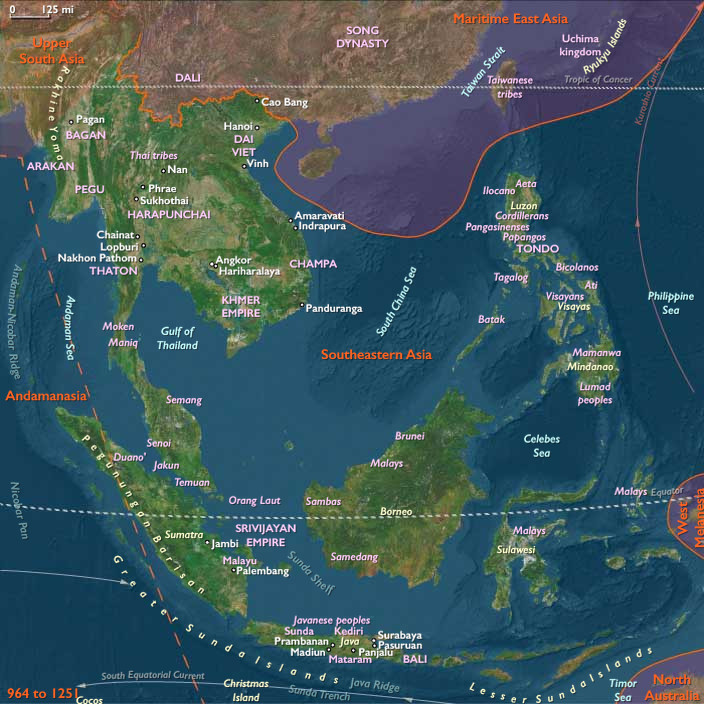
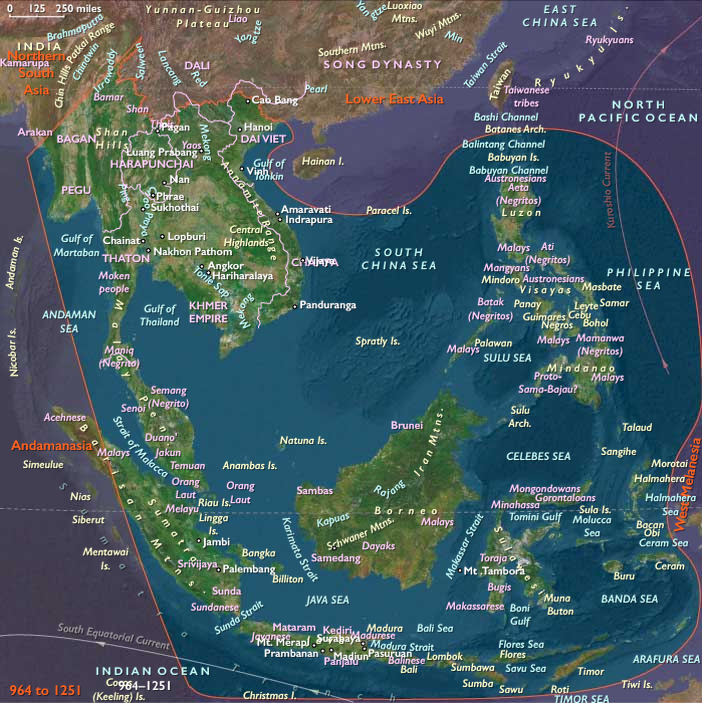
Tribhuvanāditya, the Khmer ruler from 1166, comes to power after he assassinates Yasovarman II.
Locations
Groups
Topics
Commodoties
Subjects
Regions
Subregions
Related Events
Filter results
Showing 10 events out of 48444 total
Bishop Absalon leads the Danes in constructing a fortification in 1167 on Slotsholmen, or Castle Isle, situated on the eastern shore of the island of Sjaelland, or Zealand, at the southern end of Oresund (The Sound), the waterway that separates Denmark from Sweden and links the Baltic with the North Sea.
Today a part of Copenhagen Inner City, the city's first castle is situated at the site where Christiansborg Palace, the seat of the Danish Parliament, lies today.
King Charles is killed on the island of Visingsö by supporters of Canute Eriksson, head of the rival Eric dynasty, who usurps the Swedish throne in the spring of 1167.
Charles is buried in Alvastra monastery.
Starting from Charles' death, his kinsmen (probably his half-brothers) Burislev and Kol together oppose Canute's kingship and are rival kings, recognized in some Gothenlander parts of Sweden.
Schwerin is surrounded by many picturesque lakes.
The largest of these lakes, the Schweriner See, has an area of sixty square kilometrs.
A settlement of the Slavic Obotrite in the middle of these lakes dates back to the eleventh century.
The area is called Zuarin (Zwierzyn), and the name Schwerin is derived from that designation.
In 1160, Henry the Lion, Duke of Saxony, had defeated the Obotrites and captured Schwerin.
The town is subsequently expanded into a powerful regional center, and is made a bishopric in 1167.
Vladislaus had gradually taken control of the strongholds of Moravia after the revolt of the Moravian dukes: Brno with the death of Vratislaus II in 1156, Olomouc with the death of Otto III (in spite of the claims of Sobeslav, the son of Duke Sobeslav, who was imprisoned), and finally Znojmo with the death of Conrad II.
Vladislav had also intervened in Hungary in 1163 on behalf of the emperor.
He has married his second son, Sviatopluk, to a Hungarian princess and had diplomatic contact with Manuel I Komnenos.
He had in 1164 even married his six-year-old daughter Helena to Peter, son of Manuel.
Vladislav has entrusted the command of the Czech contingent during the Italian expeditions of 1161, 1162, and 1167, to his brother Duke Děpold I of Jamnitz and his son Frederick.
Manuel is also successful in the Balkans, where his armies win back much of the northwest Balkans and almost conquer Hungary, reducing it to a client kingdom of Constantinople.
The Serbs, too, under their leader Stefan Nemanja, are kept under control.
In 1167, Manuel incorporates into the empire Dalmatia, Croatia, and Bosnia.
Andronikos Komnenos, born early in the twelfth century, around 1118, is endowed by nature with the most remarkable gifts both of mind and body: he is handsome and eloquent, but licentious; and, at the same time, active, hardy, courageous, a great general and an able politician.
Andronikos' had spent his early years alternately in pleasure and in military service.
Taken captive by the Seljuq Turks in 1141, he had remained in their hands for a year.
On being ransomed, he had gone to Constantinople, where was held the court of his cousin, the Emperor Manuel I Komnenos, with whom he is a great favorite.
Here the charms of his niece, Eudoxia, attract him and she becomes his mistress.
Accompanied by Eudoxia, he had set out for an important command in Cilicia in 1152.
Failing in his principal enterprise, an attack upon Mopsuestia, he returned, but was again appointed to the command of a province.
This second post he seems also to have left after a short interval, for he appears again in Constantinople, and narrowly escaped death at the hands of the brothers of Eudoxia.
About this time (1153) a conspiracy against the Emperor, in which Andronikos participated, had been discovered and he was thrown into prison.
There he had remained for about twelve years, during which time he made repeated but unsuccessful attempts to escape.
At last, in 1165, he is successful in escaping.
After passing through many dangers, he reached the court of his cousin Yaroslav Osmomysl of Galicia.
While under the protection of Yaroslav, Andronikos brings about an alliance between him and the Emperor Manuel I, and so restores himself to the emperor's favor.
With a Galician army, he joins Manuel in the invasion of Hungary and assists at the siege of Semlin.
Benjamin, in describing his peregrinations in his “Itinerary,” is the first traveler to observe the existence of ancient ruins in Mesopotamia, a region whose pre-classical heritage had lain forgotten and unknown for many centuries.
The throne of the western Chalukya dynasty, usurped in about 115 by Bijjala II, leader of the feudatory Kalachuri dynasty, becomes the object of a contest among Bijjala’s successors, allowing Chalukya dynast Somesvara IV to reverse the usurpation after 1167.
The war between Amalric and Nur ad-Din has gradually become a contest for control of Egypt.
During three military expeditions led by Shirkuh into Egypt to prevent its falling to the Franks, a complex, three-way struggle has developed between Amalric, Shawar, and Shirkuh.
Amalric appeals both to Emperor Manuel and to Louis VII of France for help.
Manuel agrees to lend his fleet for one of Amalric's campaigns, with the provision that Amalric divide Egypt with Constantinople.
Shawar now seeks help from Shirkuh.
The Battle of al-Babein takes place on March 18, 1167, between Amalric and a Zengid army under Shirkuh for control of Egypt.
Saladin, Nur ad-Din’s nephew, serves as Shirkuh’s highest-ranking officer in the battle.
The battle is a tactical draw between the Zengid forces and King Amalric's invasion army.
Shirkuh has avoided a pitched battle with the Crusaders, who in any case have insufficient resources to conquer Egypt and are forced to retreat, but the Latin-Greek alliance is maintained.
Stefan Nemanja, born around the year 1113 in Ribnica, Zeta (in the vicinity of present day Podgorica, capital of Montenegro), was the youngest son of Zavida, a Prince of Zahumlje, who after a conflict with his brothers, had been sent to Ribnica where he had the title of Lord.
Zavida (Beli Uroš) was most probably a son of Uroš I or Vukan.
As western Zeta was under Roman Catholic jurisdiction, Nemanja received a Catholic baptism.
After the defeat of Nemanja's kinsmen George of Duklja and Desa Urošević and the exodus of that branch of the Vojislavljević family by Constantinople, Zavida and his family had gone to the hereditary family estates of Rascia.
Upon his arrival in Ras, the capital of Rascia, Nemanja had been re-baptized in the Eastern Orthodox Church, in the Church of St. Apostles Peter and Paul which was an episcopal see.
When he reached adulthood, Nemanja had become "Prince (Župan) of Ibar, Rasina and Reke" after receiving the česti (parts of the state) by Emperor Manuel I Komnenos.
Manuel had appointed the first-born Tihomir as the supreme Grand Prince of the Serb lands, Stracimir ruled West Morava, Miroslav ruled Zahumlje and Travunia.
Manuel in 1163 had installed Nemanja's older brother Tihomir as Grand Župan of Rascia in Desa's place, which disappointed Nemanja greatly, as he had expected that he would get the throne.
Nemanja had met in Niš in 1162 with the Emperor, who had given him the region of Dubočica to rule over and declared him independent., also awarding him an imperial court title, as it is important for the Emperor to have the borderlands of the Empire ruled by loyal leaders.
Nemanja's Serb squadrons had fought in the Imperial Army in 1164 in Srem during the wars against the Kingdom of Hungary.
Nemanja rules independently, as he builds the Monastery of Saint Nicholas in Kuršumlija and the Monastery of the Holy Mother of Christ near Kosanica-Toplica, without the approval of his older brother, the Grand Župan of Rascia.
His brothers had invited him to a council at Ras, supposedly to resolve the situation, but instead they had imprisoned him and held him in a nearby cave.
The lands of Nemanja had been seized but Nemanja's supporters had complained to the church that Tihomir had done all this because of a disapproval of church-building and Nemanja had thus become targeted by the clergy, something that helps Nemanja greatly.
Nemanja in 1166 had rebelled against his older brother, the Grand Župan of Rascia, deposed him, and exiled him with his brothers, Miroslav and Stracimir.
The Emperor in response raises a mercenary army for Tihomir, made up of Greeks, Franks and Turks, which is defeated by Nemanja at the Battle of Pantino, south of Zvečan.
Tihomir drowns in the river of Sitnica, and the other brothers surrender to Nemanja, continuing to rule their previous lands.
Nemanja assumes the title of Grand Župan of all Serbia, and takes the first name Stefan (from Greek Stephanos meaning "crowned").