Trajan, having quelled Dacia, subsequently invades the …
Years: 100 - 111
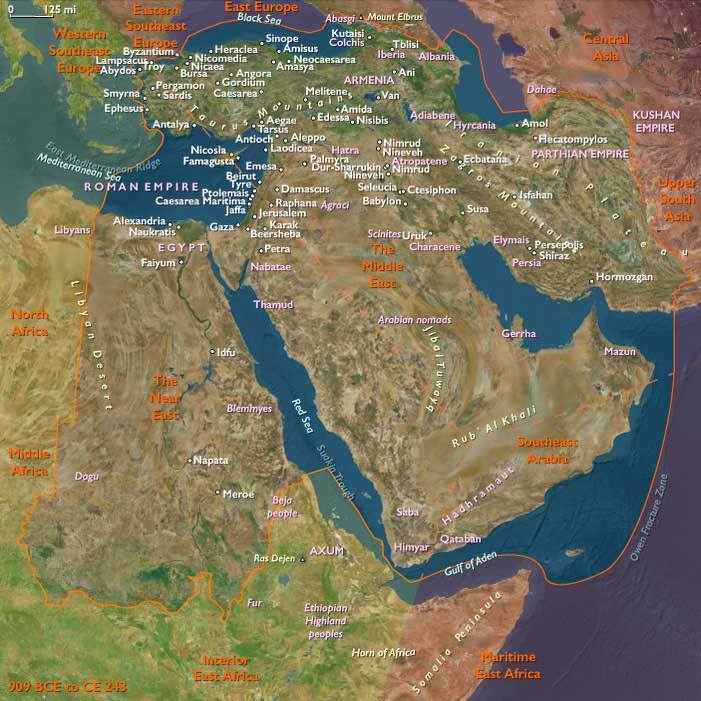
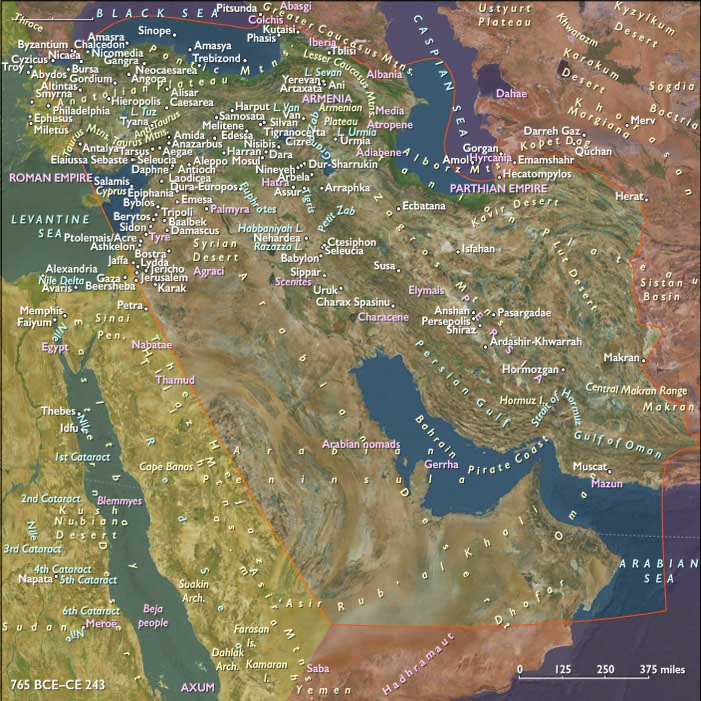
Trajan, having quelled Dacia, subsequently invades the Parthian empire to the east, his conquests expanding the Roman Empire to its greatest extent.
Rome's borders in the East are indirectly governed through a system of client states for some time, leading to less direct campaigning than in the West in this period.
People
Groups
Topics
Commodoties
Subjects
- Commerce
- Environment
- Labor and Service
- Conflict
- Mayhem
- Exploration
- Faith
- Government
- Technology
- Movements
- Theology
- Christology
- Economics
Regions
Subregions
Related Events
Filter results
Showing 10 events out of 61429 total
Old Bering Sea Culture (100–243 CE)
Ivory Ornamentation, Maritime Mastery, and Cross-Strait Connections
The Old Bering Sea culture (OBS) emerged in the early centuries of the Common Era along the Bering Strait, its sites scattered across northwestern Alaska, the Chukotka Peninsula, and intermediary islands like St. Lawrence and the Diomedes. OBS communities thrived in an environment defined by icy seas and rich marine resources, building a way of life that foreshadowed later Thule traditions.
Their settlements were small but strategic, perched on coasts close to sea-mammal migration routes. Houses were semi-subterranean, dug into permafrost for insulation, their superstructures reinforced with driftwood and whalebone. Within these homes, families crafted some of the most distinctive artifacts of the Arctic world. OBS artisans are celebrated for their elaborately engraved ivory: harpoon heads, knife handles, and ornaments decorated with sweeping curvilinear and geometric motifs. Many of these designs suggest symbolic or spiritual significance, blending functionality with artistry.
Economically, OBS people were consummate marine hunters. Seals, walrus, and small whales formed the subsistence base, augmented by caribou, birds, and fish. Harpoon technology was advanced, with toggling heads designed to secure prey in turbulent waters. Dog traction and umiak-style boats likely expanded mobility, enabling exchange and kinship ties across the Strait.
Most significantly, the Old Bering Sea horizon demonstrates the interconnectedness of Alaska and Siberia. Similarities in house types, tools, and ornament indicate sustained cross-Strait contact. OBS thus represents not an isolated community, but a cultural zone bridging continents, one that set the foundation for the later Thule expansion eastward across the Arctic.
A Han-Viet ruling class owning large tracts of rice lands arises in the first and second centuries CE.
More than one hundred and twenty brick Han tombs will be excavated in northern Vietnam, indicating Han families that, rather than returning to China, had become members of their adopted society and were no longer, strictly speaking, Chinese.
Although they brought Chinese vocabulary and technical terms into their new culture, after a generation or two, they probably spoke Vietnamese.
The second century CE is a time of rebellion in Giao Chi, Cuu Chan, and Nhat Nam, largely due to the declining quality of the Han administrators, who concentrate their energies on making their fortunes and returning north as soon as possible.
Revolts against corrupt and repressive Chinese officials are often led by the Han-Viet families.
The fall of the Han dynasty in China in 220 further strengthens the allegiance of the Han-Viet ruling elite to their new society and gives them a sense of their own independent political power.
Meanwhile, among the peasant class there is also a heightened sense of identity fostered by the spread of Buddhism by sea from India to Vietnam by the early third century.
The new religion is often adapted to blend with indigenous religions.
Buddhist temples are sometimes dedicated to the monsoon season, for example, or identified with the guardian spirit of agricultural fertility.
Although ruling-class Vietnamese tend to cling to Confucianism, various local rulers patronize the Buddhist religion, thus helping to legitimize their own rule in the eyes of the common people.
Funan, the earliest of the Indianized states, generally is considered by Cambodians to have been the first Khmer kingdom in the area.
Founded in the first century CE, Funan is located on the lower reaches of the Mekong River in the delta area.
Its capital, Vyadhapura, probably was located near the present-day town of Phumi Banam in Prey Veng Province.
The earliest historical reference to Funan is a Chinese description of a mission that visits the country in the third century CE.
The name Funan derives from the Chinese rendition of the old Khmer word bnam (mountain).
What the Funanese call themselves, however, is not known.
The people of mainland and insular Southeast Asia are responding to the stimulus of a civilization that had arisen in India during the previous millennium at about the time that Western Europe is absorbing the classical culture and institutions of the Mediterranean.
The Indianization of Southeast Asia happens as a consequence of the increasing trade in the Indian Ocean.
Vedic and Hindu religion, political thought, literature, mythology, and artistic motifs gradually became integral elements in local Southeast Asian cultures.
The caste system will never be adopted, but Indianization stimulates the rise of highly organized, centralized states.
Maritime East Asia (100–243 CE): Decline of Han Dynasty and Increasing Turbulence
Between 100 CE and 243 CE, Maritime East Asia—comprising lower Primorsky Krai, the Korean Peninsula, the Japanese Archipelago below northern Hokkaido, Taiwan, and southern, central, and northeastern China—faces mounting internal struggles, administrative breakdown, and rebellions that mark the decline and eventual collapse of the Han dynasty.
Continued Han Rule and Increasing Strains
After a brief interruption by Wang Mang's Xin Dynasty (9–24 CE), the Han dynasty had been restored and continues for nearly two centuries more. However, the restored Han rulers struggle to manage a vastly expanded population, increasing economic wealth paired with financial instability, and increasingly complex bureaucratic and political institutions. Administrative corruption spreads widely, a classic symptom of dynastic decline.
Peasant and Taoist Rebellions
Persistent dissatisfaction among peasants leads to widespread agrarian rebellions, exacerbating the empire's instability. Taoist-inspired movements, notably the Yellow Turban Rebellion, challenge Han authority, advocating egalitarian ideals and drawing massive popular support, further weakening imperial governance and draining critical resources from central authority.
Fragmentation and Collapse
The cumulative effect of internal corruption, administrative inefficiency, and recurrent rebellions severely undermines the Han dynasty's stability. By 220 CE, the Han Empire formally collapses, fragmenting into several competing states. This collapse ushers in the Three Kingdoms Period, profoundly altering China's political and social landscape for centuries.
Legacy of the Age: Transition and Fragmentation
Thus, the age from 100 to 243 CE is characterized by mounting administrative strain, widespread popular discontent, and internal rebellions culminating in the definitive collapse of the Han dynasty. These events set the stage for a prolonged period of fragmentation, warfare, and eventual reorganization that reshapes East Asian political dynamics.
Two hundred years of Han rule are interrupted briefly (in CE 9-24 by Wang Mang, a reformer), then restored for another two hundred years.
The Han rulers, however, are unable to adjust to what centralization has wrought: a growing population, increasing wealth and resultant financial difficulties and rivalries, and ever-more complex political institutions.
Riddled with the corruption characteristic of the dynastic cycle, by CE 220 the Han empire collapses.
Peasant and Taoist rebellions in China disturb the long peace of the Han Dynasty.
Two major subdivisions of the Donghu had developed by the first century: the Xianbei in the north and the Wuhuan in the south.
The Xianbei, who by the second century CE are attacking Chinese farms south of the Great Wall, establish an empire, which, although short-lived, gives rise to numerous tribal states along the Chinese frontier.
Among these states is that of the Tuoba (T'o-pa in Wade-Giles), a subgroup of the Xianbei, in modern China's Shanxi Province.
The Wuhuan also are prominent in the second century, but they disappear thereafter; possibly they are absorbed in the Xianbei western expansion.
The Xianbei and the Wuhuan use mounted archers in warfare, and they have only temporary war leaders instead of hereditary chiefs.
Agriculture, rather than full-scale nomadism, is the basis of their economy.
In the sixth century CE., the Wuhuan will be driven out of Inner Asia into the Russian steppe.
Central Asia (100–243 CE): Kushan Zenith, Silk Road Prosperity, and Cultural Brilliance
From 100 to 243 CE, Central Asia—covering modern-day Kazakhstan, Kyrgyzstan, Uzbekistan, Tajikistan, and Turkmenistan—experienced the peak of the Kushan Empire, significant economic prosperity fueled by Silk Road commerce, and vibrant cultural achievements, particularly in art, religion, and intellectual life.
Political and Military Developments
Kushan Empire at its Height (100–180 CE)
-
The Kushan Empire reached its zenith under Kanishka the Great (c. 127–150 CE), one of the most renowned Kushan emperors, whose dominion stretched from Uzbekistan and Tajikistan through northern India and Pakistan.
-
Under Kanishka, the Kushans maintained diplomatic and commercial relationships with Rome, Han China, and the Parthian Empire, ensuring political stability and economic prosperity along the Silk Road.
Nomadic Pressures and Regional Stability (181–243 CE)
-
After Kanishka, Kushan power gradually declined under his successors due to internal challenges, nomadic incursions from the northern steppes, and rising regional independence movements in areas like Sogdiana and Bactria.
-
Increasing pressure from nomadic tribes, particularly the Xiongnu, Wusun, and early Turkic-speaking peoples, disrupted northern trade routes intermittently, challenging the Kushan hold over parts of Kazakhstan and Kyrgyzstan.
Economic Developments and Silk Road Prosperity
Silk Road as a Source of Wealth
-
The Silk Road reached unprecedented prosperity, with Central Asian cities—particularly Samarkand, Bukhara, Maracanda, Termez, and Merv—benefiting enormously from trade in silk, spices, gemstones, textiles, and other luxury goods.
-
Sogdian merchants, renowned as skilled middlemen, extended their trade networks deep into China, Persia, India, and even toward Rome, accumulating substantial wealth and fostering thriving urban economies.
Agricultural Development and Urban Expansion
-
Oasis-based agriculture flourished through sophisticated irrigation systems, especially in the fertile Ferghana Valley, around Samarkand, and along the Amu Darya and Syr Darya rivers, supporting the region’s dense urban populations.
-
Urban centers expanded significantly, becoming cosmopolitan hubs of international commerce and cultural exchange.
Cultural and Religious Developments
Kushan Patronage of Buddhism
-
Under Kanishka, Buddhism reached its pinnacle in Central Asia, becoming a dominant religion throughout Bactria (modern Afghanistan, Tajikistan, and Uzbekistan) and spreading significantly into China via the Silk Road.
-
Kanishka hosted the Fourth Buddhist Council (traditionally dated around 127 CE, though chronologies vary), which facilitated the development and spread of Mahayana Buddhism, significantly influencing Buddhist thought and art across Asia.
Artistic Flourishing: The Gandhara and Mathura Schools
-
Central Asian culture flourished with artistic achievements blending Hellenistic, Indian, and Iranian influences, notably in sculpture, painting, and coinage.
-
The distinctive Gandharan art, characterized by Greco-Buddhist fusion, spread extensively into Central Asian cities, leaving a lasting artistic legacy particularly in Uzbekistan and Tajikistan.
Religious Pluralism and Cultural Syncretism
-
Alongside Buddhism, Zoroastrianism, local Iranian cults, and emerging Christianity coexisted harmoniously, particularly in cities like Merv, Samarkand, and Termez, highlighting Central Asia’s remarkable religious diversity.
-
Syncretic religious practices became common, blending local shamanistic traditions with Buddhism, Zoroastrianism, and other faiths, creating uniquely Central Asian religious identities.
Social and Urban Developments
Cosmopolitan Cities and Cultural Exchange
-
Central Asian cities grew increasingly multicultural, attracting traders, monks, scholars, and artisans from Rome, Persia, India, China, and beyond, transforming places like Samarkand, Bukhara, and Merv into vibrant centers of intellectual exchange and cultural fusion.
-
Markets, caravanserais, and monasteries along the Silk Road facilitated extensive cross-cultural interactions, fostering enduring international links.
Nomadic and Sedentary Interactions
-
Relationships between settled urban populations and nomadic steppe tribes continued to shape Central Asian society. Nomadic groups, while often disruptive, significantly influenced urban political structures, cultural practices, and economic life through both trade and conflict.
Long-Term Consequences and Historical Significance
The period from 100 to 243 CE represented a pinnacle of Central Asian power, prosperity, and cultural influence under the Kushan Empire. Its strategic role at the crossroads of Eurasia facilitated extensive economic growth through Silk Road commerce, enhancing the region’s global significance. Culturally, the era left profound legacies, particularly through Buddhism’s spread into East Asia, enduring artistic traditions, and the robust multiculturalism that shaped Central Asian identity.
By 243 CE, though the Kushan Empire’s political dominance began to wane, the cultural, religious, and economic frameworks established during this period ensured Central Asia’s continuing importance as a major Eurasian crossroads for centuries to come.

Years: 100 - 111
People
Groups
Topics
Commodoties
Subjects
- Commerce
- Environment
- Labor and Service
- Conflict
- Mayhem
- Exploration
- Faith
- Government
- Technology
- Movements
- Theology
- Christology
- Economics