
Vienna exports the Viennese Waltz to the …
Years: 1839 - 1839
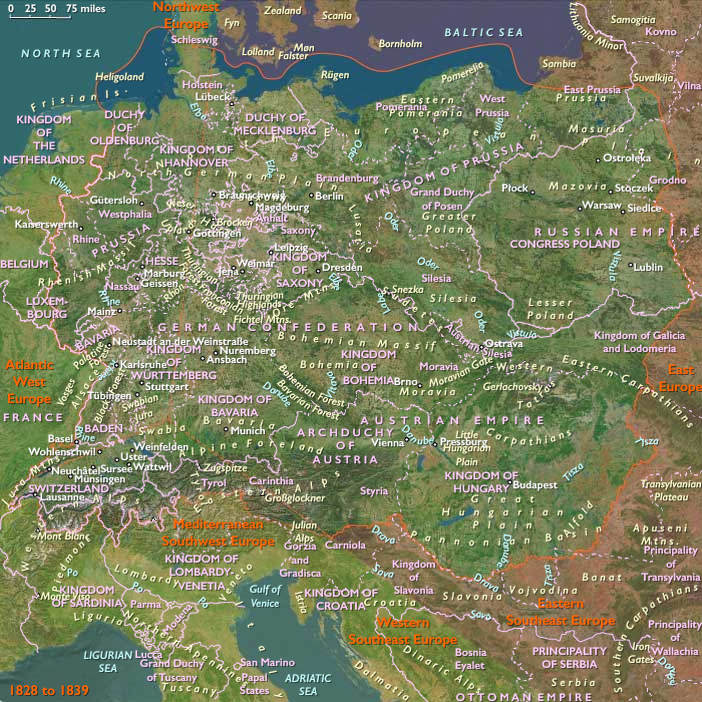
Vienna exports the Viennese Waltz to the rest of Europe.
Johann Strauss has become one of the best-known and well-loved dance composers in Vienna, the center of popular dance music in this era, by the end of the 1830s, touring with his band to Germany, the Netherlands, Belgium, England, and Scotland.
Johann will eventually pass the conducting reins and management of this 'Strauss Orchestra' to the hands of his sons variously until its disbandment by Eduard Strauss in 1901.
Tragedy had struck the family of seven-year-old Johann Strauss in 1811 when his mother died of 'creeping fever'.
When he was twelve, his father Franz Borgias (who had since remarried) had been discovered drowned in the Danube River.
His stepmother had sought to place him as an apprentice to a bookbinder Johann Lichtscheidl, but he had taken lessons in the violin and viola in addition to fulfilling his apprenticeship in 1822.
He had also studied music with Johann Polischansky during his apprenticeship and eventually managed to secure a place in a local orchestra of Michael Pamer, which he eventually left in order to join a popular string quartet known as the Lanner Quartet formed by his would-be rival, Austrian dance music composer Josef Lanner, and the Drahanek brothers, Karl and Johann.
This string quartet, which played Viennese waltzes and rustic German dances, had expanded into a small string orchestra in 1824.
Lanner, self-taught on the violin, had been one of the first Viennese composers to reform the waltz from a simple peasant dance to something that even the highest society could enjoy, either as an accompaniment to the dance or for the music's own sake.
Such is the success of his orchestra that it has become a regular feature in many Vienna Carnivals, popularly known in the local dialect as the Fasching.
Strauss had eventually become deputy conductor of the orchestra to assist Lanner in commissions after it had become so popular during the Fasching of 1824.
Lanner had already been fast gaining a reputation at the end of the 1825 Carnival season and Strauss had grown frustrated at having to deputize when necessary; as a result, his works had not been getting the recognition he thought it deserved.
In the same year, Strauss had parted company with Lanner after a concert at one of the Viennese dance establishments, 'Zum Schwarzen Bock' or the 'Black Ram'.
Lanner allowed his soon-to-be rival Strauss I to deputize in a second, smaller orchestra that had been formed in 1832 that to meet the busy schedule of the Carnival activities.
Lanner and Strauss have worked together often despite having severed their partnership and have even given a benefit concert for their former employer, Michael Pamer, who had been taken ill in 1826 at the same establishment where they had separated.
Strauss and Lanner also had accepted the award of the Freedom of the City of Vienna in 1836 and jointly taken the Citizen's Oath.
The music-loving Viennese, however, champion both of these two popular dance music composers, and individuals generally identify themselves as 'Lannerianer' or 'Straussianer'.
In fact, it is believed that the ruling Habsburg dynasty is anxious to divert its Viennese populace from politics and the revolutionary ideas that are feverishly sweeping Europe, with many cities preparing to overthrow any unpopular monarch.
The answer could be to distract the population with music and entertainment, and the musical positions that both Lanner and Strauss hold had soon been seen to be very important.
Lanner himself has been appointed to the coveted post of Musik-Direktor of the Redoutensäle in the Imperial Hofburg, of which his primary duties are to conduct concerts held in honor of the nobility and to compose new works for the Court orchestra.
Locations
People
Groups
Topics
Subjects
Regions
Subregions

Years: 1839 - 1839
Locations
People
Groups
Topics
Subjects
Regions
Subregions