Cycladic idols and vases made from Cretan …
Years: 2061BCE - 1918BCE
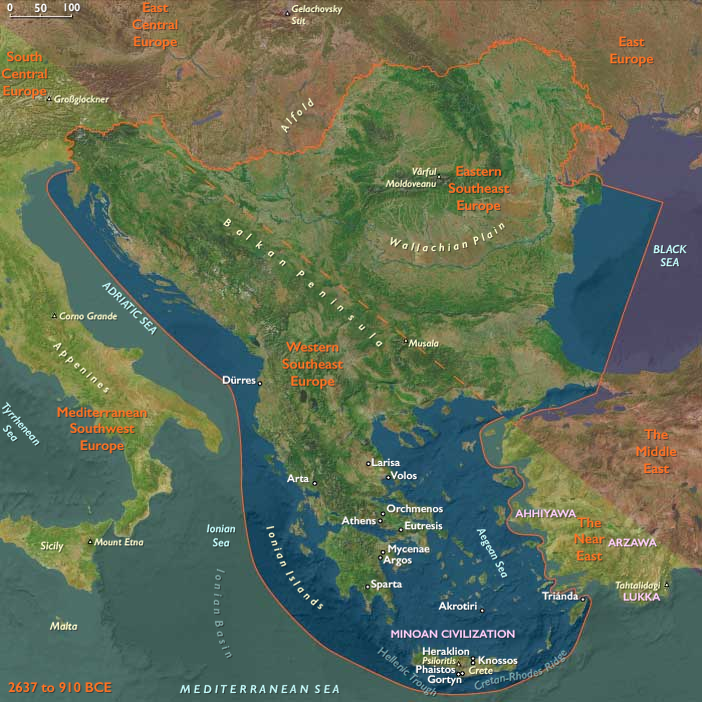
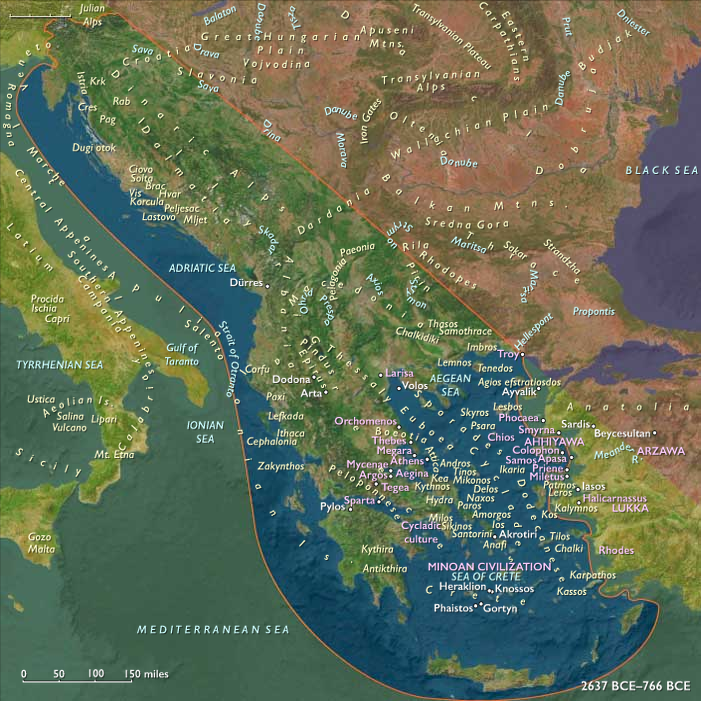
Cycladic idols and vases made from Cretan and imported stone characterize early Minoan art.
Cycladean artisans evidently cease production of the stylized marble figurines after the Cyclades come under the influence of Crete's Minoan civilization around the beginning of the second millennium.
Locations
Groups
Topics
Commodoties
Subjects
Regions
Subregions
Related Events
Filter results
Showing 10 events out of 68061 total
The Arctic Divergence: Linguistic Foundations and Cultural Differentiation
This age represents a pivotal moment in Arctic prehistory, occurring in the immediate aftermath of the great Eskimo-Aleut linguistic split around 4000 years ago (c. 2000 BCE). The ancestral Eskaleut language had recently divided into the Eskimoan and Aleut branches, and the cultural implications of this separation were becoming manifest.
The Denbigh Flint complex continued to flourish across Alaska and northwestern Canada, representing the mature phase of this Paleo-Inuit technological tradition. Proto-Aleut populations were undergoing complex cultural contacts, including ongoing admixture with Late Anangula and Ocean Bay populations in the Alaska Peninsula and Aleutian Islands.
During these 143 years, the foundations were being laid for the distinct maritime adaptations that would characterize Aleut culture. The Unangan culture of the Aleut was becoming increasingly distinct from other Arctic traditions, developing the specialized marine technologies that would define their civilization for millennia.
The Arctic Small Tool tradition was reaching its geographical limits, with groups having become the first human occupants of Arctic Canada and Greenland, completing one of humanity's most remarkable expansions into extreme environments.
Mesolithic hunters, who were most probably the first inhabitants of the Malay Peninsula, are the probable ancestors of the Semang, an ethnic Negrito group who are to have a long history in the Malay Peninsula.
The Senoi appear to be a composite group, with approximately half of the maternal DNA lineages tracing back to the ancestors of the Semang and about half to later ancestral migrations from Indochina.
Scholars suggest they are descendants of early Austronesian-speaking agriculturalists, who brought both their language and their technology, including rice cultivation, to the southern part of the peninsula approximately four thousand years ago.
They will eventually unite and coalesce with the indigenous population during the course of the epoch.
Bronzework begins in northeastern Thailand on the site of the present-day village of Ban Chiang around 2000 BCE, as evidenced by crucibles and bronze fragments.
Bronze objects include bracelets, rings, anklets, wires and rods, spearheads, axes and adzes, hooks, blades, and little bells.
Maritime East Asia (2061–1918 BCE): Xia Dynasty Traditions, Agricultural Diversification, and Austronesian Expansion
Between 2061 BCE and 1918 BCE, Maritime East Asia—comprising lower Primorsky Krai, the Korean Peninsula, the Japanese Archipelago below northern Hokkaido, Taiwan, and southern, central, and northeastern China—experiences significant cultural and agricultural developments. Key highlights include legendary cultural traditions associated with the early Xia Dynasty in China, the diversification of agriculture with the introduction of wheat, and the arrival and settlement of Austronesian-speaking ancestors of Taiwan’s indigenous peoples.
Xia Dynasty Traditions and Cultural Innovations
According to Chinese historical tradition, the early Xia Dynasty—regarded as China's first hereditary dynasty—solidifies around 2070 BCE under the legendary leadership lineage begun by Yu the Great. Mythological accounts prominently feature the Yellow Emperor (Huangdi) as a foundational ancestor of Han Chinese civilization, crediting him with vital cultural and scientific innovations. These include the development of the core principles of traditional Chinese medicine, invention of the Chinese calendrical system (including the sexagenary cycle), and establishing standardized musical pitch (huang chung, or "yellow bell") fundamental to later Chinese musical traditions.
These narratives significantly shape Chinese historical identity, emphasizing foundational virtues and cultural continuity rooted deeply in the legendary Xia period.
Austronesian Expansion and Early Settlement in Taiwan
During this same era, significant demographic and cultural transformations occur on Taiwan. Archaeological evidence confirms human habitation dating back roughly 30,000 years, but around 2000 BCE, ancestors of modern Taiwanese indigenous peoples, speaking Austronesian languages, settle permanently on the island. These ancestral populations are culturally and genetically connected with groups in maritime Southeast Asia, sharing maternal lineage links with the broader Polynesian population.
Taiwan thus emerges as a critical early node in the Austronesian migration network, eventually leading to widespread maritime settlement across the Pacific. This early Austronesian presence on Taiwan has enduring implications, linking Taiwan’s indigenous peoples culturally and linguistically with diverse Pacific and Southeast Asian communities.
Introduction and Establishment of Wheat Cultivation
Another crucial agricultural advancement in southern, central, and northeastern China during this era is the introduction of wheat cultivation, around 2000 BCE. Wheat’s arrival significantly diversifies agricultural productivity and diets, enhancing food security and laying foundations for increasingly complex, stable, and prosperous societies. Wheat farming complements existing staple crop systems based on rice and millet, thus strengthening agricultural resilience in Lower East Asia’s varied environmental contexts.
Legacy of the Era: Foundations of Cultural Complexity and Diversity
Thus, the era 2061–1918 BCE profoundly impacts Maritime East Asia through foundational legendary traditions of the early Xia Dynasty in China, major agricultural innovations, and early Austronesian migrations into Taiwan. These developments reinforce the region’s central role in the historical evolution of East Asian civilization and cultural diversity, setting enduring precedents for future regional historical trajectories.

Evidence suggests that the art of falconry may have begun in Mesopotamia, or in China and Mongolia, with the earliest accounts dating to approximately 2000 BCE.
There is some disagreement about whether such early accounts document the practice of falconry (from The Epic of Gilgamesh and others) or are misinterpreted depictions of humans with birds of prey.
Further expansion of the domesticated horse, into the lowland Near East and northwestern China, happens around 2000 BCE, again apparently in conjunction with the chariot, formerly pulled by the the slower onager that the horse has now replaced.
The newly developed spoked wheel leads to the mass production of two-wheeled chariots as important instruments of war, armor being provided by bronze shields.
The fabled Yellow Emperor of the legendary Xia, or Hsia, Dynasty is a cultural hero who Chinese mythology regards as the ancestor of all Han Chinese.
Among his other accomplishments, the Yellow Emperor has been credited with the invention of the principles of Traditional Chinese medicine, and to have invented the earliest form of the Chinese calendar: its current sexagenary cycles are counted based on his reign.
Also attributed to him is the yellow bell, or huang chung, the name given to the absolute (fixed) pitch produced by a bamboo pipe of set length.
Evidence of human settlement in Taiwan dates back thirty thousand years, although the first inhabitants of Taiwan may have been genetically distinct from any groups currently on the island.
About four thousand years ago, ancestors of current Taiwanese aborigines settled in Taiwan.
These aborigines are genetically related to Malay and maternally to Polynesians, and linguists classify their languages as Austronesian.
It is thought likely that Polynesian ancestry may be traceable throughout Taiwan.
Wheat appears in China by around 2000 BCE.
China’s village agricultural units cooperate in valley defense against perennial intrusions of mounted nomad bowmen from Mongolia and Manchuria to the north (the legendary Xia dynasty, according to Chinese literary sources, derives from a leading member of one such unit).
The development of Chinese culture in the loess lands of China's middle Huang He valley serves (with Mesopotamia and the Indus Valley) as the third of Asia’s “culture hearths.”