
Trade between Elmina and Portugal has grown …
Years: 1480 - 1491
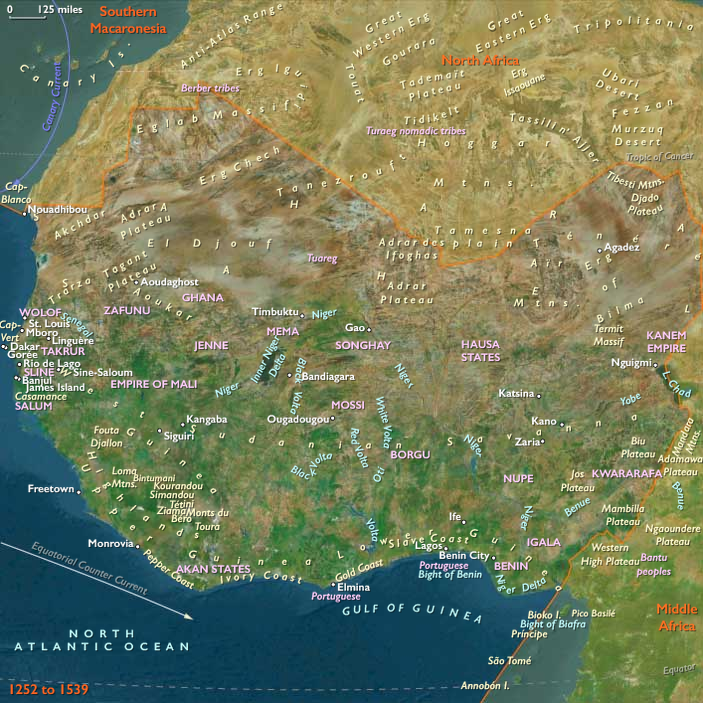
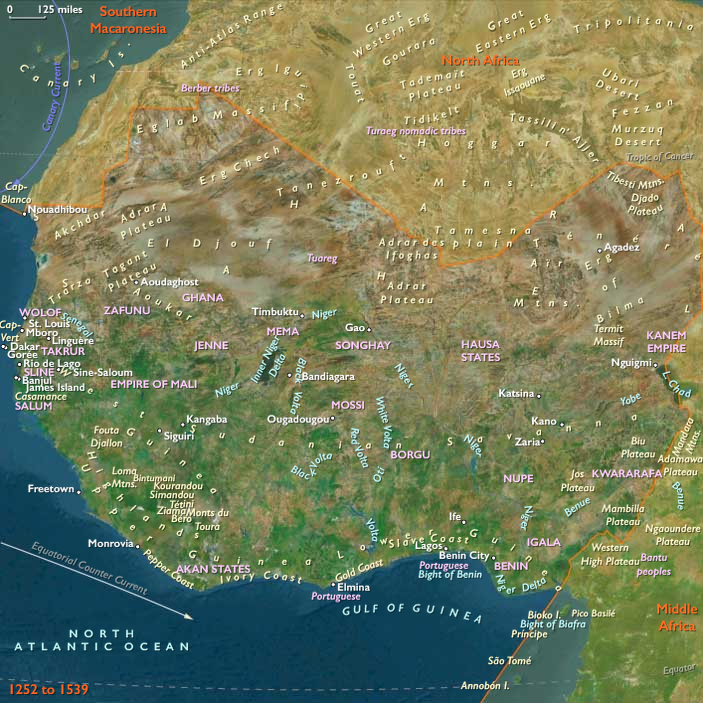
Trade between Elmina and Portugal has grown throughout the decade following the establishment of the trading post under Gomes.
In 1481, the recently crowned John II decides to build a fort on the coast in order to ensure the protection of this trade, which is once again held as a royal monopoly.
King John sends all of the materials needed to build the fort on nine caravels and two transport ships with six hundred soldiers and one hundred masons and carpenters.
The supplies, which include everything from heavy foundation stones to roof tiles, are sent, in pre-fitted form, along with provisions for six hundred men.
Under the command of Diogo de Azambuja, the fleet sets sail on December 12, 1481 and arrives at Elmina, in a village called Of Two Parts a little over a month later, on January 19, 1482.
Some historians note that Christopher Columbus was among those to make the voyage to the Gold Coast with this fleet.
Upon arrival, Azambuja contracts a Portuguese trader, who has lived at Elmina for some time, to arrange and interpret an official meeting with the local chief, Kwamin Ansah (interpreted from the Portuguese, "Caramansa").
Concealing his self-interest with elegant manners and friendliness, Azambuja tells the chief of the great advantages in building a fort, including protection from the very powerful king of Portugal.
During the meeting, Azambuja and Chief Kwamin Ansah both participate in a massive peace ritual that includes a feast, live musicians, and many participants, both Portuguese and native.
Chief Kwamin Ansah, while accepting Azambuja, as he has any other Portuguese trader who arrived on his coast, is wary of a permanent settlement.
However, with firm plans already in place, the Portuguese will not be deterred.
After offering gifts, making promises, and hinting at the consequences of noncompliance, the Portuguese finally receive Kwamin Ansah's reluctant agreement.
When construction begins the next morning, the chief’s reluctance is proved to be well-founded.
In order to build the fort in the most defensible position on the peninsula, the Portuguese have to demolish the homes of some of the villagers, who consent only after they had been compensated.
The Portuguese also try to quarry a nearby rock that the people of Elmina, who are animists, believe to be the home of the god of the nearby River Benya.
Prior to the demolition of the quarry and homes, Azambuja sends a Portuguese crew member, João Bernaldes, with gifts to deliver to Chief Kwamin Ansah and the villagers.
Azambuja sends brass basins, shawls, and other gifts in hopes of winning the goodwill of the villagers, so they will not be upset during the demolition of their homes and sacred rocks.
However, João Bernaldes does not deliver the gifts until after construction begins, by which time the villagers have become upset upon witnessing the demolition without forewarning or compensation.
In response to this, the local people forge an attack that results in several Portuguese deaths.
Finally, an understanding is reached, but continued opposition lead the Portuguese to burn the local village in retaliation.
Even in this tense atmosphere, the first story of the tower is completed after only twenty days; this is the result of having brought so much prefabricated building materials.
The remainder of the fort and an accompanying church are completed soon afterward, despite resistance.
The fort is the first prefabricated building of European origin to have been planned and executed in Sub-Saharan Africa.
Upon its completion, Elmina is established as a proper city.
Azambuja is named governor, and King João adds the title "Lord of Guinea" to his noble titles.
São Jorge da Mina takes on the military and economic importance that had previously been held by the Portuguese factory at Arguim Island on the southern edge of the Moorish world.
Locations
People
Groups
Topics
Commodoties
Subjects
Regions
Subregions
Related Events
Showing 10 events out of 40684 total
Years: 1480 - 1491
Locations
People
Groups
Topics
Commodoties
Subjects
Regions
Subregions