
Totila defends the city of Verona against …
Years: 541 - 541
October
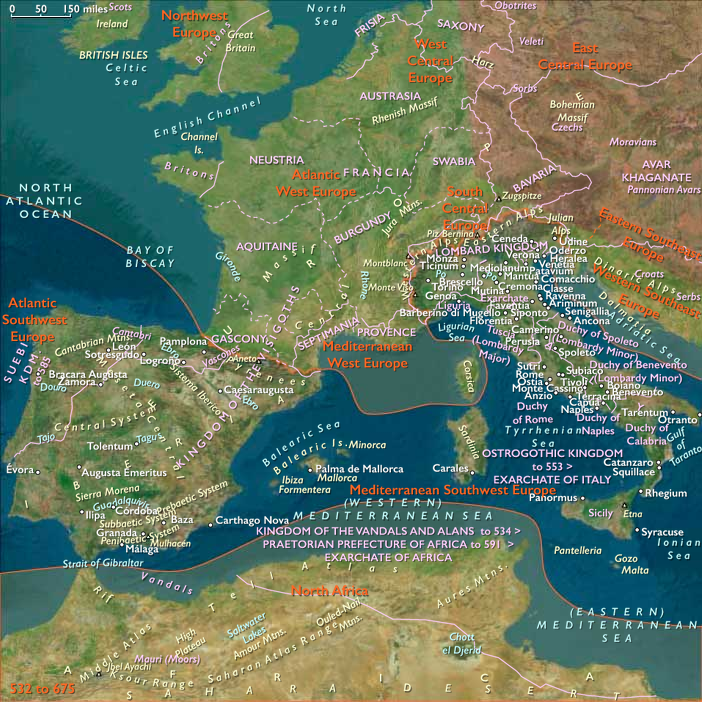
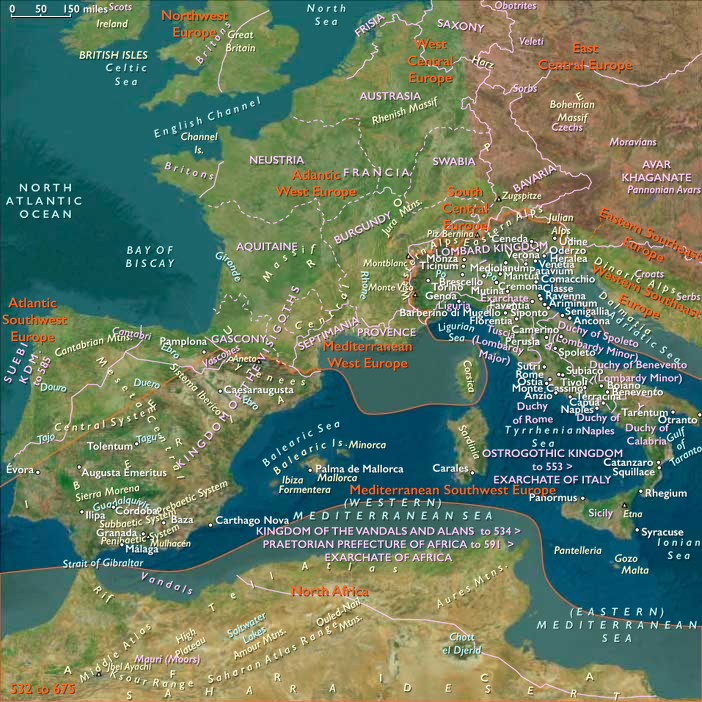
Totila defends the city of Verona against a numerically superior imperial army in the winter of 541.
Gaining control over the Po Valley, he prepares a Gothic offensive in Central Italy.
Locations
People
Groups
- Goths (East Germanic tribe)
- East, or Oriens, Praetorian prefecture of
- Italy, Praetorian prefecture of
- Ostrogoths, Italian Kingdom of the
- Roman Empire, Eastern: Justinian dynasty
Topics
Subjects
Regions
Subregions
Related Events
Filter results
Showing 10 events out of 57732 total
Justinian, fully occupied in Italy, has somewhat neglected the army in the East.
A Gothic embassy had reached Persia in 539, and the information it provided had caused Khosrau to grow restive under the constraints of the “Endless Peace.”
In 540, the same year that a Bulgar force had raided Macedonia and reached the long walls of Constantinople, Khosrau's armies had moved into Mesopotamia, northern Syria, and Roman Armenia and systematically looted the key cities, reaching even Antioch in the pursuit of booty and blackmail and returning unhurt.
John the Cappadocian, praetorian prefect of the East, is dismissed by the empress Theodora for treason.
He is banished to Cyzicus and his estates are confiscated.
Belisarius, despite his initial successes in the Italian campaign against the Goths, is recalled to Constantinople in 541 by Justinian, who fears that his general will be proclaimed Emperor in the West by his troops.
Charged by the emperor with handling the situation in Armenia, Belisarius arrives in Upper Mesopotamia and attacks the fortress city of Nisibis.
After a unsuccessful siege he is forced to ravage the country.
Khosrau intervenes in Lazica and supports the weakened king Gubazes II against a full-scale uprising.
He sends an expeditionary force under Miohr-Mihroe (Mermeroes in Byzantine sources) and captures the Roman stronghold of Petra, located on the coast of the Black Sea, which provides the Persians a strategic port.
Bubonic plague appears suddenly in the Egyptian port of Pelusium in 541, spreading to ...
...Alexandria.
The Fourth National Church Council of the Franks (541 CE): Strengthening Religious Authority and Emancipation Reforms
The fourth national church council of the Franks, convened in 541 CE, reinforces Frankish ecclesiastical autonomy, promotes the expansion of Christian worship, and implements further measures regarding slavery and Jewish-Christian relations.
1. Independence from Byzantine Religious Edicts
- The council rejects Emperor Justinian’s ordinances regarding Easter, instead maintaining the date fixed by Pope Victor I (late 2nd century).
- This signifies the Frankish Church’s growing independence from both the Eastern Roman Empire and Byzantine theological influence.
2. Establishing and Maintaining Parish Churches
- Those who owned or wished to establish a parish church on their lands were ordered to take the necessary measures to uphold the dignity of Divine worship.
- This decree aimed to expand Christian infrastructure, ensuring that even in rural areas, properly maintained churches were available for worship.
- It also reinforced bishopric oversight over local religious institutions, preventing private landowners from abusing ecclesiastical privileges.
3. Emancipation of Slaves and Christian Ransom Laws
The Frankish Church continues Clovis’ early reforms on the emancipation of slaves, refining the laws first introduced at the Council of Orléans (511 CE):
-
Permanent Emancipation of Slaves Freed by Bishops
- Slaves freed by bishops would remain free even after the bishop’s death, even if other administrative acts of the bishop were overturned.
- This prevented noble or royal authorities from reversing the Church’s manumission of slaves.
-
Final Ransom for Christian Slaves Held by Jews
- Christians who had been enslaved by Jews but later sought refuge in churches (right of sanctuary) were to be permanently freed through ransom payments.
- This policy strengthened the Church’s role in protecting Christian captives and weakened Jewish slave ownership.
-
Prohibition on Jewish Ownership of Christian Slaves
- Jews who encouraged Christian slaves to convert to Judaism in exchange for freedom were forbidden to own such slaves.
- This reinforced Christian dominance within Frankish society and further marginalized Jewish economic influence.
4. Impact on the Frankish Church and Society
- The council affirmed the Frankish Church’s autonomy, refusing to follow Byzantine religious directives.
- It expanded Christianity by encouraging the construction of more parish churches across Frankish lands.
- It strengthened social and legal protections for freed slaves, particularly those liberated by the Church.
- It reinforced anti-Jewish laws, restricting Jewish participation in slavery and economic affairs.
Conclusion: The Increasing Power of the Frankish Church
The Fourth National Church Council (541 CE) is another step in the consolidation of Catholic Christianity as the defining force of Frankish governance and society. The Church’s growing influence over both religious and legal matters reflects the deepening relationship between the Frankish monarchy and the clergy, a development that will shape the medieval European world for centuries to come.
Rigorous financial exactions and the rapacity of the soldiers make the new imperial regime unpopular in Italy.
Many of the Ostrogoths have never submitted, and after the two short and unfortunate reigns of Hildebad and Eraric, the Ostrogothic nobles proclaim Totila as their king in the autumn of 541 after the death of his uncle Ildibad.
He wins the support of the lower classes by liberating slaves and distributing land to the peasants.
The Plague of Justinian, which marks the beginning of a two hundred-year long pandemic, will go on to destroy up to a quarter of the human population of the eastern Mediterranean, ultimately killing an estimated one hundred million people in Asia, Europe and northern Africa.
The bubonic plague of 541-543 to some extent hinders the war in the East, which drags on under other generals.
First noted in Egypt, the plague had from there passed through Syria and Asia Minor to Constantinople.
The so-called Plague of Justinian is the first known pandemic on record, and marks the first firmly recorded pattern of bubonic plague.
This outbreak is thought to have originated in Ethiopia or Egypt.
Constantinople, a huge city, imports massive amounts of grain, mostly from Egypt, to feed its citizens.
The grain ships may have been the source of contagion for the city, with massive public granaries nurturing the rat and flea population.
At its peak, the plague is killing five thousand people in Constantinople every day.
The plague kills at least two hundred and thirty thousand in Constantinople (before counting stops) and perhaps two million or more in the rest of the empire.
Emperor Justinian contracts the disease but recovers.
Based on Procopius' description of its symptoms at Constantinople in 542, the disease has appeared in its more virulent pneumonic form, wherein the bacilli settle in the lungs of the victims.
The appearance of the pneumonic form is particularly ominous because it may be transmitted directly from person to person, spreading the infection all the more readily and producing exceptionally high mortality rates.
Comparative studies, based upon statistics derived from incidence of the same disease in late-medieval Europe, suggest that between one-third and one-half the population of Constantinople may well have died, while the lesser cities of the empire and the countryside by no means remained immune.
Years: 541 - 541
October
Locations
People
Groups
- Goths (East Germanic tribe)
- East, or Oriens, Praetorian prefecture of
- Italy, Praetorian prefecture of
- Ostrogoths, Italian Kingdom of the
- Roman Empire, Eastern: Justinian dynasty
